
“Steal” bills itself as a slick, high-voltage crime thriller, the kind that should leave you breathless by the end of every episode. What it actually delivers is something far more subdued: a series that gestures toward intensity but rarely sustains it. And yet, in the middle of that muted energy, there are flashes of life most notably in Sophie Turner’s performance that remind you what this show might have been if its ambition and execution had fully aligned.
There’s an unspoken contract that crime thrillers make with their audience. We come expecting danger with personality: elusive criminals who feel smarter than the system, investigators pushed to the brink, and a narrative rhythm that pulses with urgency. “Steal” honors that contract in its premiere, which opens with real momentum and a sense that we’re being ushered into a cat-and-mouse story worth investing in. But once that initial episode concludes, something deflates. The pace slackens, the narrative drive loses its grip, and what began with promise gradually turns into a more dutiful, less gripping experience.
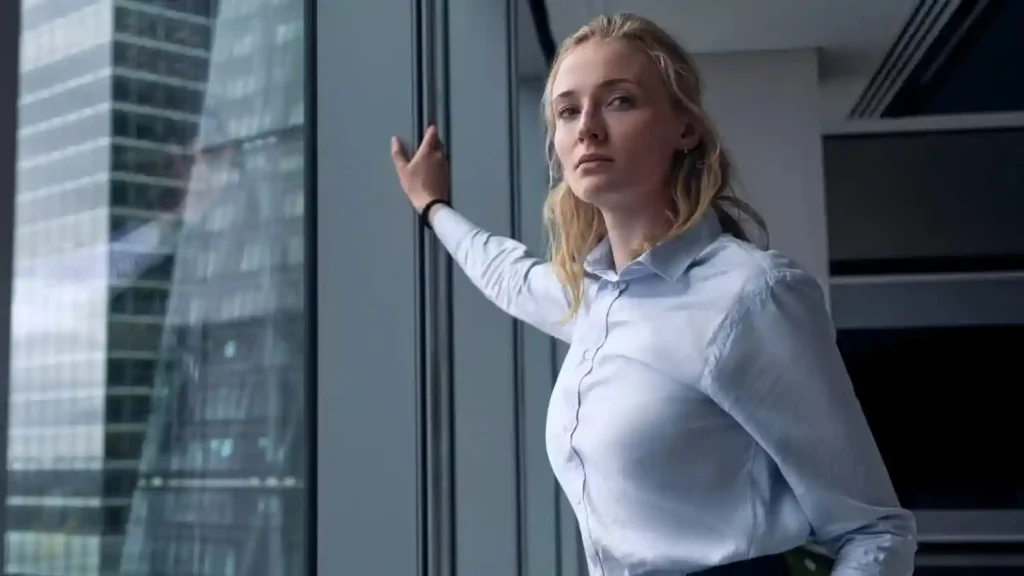
Turner plays Zara Dunne, an underpaid office worker who suddenly finds herself thrust into the center of catastrophe when she becomes a key witness to a massive heist billions of pounds in pension funds siphoned into offshore accounts by an organized, highly skilled criminal network. It’s a compelling setup, the kind that immediately raises stakes not just for the characters but for the world they inhabit. But the series quickly pivots away from the raw shock of that event and focuses instead on the aftermath, following DCI Rhys Covac (Jacob Fortune-Lloyd) as he attempts to piece together who orchestrated the crime and how deep the conspiracy runs.
Highly Recommended: The Copenhagen Test Parents Guide
On paper, this structure should work beautifully. A short, six-episode season usually allows for tight storytelling, carefully controlled arcs, and a sense of inevitability that builds with each chapter. Here, though, the storytelling wobbles. After the premiere establishes its tone and direction, the episodes that follow feel oddly hesitant, as though the series is stalling for time rather than deepening its themes. You can feel the drag setting in, the narrative inching forward while your own engagement starts to drift.
And yet, it wouldn’t be fair to say the show is without merit.
There are moments real ones where the series briefly becomes what it wants to be. The shifting dynamics between Zara and Covac carry a genuine charge, a push-and-pull of trust, suspicion, and vulnerability that creates some of the most watchable scenes. Her relationship with Luke, her close friend and co-worker, adds another layer of emotional complexity, grounding the story in something recognizably human rather than purely procedural. These interactions crackle in a way the larger plot often doesn’t. You find yourself leaning in, because suddenly the stakes feel personal again.
The show also deserves credit for flirting with moral ambiguity instead of defaulting to easy binaries. Characters aren’t always clearly right or wrong, and the series seems interested at least in theory in exploring the grey spaces between victimhood, complicity, survival, and self-interest. When those ideas surface, “Steal” feels more thoughtful than its surface-level premise might suggest.
Highly Recommended: Spartacus: House of Ashur Parents Guide
Unfortunately, those strengths are undermined by structural choices that dull the show’s impact. The most intriguing figures the criminals themselves are kept at a distance for much of the series, presumably to preserve mystery. But in a genre that thrives on charismatic antagonists, this restraint backfires. Instead of deepening the tension, it drains it. The absence of vivid antagonistic presence leaves the story feeling oddly flat, as though the engine is running but never revving.
You can sense the effort behind the project. There’s a clear intention to craft a psychological thriller, one invested in character, moral tension, and thematic depth. But ambition alone isn’t enough. Because of the uneven pacing and tonal inconsistency, the show never fully coheres. It plants seeds for twists and revelations throughout its run, yet the final payoff feels underwhelming not devastating in the moment, but faintly disappointing once you’ve had time to consider what was promised versus what was delivered.
Still, it would be unfair not to acknowledge the cast. Turner, in particular, commits to Zara with sincerity and texture. She gives the character a weary resilience and an emotional openness that makes her easy to root for, even when the script doesn’t always serve her. Her co-stars hold their own, too, bringing credibility to scenes that might otherwise fall flat. In the better moments, their performances are what keep the show afloat.
“Steal” does manage to stage some effectively tense action sequences, and it’s in those moments that the series feels most alive. The choreography is solid, the performances sell the stakes, and for brief stretches you can see the version of the show that might have fully embraced its identity as an action-driven drama rather than a restrained crime mystery. If you approach it with that mindset, you’ll probably enjoy it more.
Highly Recommended: The Monster of Florence (2025) Parents Guide
Ultimately, the series seems caught between genres, never quite deciding whether it wants to be a pulse-pounding crime thriller or a character-focused drama with action elements. Its strongest material arguably belongs to the latter, even if its marketing suggests otherwise. It doesn’t reinvent the wheel, and even its familiar tropes feel more routine than revelatory. But there is effort here. There is craft in places. And there is at least one performance Turner’s that suggests a more compelling show flickering beneath the surface.
Steal (TV Series) — Parents Guide
Steal is NOT rated by the Motion Picture Association (MPA).
Violence & Intensity: The series leans more toward psychological tension than graphic brutality. There are moments of danger, threat, and suspense particularly around the heist and its aftermath but violence is generally restrained rather than explicit. Some scenes involve confrontations, peril, and implied harm, with tension often driven by atmosphere rather than bloodshed. Action sequences exist, but they are more anxious than visceral. Teens sensitive to intense situations or prolonged suspense may still find certain scenes unsettling.
Language: Characters occasionally use mild to moderate profanity, especially in moments of stress or conflict. The language feels naturalistic rather than excessive. There are no notable slurs, and the tone tends to be serious and grounded rather than crude or aggressive.
Sexual Content / Nudity: The show does not focus on sexual content. There are subtle romantic or emotional undertones in relationships, but no explicit sex scenes. Any intimacy is handled discreetly and more suggestively than visually.
Drugs, Alcohol & Smoking: Some adult characters are shown drinking socially or in moments of emotional pressure. Alcohol use is present but not glamorized. There are no significant storylines centered on drug use, and smoking is either rare or absent.
Age Recommendations: Given the thematic material (crime, moral ambiguity, psychological tension) and occasional strong language, Steal is best suited for ages 14+. Mature teens will likely handle the content without issue, while younger viewers may find the tone slow or the themes difficult to process.
“Steal” begins streaming on Prime Video January 21.

Stephanie Heitman is a seasoned journalist and author dedicated to helping parents navigate the world of Hollywood entertainment through thoughtful, family-oriented film reviews. With over a decade of experience in writing and a passion for fostering safe, enriching viewing experiences, Stephanie launched Parentguiding.com to provide parents with the insights they need to make informed choices for their families.