
What do you imagine happens to a police officer tasked with escort duty if the prisoner in his custody slips away somewhere between prison gates and a courtroom corridor? You assume there’s a penalty, of course maybe a suspension, maybe worse. Sirai wastes no time clarifying the stakes. Barely minutes in, the film calmly lays out IPC Section 129: if a convict escapes, the escorting officer could face up to three years in prison. It’s delivered without drama, almost casually, which is exactly why it lands so hard. You can feel the fuse being lit. That single legal fact lodges itself in your mind and quietly hums there, shaping every decision and glance that follows.
From that point on, Sirai unfolds as a tightly wound suspense thriller, but one that’s as interested in systems as it is in tension. The density of detail the routines, the hierarchy, the small humiliations of escort duty immediately signals the hand behind the screenplay. This is Tamizh, the former cop turned filmmaker who previously gave us Taanakkaran, and once again he peers straight into the machinery of authority. As before, the system feels less like an institution and more like a leftover colonial engine, grinding forward without mercy, indifferent to who gets crushed under its weight. Honest officers like Head Constable Kathiravan (Vikram Prabhu) and accused men like Abdul Rauf (LK Akshay Kumar) are not players here; they are expendable parts.
Highly Recommended: Indian Police Force 2024 Parents Guide
The story is set in 2003, and it opens with a deceptively cheerful montage one of those songs that sketches a life in shorthand. Kathiravan at home with his wife Mariyam (Ananda Thambirajah), who is herself a police officer, and their children. It’s warm, familiar, almost comforting. But the calm is fragile. At work, Kathiravan is under strain, serving as an escort cop while simultaneously facing an inquiry related to an encounter case. Fate, or maybe just the relentless domino effect of duty, intervenes when he agrees to swap assignments so a colleague can visit his ailing mother. That decision puts him in charge of escorting Abdul, a murder accused, from Vellore prison to a court in Sivagangai.
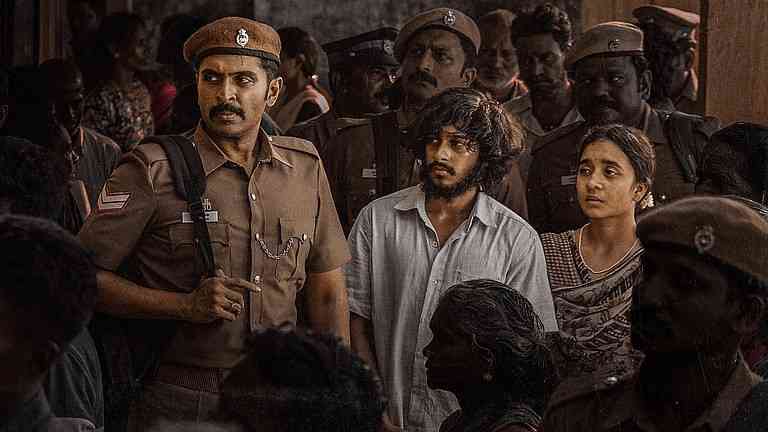
From the instant Abdul appears on screen, his restlessness is palpable. He’s alert, nervous, eyes darting, constantly scanning for exits physical or otherwise. You don’t need dialogue to understand that escape is on his mind. And disturbingly, he isn’t wrong to hope. The escort detail is riddled with small lapses, tiny cracks in procedure, largely due to the complacence of the two constables accompanying Kathiravan. The film quietly invites you to notice these gaps, to count them, to worry over them. Will Abdul run? Why is he so desperate to get away? Who did he kill, and under what circumstances? And if things go wrong, will Kathiravan be chewed up by the very force he serves? Over a taut, focused two hours, Sirai methodically works through these questions.
The atmosphere is doing as much work as the plot. There’s a stripped-down quality to Sirai—no excess, no ornamental flourishes yet it never feels small. The film uses its limited canvas shrewdly, extracting tension from buses, roadsides, holding cells, and overheard conversations. What’s genuinely striking is how ambitious it feels despite its minimalism. Tamizh, along with director Suresh Rajakumari, keeps finding space to interrogate deeper issues, especially the casual ease with which society slips into religious prejudice. As Abdul’s journey unfolds, it begins to reflect something uncomfortable back at us. Like Kathiravan and his fellow officers, we too are prone to snap judgments, to assumptions shaped by names, appearances, and inherited biases. It’s hard not to recognize ourselves in that reflex.
Highly Recommended: Baahubali: The Epic Parents Guide
If you remember Taanakkaran, you might recall a seemingly throwaway fable told by MS Bhaskar’s character about a guard stationed beside a particular tree at a police academy a story that quietly revealed the absurdity and rigidity of institutional logic. Sirai operates in a similar register. Here, names function almost like social barcodes, instantly revealing caste, religion, and supposed place in the hierarchy. Identity becomes a shorthand for guilt or innocence, belonging or exclusion. There’s an unavoidable resonance with other contemporary films Neeraj Ghaywan’s Homebound comes to mind where personal identity is inseparable from social judgment.
The film’s strongest stretch begins with an electric sequence involving a loaded rifle one that practically dares the audience not to hold its breath and builds toward a moment that pays tribute to a Tamil Eelam martyr. It’s a powerful run, both thematically and dramatically. The performances here are razor-sharp, and Suresh Rajakumari deserves real credit for the staging, which balances tension with emotional clarity rather than sheer spectacle.
After this high point, the film briefly loses some of its grip. The narrative shifts toward Kalaiyarasi, played by Anishma Anilkumar (it’s best to go in knowing as little as possible about her role), and the tone wobbles. One antagonist, in particular, veers into caricature, and the film flirts with a more conventional, even shallow, melodramatic mode. Still, Sirai is disciplined enough not to linger here. The runtime is lean, and before these missteps can calcify, the film pivots again.

In its final stretch, Sirai reveals another layer of intent. Tamizh takes a precise, almost surgical look at the contemporary social landscape, especially the lived reality of Muslims in an increasingly polarized nation. The critique is pointed but not didactic. It surfaces in images a single frame that quietly affirms constitutional secularism, a callback to something as mundane as a bar of soap and these moments land with a gentle, surprising grace. You might even find yourself smiling, not because the issues are resolved, but because the film trusts you to read between the lines.
The climax delivers a subversion that’s bound to spark conversation. It echoes an idea articulated earlier this year in another Tamil film, Maayakoothu: that fictional characters, whether virtuous or flawed, deserve narrative justice because they mirror real people. If creators are playing god, the argument goes, they bear a responsibility to be kinder and fairer than reality itself often is. Sirai embraces this philosophy. It offers its characters dignity without softening the world they inhabit, and remarkably, it manages to do so without dulling the suspense or compromising the experience of watching a thriller unfold.
Highly Recommended: Kalki 2898 AD Parents Guide
Vikram Prabhu, too, benefits from this clarity of purpose. After Love Marriage and now Sirai, he appears to be finding his footing again, delivering a performance that’s grounded and quietly affecting rather than showy. Still, the film’s real revelations are its newcomers. Akshay Kumar, as Abdul, brings a restrained intensity that hints at depth and future promise, while Anishma Anilkumar leaves a strong impression despite limited screen time never an easy feat.
Sirai may not dominate year-end lists or inspire breathless accolades, but that feels beside the point. Its value lies elsewhere. This is the kind of writer-driven, idea-forward cinema Tamil films need more of stories that trust intelligence, embrace moral complexity, and refuse easy answers. More than that, it’s the kind of hopeful, principled filmmaking that a fractured society could stand to champion, not because it offers comfort, but because it insists on empathy where it’s most difficult.
Content Breakdown for Parents
Violence & Intensity: There’s no graphic violence, but the tension is constant. Guns are present, police authority is enforced, and the threat of violence hangs heavily over several scenes. A few moments involving weapons especially a rifle are staged with sharp suspense and may feel intense for younger viewers.
Language: The film uses realistic, situational language consistent with police settings. There’s occasional harsh or aggressive dialogue, but no excessive profanity. Some lines may carry a hostile or accusatory tone tied to social prejudice rather than swear words.
Sexual Content / Nudity: None. The film avoids sexual material entirely. Family relationships are portrayed respectfully and without innuendo.
Drugs, Alcohol & Smoking: Some characters smoke or drink briefly, mostly in realistic background moments rather than glorified scenes.
Scary or Disturbing Scenes: While there are no horror elements, younger viewers may find the film emotionally unsettling. Themes of wrongful suspicion, systemic bias, and fear of punishment can linger. Certain confrontations may feel stressful, especially for sensitive kids.
Recommended Age Range: Best suited for teens, older adolescents, and adults who can engage with layered themes and moral ambiguity. Not recommended for young children due to sustained tension and social subject matter.

Matthew Creith is a movie and TV critic based in Denver, Colorado. He’s a member of the Critics Choice Association and GALECA: The Society of LGBTQ Entertainment Critics. He can be found on Twitter: @matthew_creith or Instagram: matineewithmatt. He graduated with a BA in Media, Theory and Criticism from California State University, Northridge. Since then, he’s covered a wide range of movies and TV shows, as well as film festivals like SXSW and TIFF.