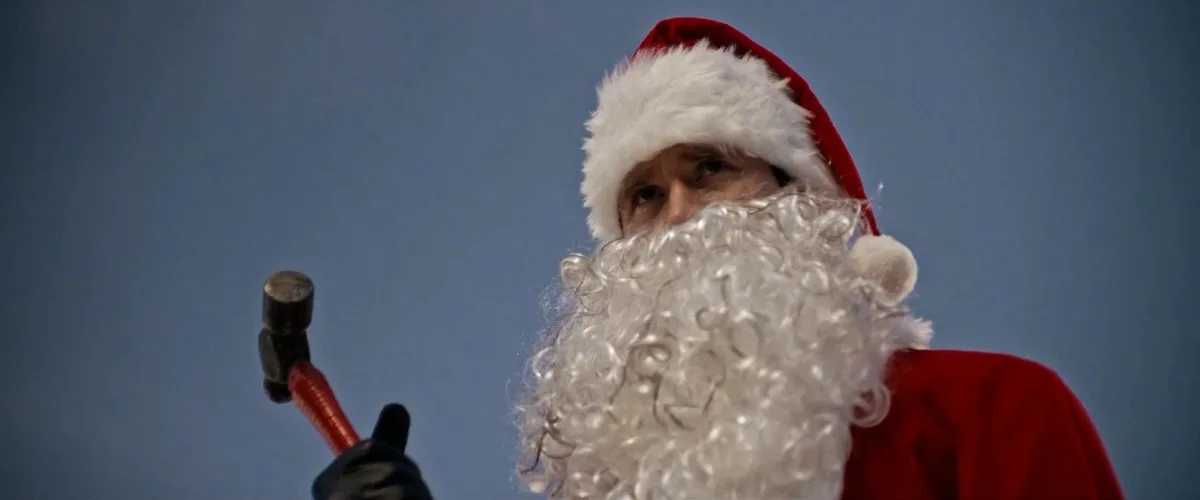
Say what you will about the original “Silent Night, Deadly Night,” but that scrappy 1984 button-mashing slasher earned its place in the cult-movie attic by dreaming up ever more deranged ways for its axe-swinging Santa to mete out “punishment.” It was never elegant, but it had a lurid commitment that made it hard to forget. Five sequels cashed in on that formula, and now because the genre never met a corpse it wouldn’t reanimate we’re onto the second full reboot. This one again borrows the original title and pulls the familiar lead, Billy, into a new configuration, casting Rohan Campbell as a haunted young man refashioned into a tormented antihero.
Just as in the ’84 film, Billy’s childhood is shattered by a grotesque run-in with an armed Santa Claus. But the new Billy attempts something his predecessor never quite managed: he tries to restrain the holiday itch that crawls up his spine each December. In a twist that feels knowingly indebted to Dexter, he only dispatches those who “deserve it,” at least by his own chaotic moral code. And whispering in his ear sometimes nudging, sometimes needling is a talkative inner voice voiced by Mark Acheson, turning the film into an off-kilter two-hander whenever they bicker or banter. It’s a bold swing, this notion of pairing your killer with his own spectral Santa sidekick, but a shaky one.
Highly Recommended: Little Disasters Parents Guide
And that risk never fully pays off, largely because the filmmakers don’t burrow nearly far enough into the psychological muck they’ve stirred up. Sure, the movie delivers some satisfyingly grisly kills this franchise can still swing an axe with gusto but you eventually find yourself wondering: why bother with a more “character-driven” remake if you’re not going to examine the character at its center?
This version of Billy has been reshaped into a kind of moody wanderer, the Byronic cousin of the lonely drifter from the old Incredible Hulk TV series. Instead of hulking out into a green id monster, he’s nudged toward murder by the unholy voice of Charlie the same killer Santa who orphaned him. Later, Billy more or less explains that he began listening to Charlie ten years ago, back when he was a scared, disoriented 17-year-old struggling with the horror of what he was becoming. Now he’s drifted into the snowy quiet of Hackett, Minnesota, where he takes a job at a cozy Christmas tchotchke shop run by a homespun Mr. Sims (David Lawrence Brown) and his magnetic, soft-edged daughter Pamela (Ruby Modine).
Billy is smitten with Pamela almost immediately and you can feel why. She’s warm, wounded, and sharp in unpredictable ways. When Mr. Sims teasingly labels her fiery mood swings as “EPD,” or “explosive personality disorder,” you sense it’s meant more as shorthand than diagnosis, because frankly, in a world where even homicidal Santas follow a certain moral hierarchy, labels stop meaning much.
And so Billy finds himself carving his way through townsfolk who are unmistakably “naughty” by the loose standards of late-era slasher morality. His choices are guided if you can call it guidance by Charlie, whom Billy insists has a supernatural read on who deserves to die and what’s happening in the shadows around them. Billy even treats Charlie as a kind of twisted stand-in father figure, though the movie barely cracks open that Freudian gift box. It just hints at it, then wanders off.
Highly Recommended: Influencers (2025) Parents Guide
The trouble is, Billy’s been at this for years, and the film never builds a meaningful tension around his double life. He ambles from one kill to the next, unhurried and largely unthreatened, as though the story can’t decide whether he should fear discovery or simply enjoy his warped vocation. In the meantime, the film drifts into a tentative romance between Billy and Pamela a relationship that should feel charged with shared emotional damage but instead hovers like an intriguing idea the filmmakers never commit to. It’s another dead-end alley in a movie that keeps turning the wheel without choosing a direction.
For much of its runtime, the new “Silent Night, Deadly Night” leans on the vague promise that this Billy is someone we might actually like or at least pity. And truthfully, it isn’t hard: Campbell wears Billy’s internal war on his face in a way that immediately pulls you in. Modine plays off him nicely, their uneasy chemistry lending warmth to scenes that would otherwise go slack. That makes the eventual trajectory of their relationship feel tired and disappointingly prepackaged, as if the film lost its nerve right when the characters were finally poised to reveal something honest.
Slasher films, especially ones birthed from ’80s grindhouse stock, are ultimately conveyor belts for elaborate carnage, and this installment doesn’t shake that legacy. The centerpiece kill sequence arrives midway through and it’s already splashed across the marketing. Billy barges into a neo-Nazi Christmas bash, granting the movie a roomful of easily dispensable villains. He cuts through them with grisly efficiency while a winkingly upbeat hair-metal track blares overhead. It should be exhilarating, but because the victims barely qualify as characters, the sequence plays more like a chore checklist than a crescendo. You want to root for Billy, but the flat choreography and recycled death beats leave each kill feeling strangely anonymous.
Highly Recommended: The Mysterious Gaze of the Flamingo Parents Guide
And that, ultimately, is the film’s core problem: it isn’t that the filmmakers dared to flip the original concept on its head it’s that they didn’t follow their wildest impulses to the edge. The original film, for all its crude mayhem, believed wholeheartedly in its own depravity; some of the sequels, too, embraced a kind of deranged sincerity. This new take mostly coasts when it should plunge headlong into its own madness. A “nice-guy killer” isn’t a losing idea on its face. But a nice-guy killer Santa? That should be gloriously, deliriously unhinged. Instead, this one barely raises its voice.
Detailed Content Breakdown for Parents
Violence & Intensity: This film delivers intense horror violence not just jump scares but extended sequences of bloodshed, dismemberment, and graphic killings. The very premise revolves around murder and revenge, and many of the scenes are orchestrated to shock or disturb rather than merely suggest. Expect visceral imagery that older teens and adults will find thrilling but younger viewers likely won’t.
Language: The dialogue includes strong profanity and harsh language typical of R-rated horror films. It isn’t the core of the experience, but the way characters speak mirrors the violent, cynical world the movie inhabits.
Sexual Content / Nudity: There’s minimal focus on sexual content this isn’t a film about romance, even if there’s an emotional thread between two characters. There is no significant nudity as the terror takes center stage.
Drugs, Alcohol & Smoking: Substance use, smoking, or drug narratives aren’t central to the story. What does appear are adult characters coping with psychological scars and stress, not through substances but through emotional and violent responses.
Recommended Age Range: Not suitable for children or pre-teens. Best for: Mature teens (17+) and adults who enjoy intense horror and survive graphic violence without distress.

Stephanie Heitman is a seasoned journalist and author dedicated to helping parents navigate the world of Hollywood entertainment through thoughtful, family-oriented film reviews. With over a decade of experience in writing and a passion for fostering safe, enriching viewing experiences, Stephanie launched Parentguiding.com to provide parents with the insights they need to make informed choices for their families.