Rental Family is Rated PG-13 by Motion Picture Rating (MPA) for thematic elements, some strong language, and suggestive material.
An American actor lands a job at the start of Hikari’s Rental Family, but the assignment he walks into isn’t remotely the kind of part he’s accustomed to. When he arrives at the designated location, he’s guided almost ceremonially into a quiet room where a funeral is already underway. A small group is gathered around a coffin, mourning a man lying peacefully inside. But then the scene pivots: when the service ends, the “corpse” rises, dusts off the performance, and thanks his audience. “For the first time, I felt worthy of being here,” he says, with the sincerity of someone who’s been offered emotional oxygen for the very first time.
That’s the moment our protagonist, Phillip Vandarpleog (Brendan Fraser), who’s spent the past seven years adrift in Tokyo, realizes the company that hired him to appear as a “sad American” is not a traditional talent agency at all. Instead of placing actors in commercials or bit parts, they arrange something stranger and, as the film quickly suggests, more intimate. They provide “specialized services,” the kind of immersive, real-world acting that blurs the edges of reality. “I think you might be good for more than just ‘sad American,’” the company’s owner, Shinji (Takehiro Hira, bringing the same cool precision he showed in Shōgun), tells Phillip, watching him with the faint hope of someone scouting a hidden talent.

Also Read: All That We Love Parents Guide
Shinji hands him a simple card that reads Rental Family, and tries to explain the philosophy behind it: people come to them not for entertainment, but for emotional infrastructure. For borrowed love, borrowed support borrowed truth. Phillip is understandably baffled. “You don’t have to be that person,” Shinji says gently, as though easing a nervous actor into a cold pool. “You just have to help them reach whatever is missing.” To him, this isn’t deception. It’s service. “A chance,” he calls it, “to perform roles that actually mean something.”
Phillip’s career up to this point has consisted mostly of a once-famous toothpaste ad and a lot of waiting around for the universe to take him seriously, so he accepts. Tentatively, but he accepts. Soon he meets the other members of Shinji’s uncanny outfit Aiko (Mari Yamamoto, whose mix of warmth and exasperation is an instant delight) and Kota (Kimura Bun, giving off the weary charm of a man who’s seen too many odd gigs). They usher Phillip into his first assignments. One moment he’s a groom, entering a staged marriage designed to liberate a woman from the heavy expectations of her own family. The next, he’s whoever someone needs him to be. And, almost imperceptibly, Phillip starts to find purpose in all this pretending purpose he never found in the “real” acting world.
Then comes the job that shifts everything.
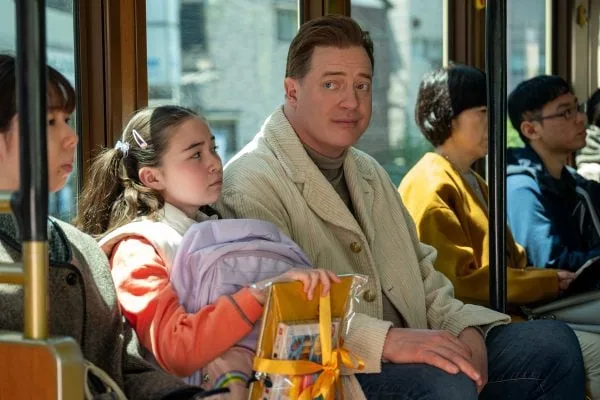
“This little girl needs a father so she can get into a private school,” Aiko tells him, her voice carrying both practicality and guilt. Mia’s mother (Shino Shinozaki) wants the school interview to feel legitimate, which means Phillip must be introduced to the child as though he truly is her father. Phillip resists, instinctively aware that this is not the kind of illusion you can simply walk away from. But when he finally meets young Mia (Shannon Gorman), the hesitation dissolves. She is open, trusting, curious it’s almost disarming how easily she lets him into her small universe. And Phillip, who has drifted through life with a kind of muted ache, suddenly finds himself enjoying this invented parenthood. Maybe even craving it. Before long, he’s turning down actual acting roles just so he can spend afternoons with a child who offers him a sense of meaning he didn’t know he was missing, and perhaps wasn’t sure he deserved.
Highly Recommended: So Fades the Light (2025) Parents Guide
But the illusion, like all illusions, has an expiration date. And when the job is over, Phillip is left with a hollow ache: what becomes of a life you inhabited so fully that it began to feel like your own? What becomes of the memories you performed so earnestly that they grafted themselves onto your heart? And most devastating of all what becomes of the child who believed in you? Mia may get into the school, yes, but afterward she’s left staring into the same void Phillip has always known too well.
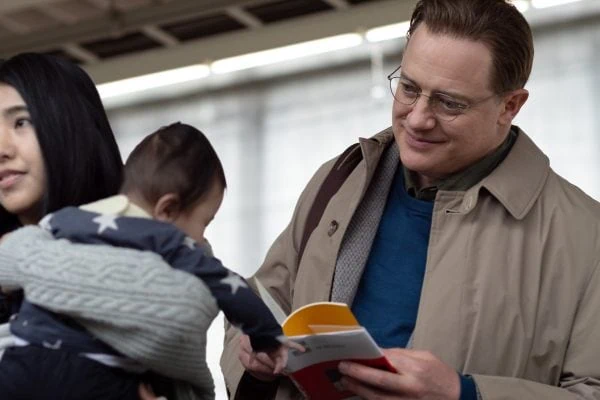
As Phillip cycles through more roles sometimes several at once he begins to understand the emotional labyrinth he’s entered. Yes, he’s offering comfort. But he’s also inflicting wounds, however unintentionally. And at some point, he must make an impossible choice: is he here to complete the job, or to genuinely help the person standing in front of him? Those two paths, the film suggests, are not always the same. The answer Phillip finally reaches quietly, painfully begins to shape the man he ultimately becomes.
Highly Recommended: Little Angels 2025 Parents Guide
Brendan Fraser delivers one of the most delicate, quietly arresting performances of his career. It’s the sort of role that lets him communicate everything with a flicker across his face, or the softening of his eyes at just the right moment. There’s a visible ache in Phillip, but also kindness, and Fraser makes him someone we care about almost instantly. His chemistry with Takehiro Hira, Yamamoto, and Kimura Bun is effortless; the trio brings both wry humor and understated poignancy to the film, and several scenes between them land with unexpected comedic spark.
The true revelations, alongside Fraser, are Shannon Gorman and Akira Emoto. Gorman, as Mia, has that rare quality where the camera seems to lean toward her. For such a young performer, she commands the screen with a presence that feels instinctive unforced and undeniable. Emoto, meanwhile, plays Kikuo Hasegawa, a once-famed actor whose memory is beginning to slip away. His daughter hires Phillip to pose as a journalist interviewing him, and what follows is one of the film’s most quietly devastating arcs. Emoto imbues Kikuo with tenderness, ferocity, and a deep reservoir of vulnerability. Through him, the film articulates something profound about memory how its power rests not in the accuracy of the past, but in the emotional truth we carry forward.
Highly Recommended: The Carpenter’s Son Parents Guide
Writer-director Hikari (coming off the electricity of Beef) and co-writer Stephen Blahut craft a tale so grounded and empathetic that it feels as though it might be unfolding just outside your own peripheral vision. Their story slips effortlessly between tones laugh-out-loud humor, raw grief, unexpected warmth, and moments that quietly break you open. The irony and absurdity of the premise pull you in from the first frame, but beneath it beats a story about longing and the profound human need for connection. You may find yourself laughing one moment and staring into your own emotional reflection the next.
Rental Family wrestles with big ideas: the porous line between performance and truth, the risks we must take if we want to live authentically, the emotional costs of modern loneliness. Its Tokyo setting gives these themes room to deepen and resonate, highlighting both the beauty and isolation of contemporary life.
For me, the film ultimately stands as a testament to the connections that sustain us the families we’re born into, the ones we choose, and the ones we build out of necessity and love. In its own way, it reminds us that we are never entirely alone, even on days when loneliness feels like the only language we speak. As another film recently put it, “we contain multitudes,” and it’s never too late to find or become someone’s rental family.
Hikari’s Rental Family is an ode to anyone who’s grieving, adrift, or quietly hurting. It’s a story about healing as an inside job, about the strange and holy act of choosing to be alive. The film is irresistibly, achingly human and, without hesitation, one of the year’s best.
Detailed Content Breakdown for Parents
Violence & Intensity: There’s no major physical violence or action-movie-style fights. Emotional intensity is present, though: scenes involving grief, loneliness, and moral complexity can feel heavy or bittersweet. For example, the film begins with a staged funeral, which may feel emotionally unsettling to some children. There’s a gentle dramatic tension rather than anything graphic.
Language: Some strong language is expected (PG-13), though not likely pervasive profanity. No widely reported use of explicit slurs. The tone of dialogue tends to be sincere, reflective, and emotionally honest rather than gratuitous.
Sexual Content / Nudity: There’s no indication that the film is sexually explicit. The “rental” relationships are mostly emotional or familial (husband, parent, etc.), not about sexual exploitation. There may be some moments of implied intimacy or close relationships, but nothing suggests graphic sexual scenes or nudity.
Drugs, Alcohol & Smoking: There is no significant mention in promotional or review material of drug use, heavy drinking, or smoking as central elements. If any substance use appears, it seems unlikely to be a major focus.
Parental Concerns
Younger children (especially under about 10) might not fully grasp the emotional nuance of “rental family” services or the moral complexity of pretending to be someone else.
The funeral opening could be emotionally confusing or upsetting.
The film wrestles with deep themes grief, identity, memory which might spark serious questions or emotional responses.
Because relationships are “performed,” kids might ask about authenticity, which could lead to conversations about what it means to be “real.”

Stephanie Heitman is a seasoned journalist and author dedicated to helping parents navigate the world of Hollywood entertainment through thoughtful, family-oriented film reviews. With over a decade of experience in writing and a passion for fostering safe, enriching viewing experiences, Stephanie launched Parentguiding.com to provide parents with the insights they need to make informed choices for their families.