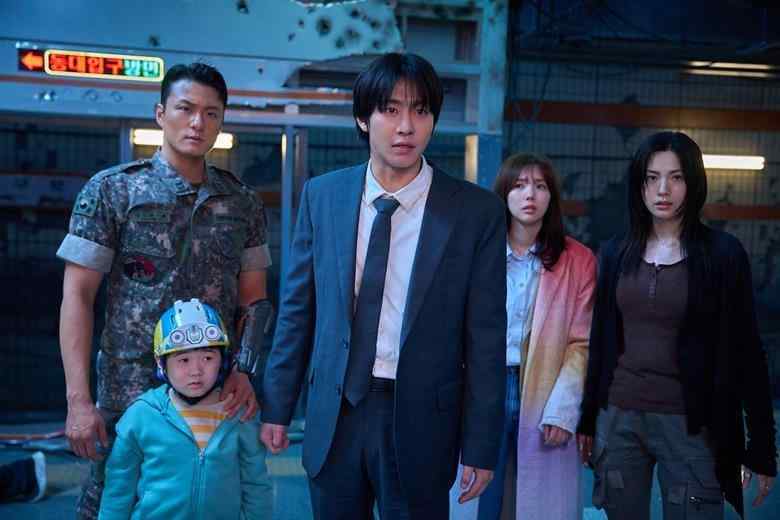
Right from the first minute, Omniscient Reader: The Prophecy promises high‑concept thrills but delivers something far more hollow: a glossy spectacle that never quite gets under your skin. Based on the cult favorite web novel Omniscient Reader’s Viewpoint, this adaptation arrives with weighty expectations and largely defies them.
Omniscient Reader: The Prophecy Movie Review
The story follows Kim Dok-ja, a quiet, overlooked office worker whose life revolves around a single thing: reading a long-running web novel called Three Ways to Survive the Apocalypse. He’s not a hero, not even particularly special but he’s the only person in the world who’s read every chapter of that strange, obscure story.
And then, one day, that story becomes real.
Without warning, the world around him transforms into the very apocalyptic nightmare he’s spent years reading. Buildings collapse, strange creatures invade, and people are forced to participate in deadly “scenarios” controlled by mysterious godlike beings called Dokkhaebis, who seem to treat the end of the world as entertainment.
But here’s the twist: unlike everyone else, Kim Dok-ja knows what’s going to happen next or at least, he thinks he does. Armed with his knowledge of the novel, he begins to navigate this terrifying new reality. Early on, he tracks down the story’s true protagonist, Yoo Joong-hyuk a classic, cold-blooded, action-hero type who’s lived through this apocalypse again and again in a seemingly endless loop.
Together, though often at odds, they form an uneasy alliance as they fight through one scenario after another giant serpents, collapsing bridges, brutal time trials, and even betrayals from fellow survivors. Along the way, they’re joined by a cast of supporting characters: Jung Hee-won, a righteous brawler with a fierce sense of justice; Lee Gilyoung, a child with the power to control insects; and Yoo Sang-ah, Dok-ja’s former coworker, whose quiet strength becomes a guiding light.
As the world grows more unstable and the “scenarios” become more sadistic, the line between fiction and reality begins to blur. Dok-ja isn’t just reading the story anymore he’s inside it. And with every step forward, the future becomes less predictable. The novel he thought he knew starts diverging from the script.
And that’s when the real theme begins to emerge: What happens when a reader becomes the protagonist?
There’s a deep emotional tension in Dok-ja’s journey. He starts out clinging to the safety of a story he’s memorized, treating people like characters, outcomes like plot points. But slowly, painfully, he’s forced to face the truth: these aren’t just players in a game — they’re real people, and their pain, losses, and victories matter.
At its heart, Omniscient Reader: The Prophecy is about agency. It asks: Can you change fate if you know what’s coming? Can you stop tragedy if the script says it must happen? And more than that, it explores the loneliness of knowing too much, of standing apart because you’re the only one who’s “read ahead.”
Kim Dok-ja starts the story as an observer. By the end, he becomes a leader, a friend, even a sacrificial figure. He learns that being the reader doesn’t mean being in control sometimes it means carrying the burden of stories you can’t rewrite. Highly Recommended: My Demon Parents Guide 2023.
But the film, in its attempt to condense a massive, layered novel into a two-hour runtime, doesn’t fully capture this nuance. The big questions are still there, flickering beneath the surface, but they’re often overshadowed by flashy action and world-building that moves too fast to let anything breathe. It’s like speeding through the chapters of a great book without stopping to reflect on what they mean.
Still, even with its flaws, the core idea remains powerful: that stories shape us, and that sometimes, we have to step beyond the role we’ve been given to become something more.
Performances & Characters
Ahn Hyo‑seop brings sincerity to Kim Dok‑ja, but the emotional complexity his character originally owns cunning, moral ambiguity, self‑interest is flattened into a more conventional “nice guy.” That shift makes the story feel sanitized. Lee Min‑ho delivers the cold hero aura fans expect, but remains underwritten: a powerful figure but lacking the emotional nuance that defined him in the novel. Chae Soo‑bin, Jisoo, Nana, and Shin Seung‑ho round out the ensemble with visual flair, but their arcs feel truncated. Fans have even criticized Jisoo’s character changed into a gun‑wielding fighter instead of the sword‑trained warrior readers know as emblematic of the film’s superficial reimagining.
Direction, Visuals & Pacing
Director Kim Byung‑woo clearly leans into visual spectacle—CGI creatures, collapsing cityscapes, and dramatic set pieces abound. The movie looks polished, even bombastic, but it also feels generic, trading originality for noise. Critics noted that while the visuals are glossy and occasionally impressive, the film lacks substance beneath its sheen. The pacing contributes to the problem: hurried scenario to scenario, important emotional beats barely registered. Long‑time fans lament that iconic scenes and layers of world‑building are truncated or omitted entirely Indiatimes.
Omniscient Reader: The Prophecy Parents Guide
Violence & Gore: The film is heavy on dystopian violence rampaging monsters, collapsing buildings, perilous trials, and quite a bit of blood. Expect tense scenes with people attacked, injured, or worse, frequent fight sequences, and emotional trauma among characters. It’s not horror‑level gore, but intense enough to unsettle sensitive viewers. The tone is dark and relentless in places, with injuries portrayed in a visceral way that avoids personalization but still delivers impact.
Language: You’ll hear occasional strong language some profanity, perhaps a stray f‑word or two, along with coarse expletives in moments of stress or despair. The dialogue doesn’t dwell on the vulgar, but it feels authentic to characters in crisis.
Sexual Content: There’s no explicit nudity, but the narrative does include distressing sexual themes. While not graphic, the film references sexual assault and alludes to the sex-trafficking undercurrents that appear in the novel. It’s implied and emotional rather than visual, but undoubtedly mature in context.
Substance Use / Drugs: There’s minimal to no substance use—no casual drinking or recreational drug scenes call out in the source material or reviews. Rather than partying or vices, this story leans into survival, existential drama, and moral choices under pressure.
Recommendation
This film is built for mature teens and adults who gravitate toward existential storytelling fused with high-stakes fantasy. If you’re guiding younger teens or pre-teens, consider watching it together and be prepared to hit pause when the emotional or visual intensity spikes.
Final Thoughts
If you’re new to Omniscient Reader and just want a stylized fantasy action movie, you might find enough high‑octane visuals and familiar faces to enjoy it. But if you came for the deep narrative, psychological nuance, and richly flawed characters that defined the original work—you’ll likely feel short‑changed. The adaptation opts for quick thrills over thematic weight and character depth. In the court of live‑action adaptations, it rivals a PowerPoint presentation more than a living story for fans who cared deeply about the material.
Director: Byung-woo Kim
Writers: Umising Nsong
Stars: Ahn Hyo-seop, Lee, Min-ho, and Kim Jisoo
Release date: August 1, 2025 (United States)
Country of origin: South Korea
Score: 3 / 10

Stephanie Heitman is a seasoned journalist and author dedicated to helping parents navigate the world of Hollywood entertainment through thoughtful, family-oriented film reviews. With over a decade of experience in writing and a passion for fostering safe, enriching viewing experiences, Stephanie launched Parentguiding.com to provide parents with the insights they need to make informed choices for their families.