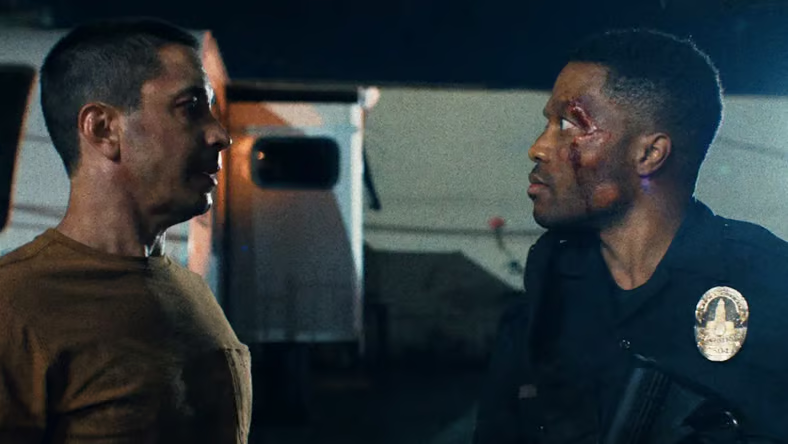
Night Patrol is Rated R by Motion Picture Rating (MPA) for strong bloody violence, gore, pervasive language, sexual references, and some drug use.
Working with co-writers Tim Cairo, Jake Gibson, and Shaye Ogbonna, Prows constructs a supernatural warzone where Black residents of a housing project find themselves under siege by a corrupt, otherworldly LAPD unit. It’s a midnight movie with real fury behind its eyes one that uses the familiar architecture of horror to tell a story about culture, displacement, and institutional violence, and does so on behalf of people who know all too well what it means to be targeted for the skin they’re in.
Jermaine Fowler leads as Xavier Carr, a former Crip who’s become an LAPD officer in the hope that he can serve as a shield for his community rather than another weapon pointed at it. His partner, Ethan Hayworth (played with unsettling restraint by Justin Long), is a war veteran freshly promoted into the elite Night Patrol unit. Xavier feels the sting of envy Night Patrol is the kind of assignment every cop covets. But Ethan’s interest in the unit runs deeper than ambition. His father died while serving with Night Patrol, and Ethan intends to dig into the truth of what really happens when the sun goes down. That investigation drags him straight into conflict with Xavier’s brother, “Cripboi” (RJ Cyler), still embedded in gang life. It’s already volatile.
Then it gets worse. Night Patrol has a plan: engineer a gang war between the Crips and Bloods, manufacture chaos, and use that bloodshed as an excuse to wipe Colonial Courts an entire public housing project off the map.
And to be clear, this is not just a metaphorical monster movie. Night Patrol commits fully to the literal. The creatures here aren’t just men hiding behind badges; they are actual, grotesque entities operating within the police force. What initially resembles a rough-edged cousin of End of Watch or Training Day quickly mutates into something stranger and more feral, full of conspiracies and revelations that erupt into startling, often brutal violence.
Highly Recommended: Good Luck, Have Fun, Don’t Die Parents Guide
If you remember Prows’ segment “Terror” from V/H/S/94, you can feel the same creative impulse at work: the tease of something supernatural eventually gives way to full-blown horror. The difference is that this time, the presence of the LAPD as the vehicle for that horror adds an extra layer of bile and boldness. The villains here aren’t just monstrous they’re institutionally protected monsters, and the film leans into that with savage glee.
What gives Night Patrol its real charge, though, is how directly it speaks about Black identity in America and the deliberate erasure of cultural specificity. This is a film that refuses to dress up its meaning in polite metaphor. Night Patrol’s members exploit their inherited powers to annihilate entire housing communities for profit and control, and the script makes sure we understand the racial implications without softening the edges. The dialogue is deliberately harsh. These cops are portrayed as tattooed, blue-uniformed bigots, barely restraining their hunger for violence, spewing hateful rhetoric with the ease of men who have never been held accountable. The moment Phil Brooks (yes, CM Punk) enters the frame, inked up and casually abusing his authority, you can sense the film drawing a hard line in the sand. Prows and his collaborators don’t bother pretending neutrality; the rage here is naked, and the cast performs it with an urgency that feels less like acting and more like exorcism.
That said, the film’s passion occasionally trips over its own insistence. Night Patrol can be shaggy, even repetitive, especially when it circles its themes again and again as if worried we might miss them. Given the world we’re living in, that anxiety is understandable. But it does lead to scenes that feel like echoes rather than progress. Characters repeatedly gather to explain once more why the LAPD would deploy supernatural death squads against Black communities. Entire stretches of dialogue reiterate the same grim truth: that these communities are viewed as disposable. You start to feel the drag in the rhythm. Action builds momentum, then stops cold for another exposition huddle, padding the runtime with information we’ve already absorbed. The intent is sincere. The execution is sometimes heavy-handed.
Still, there’s something deeply moving in how the film frames culture itself as a form of resistance. Nicki Micheaux plays the mother of Xavier and Cripboi, grounding the film with a presence that feels ancestral as much as maternal. Her South African Zulu heritage is not just background texture; it’s the spiritual core of the story. She rejects Xavier’s embrace of his “slave name,” distrusts the LAPD’s ability to confront its own rot, and holds fast to traditions that the film treats as sources of power. Ethan, meanwhile, insists he’s “one of the good ones,” but the movie quietly challenges that idea: even if his motives are personal rather than malicious, does that absolve his complicity? As Colonial Courts transforms into a battlefield bodies piling up, alliances forming between Crips and Bloods against a common enemy performers like RJ Cyler, Freddie Gibbs, and Flying Lotus embody a kind of cultural reclamation. They invoke Zulu teachings with the intensity of warriors discovering armor. It gives the film its own distinct identity: not just a revenge thriller, but a genre piece that argues for heritage as survival, for memory as weaponry.
Highly Recommended: Greenland 2: Migration (2026) Parents Guide
Night Patrol may be too much at times too loud, too long, too eager to make sure you get the point. It’s rough around the edges, occasionally buried under its own urgency. But it’s also bracingly alive. As a midnight movie, it thrives at the intersection of excessive bloodshed and righteous fury. Prows directs like someone who has no interest in playing it safe, pushing his narrative into uncomfortable territory and daring you to look away. The ensemble cast throws themselves into the madness with conviction. Sirens wail. Blood spills. Conspiracies unravel. And beneath all of it runs a stubborn, defiant belief in the power of genre to carry truths that polite dramas often flinch away from. If the film’s message doesn’t land for you, it’s hard not to wonder whether the problem is the movie or your willingness to hear what it’s screaming.
Night Patrol (2025) Parents Guide
The violence in Night Patrol is frequent, explicit, and designed to disturb rather than entertain. Gunshots are loud and messy, wounds linger on screen, and the camera doesn’t shy away from bloodshed. There are brutal beatings, executions, and grotesque supernatural transformations that blur the line between body horror and social metaphor. Bodies accumulate as the housing project becomes a battlefield, and the emotional weight of police brutality is allowed to sit uncomfortably rather than being glossed over. The atmosphere is tense almost constantly, more like living inside a nightmare than watching a stylized action movie. For younger viewers, this level of intensity would likely feel overwhelming.
The language is equally unfiltered. Profanity is constant, with heavy use of strong language throughout. More difficult still is the presence of racial slurs and bigoted dialogue, spoken by antagonists in ways meant to expose their cruelty and ideology. The film’s intention is clearly critical, but the words are still heard in full, and repeatedly. Characters often speak with hostility and aggression, and verbal confrontations carry real emotional sting. It’s the kind of dialogue that can linger in the air long after a scene ends.
Sexual content is present but not central. There are sexual references and occasional crude remarks in dialogue, but no extended sex scenes and no explicit nudity driving the story. Compared to the violence and thematic weight, this aspect of the content feels relatively mild, though still firmly within R-rated territory.
Drug and alcohol use appears mostly as environmental texture rather than a focus. There are references to drugs in connection with street life, brief moments of implied or background use, and adults who drink or smoke under stress. None of this is glamorized, but it is depicted matter-of-factly as part of the film’s world.
Age Recommendations
In terms of age appropriateness, Night Patrol is best reserved for adults. Viewers under 18 are likely to find both the content and the themes difficult to process, and even older teens would need a high level of maturity and parental guidance to engage with it in a healthy way.
Highly Recommended: Run Away (2026) Parents Guide

Stephanie Heitman is a seasoned journalist and author dedicated to helping parents navigate the world of Hollywood entertainment through thoughtful, family-oriented film reviews. With over a decade of experience in writing and a passion for fostering safe, enriching viewing experiences, Stephanie launched Parentguiding.com to provide parents with the insights they need to make informed choices for their families.