
Marty Supreme Rated R by Motion Picture Rating (MPA) for language throughout, sexual content, some violent content/bloody images and nudity.
It’s 1952 when we first meet Marty Mauser, sneaking a young woman into the back of the shoe shop where he works in New York. The camera lingers on their tentative, electric intimacy as they start making out. “My husband is sick,” she whispers, breathless, trying to justify her escape from domestic confines. Marty, ever the pragmatist, replies almost reflexively, “I can’t get sick,” his mind clearly elsewhere on the Table Tennis Championship that awaits him. “No, it’s food poisoning,” she insists, and with that, the air thickens, charged with a tension that is both romantic and reckless. It’s a bold, audacious opening, one that signals from the first frames that Marty Supreme will not be a quiet or conventional story.
As Alphaville’s “Forever Young” begins, the screen softens into pink hues, and a sperm cell drifts across the frame, soon multiplying in a surreal, almost comical flourish. It’s a visual cue playful, provocative that what we are about to witness is less a straightforward tale of ambition than a myth in motion. Marty and his lover, Rachel Mizler, portrayed with glimmering precision by Odessa A’zion, are characters charged with a furious energy. The lyrics, “Let us die young or let us live forever,” seem to echo the very essence of Marty himself: a young man determined not to follow the world but to incinerate it, chasing not love, not recognition, but a legend of his own making.
Highly Recommended: 10 Best New Movies & Shows Coming To Netflix (December 2025)
We soon see Marty at the Championship, and it’s clear he is extraordinary. His skill is undeniable, but what makes him magnetic on the table is more than talent it’s the way he plays. There’s a showmanship here, a grace and wit that draws admiration even from those he defeats. Respect is earned, not demanded, and yet, beneath this façade of control, Marty is orchestrating another game entirely. His gaze has already fallen on Kay Stone, the Hollywood star staying at the same hotel he’s assigned himself to. Played with elegant restraint by Gwyneth Paltrow, Kay is married to Milton Rockwell, a wealthy pen magnate embodied with quiet menace by Kevin O’Leary. Still, she accepts Marty’s invitation to the semifinals, and in that choice, the tension between worlds the ordinary and the dazzlingly unattainable begins to hum.

And then, as life insists on unpredictability, Marty’s trajectory falters. A new, silent paddle in the hands of Japanese player Koto Endo, brought to life with authentic precision by table tennis athlete Koto Kawaguchi, topples Marty in the finals. What follows is a portrait of denial and desperation. Marty becomes not just a sore loser, but a man unmoored, chasing validation with reckless abandon. Stripped of job, money, home, and self-respect, he will do anything to assert his worth: avoiding a pregnant lover, exploiting friends and strangers alike, and placing himself and others in jeopardy. It’s a darkly comedic spiral, and yet one that’s irresistible to watch.
The journey that follows is impossible to predict. Josh Safdie and Ronald Bronstein, who co-wrote the screenplay, deliver a narrative that zips with energy and absurdity, a film rhythmically precise yet chaotically alive. There are moments that will make you laugh uncontrollably, from Marty’s most obnoxious quips to the deliriously funny bathtub scene, and the confrontation at the house of Christopher (John Catsimatidis) and Dion Galanis (Luke Manley), the only businessmen who have ever taken him seriously even if only for a fleeting moment.
Though inspired by real-life table tennis champion Marty Reisman, Marty Supreme is resolutely fictional, and Safdie and Bronstein place character above historical fidelity. Marty himself is the lynchpin of the story, a series of contradictions made flesh: he is not a nice man, yet he’s not without fascination. Brilliant at table tennis, yet perpetually shirking responsibility. Deluded, self-destructive, entitled, and yet capable of ingenuity and occasional, disarming charm. He blames others for his mistakes, treats friends and family with indifference, and yet, in rare moments, can inspire genuine sympathy. He is narcissism personified, and yet so immature and delusional that complete dismissal becomes impossible.
Highly Recommended: Jingle Bell Heist Parents Guide
Marty is not simply flawed he is a child with the world’s toys ripped from his hands. His drive, his recklessness, his inability to engage in adult reflection, all stem from a deeply instinctual, defensive way of being. Watching him is exhausting, even infuriating at times, yet we remain riveted because he is never one-dimensional. The contradictions the intelligence and irresponsibility, the charm and the cruelty make following his journey impossible to resist.
Technically, the film is a marvel. Darius Khondji’s cinematography captures both the kinetic thrill of the table and the delicate absurdities of Marty’s life with equal grace. Editing by Bronstein and Safdie propels us through the narrative, while Chris Chae’s sound design and Daniel Lopatin’s score create a world brimming with tension, excitement, and humor. The matches themselves are gripping, but the stakes outside the arena Marty navigating threats, devising plans, making life-altering decisions are equally, if not more, riveting. The film pulses with energy, sustained by Marty’s poor choices, dramatic flair, and the occasional, unexpected moment of right action.
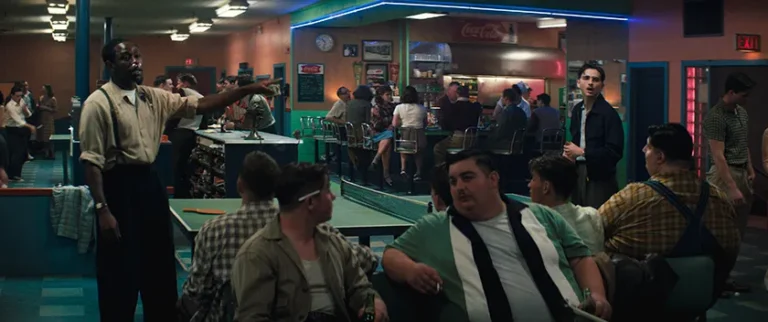
And yet, the movie knows when to breathe. One scene, quiet and devastating, brings us to tears in seconds, providing a culmination of Marty’s arc and a rare, hard-earned redemption. Timothée Chalamet, in this moment, proves why he belongs in the conversation for the highest acting honors. It’s a scene that transforms the chaos of the film into clarity, making the emotional stakes feel real, earned, and deeply moving.
Chalamet is, from start to finish, utterly magnetic. We’ve watched him grow across films like Lady Bird, Call Me By Your Name, Little Women, Bones and All, Dune, and A Complete Unknown but Marty Supreme is his most fully realized performance yet. He inhabits Marty completely, balancing chaos with restraint, ego with vulnerability, and delivering a performance that makes his final emotional turn feel like a revelation rather than a payoff.
Highly Recommended: Murder Mystery 2 Parents Guide
He is ably supported by a remarkable cast. Odessa A’zion continues her ascent with a performance that is luminous and grounded. Tyler the Creator is magnetic as Marty’s closest companion, providing charm, humor, and relatability. Kevin O’Leary embodies a villain whose presence looms without caricature. Gwyneth Paltrow, as the only character who sees Marty for who he truly is, is magnetic, while Abel Ferrara’s cameo as the unpredictable Ezra Mishkin adds another layer of controlled chaos to the story.
“Can you imagine when this race is won?” Alphaville asks at the start of the film, and by the end, we can. Only the race is not one we expected. Marty Supreme is about the pursuit of legend, yes, but it’s also about the messy, unpredictable ways real life asserts itself. With superb storytelling, impeccable rhythm, and a dazzling lead performance, Josh Safdie reminds us that while we chase dreams, we are often forced to grow up along the way. It’s chaotic, funny, painful, and exhilarating a film that lingers in the mind long after the final point has been scored.
Detailed Content Breakdown for Parents
Violence & Intensity: Most “violence” is sports-related (table tennis competition), but there are moments of physical chaos, fights, and risky stunts. Tension and suspense come from Marty’s poor decisions and the consequences he faces nothing supernatural, but real-world danger is present.
Language: Strong and frequent profanity. Sarcastic and biting humor, sometimes aimed at others in a hurtful way. No racial or ethnic slurs noted, though some aggressive teasing occurs.
Sexual Content / Nudity: Sexual situations, including brief nudity and implied sexual activity. Romantic relationships are a key driver of the plot, often depicted with intimacy that may be suggestive for younger viewers.
Drugs, Alcohol & Smoking: Adults drink alcohol in various social contexts. No significant drug use highlighted, but some characters engage in questionable behaviors. Occasional smoking seen on screen.
Parental Concerns
Strong adult themes, including sexual content and risky behavior.
Mature language and sarcastic, often biting humor.
Marty’s reckless decision-making may be confusing for younger viewers, as it is often glamorized with comedy.
Final Verdict
Marty Supreme is a thrilling, chaotic ride that blends sports excitement with dark humor and human drama. It’s not suitable for children or younger teens, but older teens and adults will find it engaging, clever, and emotionally resonant particularly for fans of character-driven stories with flawed, fascinating protagonists.
Director: Josh Safdie
Genre: Sport, Drama, Comedy
Run Time: 150′
Rated: R
U.S. Release: December 25, 2025
U.K. Release: December 26, 2025
Where to Watch: In theatres

Matthew Creith is a movie and TV critic based in Denver, Colorado. He’s a member of the Critics Choice Association and GALECA: The Society of LGBTQ Entertainment Critics. He can be found on Twitter: @matthew_creith or Instagram: matineewithmatt. He graduated with a BA in Media, Theory and Criticism from California State University, Northridge. Since then, he’s covered a wide range of movies and TV shows, as well as film festivals like SXSW and TIFF.