“I sometimes think Andy Warhol was onto something when he mused, ‘I’d like to be a machine.’ Watching Jordan Harrison’s Marjorie Prime which reopened Monday at the Helen Hayes Theatre that line kept circling back through my thoughts like a sly refrain. By the time the lights came up, I realized I’d rather watch the performers mimic circuitry than watch them wrestle with simple humanity.
Back in 2015, when Harrison’s drama was still a fresh Pulitzer finalist, its premise a sleek, grief-soothing android called a ‘prime’ that reanimates the likeness of a lost loved one felt startling, even eerie. A prime can mimic the dead with uncanny precision, but only after the living spoon-feed it enough memories to craft an approximation of emotional truth. In Harrison’s story, it’s Marjorie, an elderly widow, who receives a prime version of her late husband. Yet a decade of robot-saturated storytelling has taken some of the shine off the idea; since Blade Runner, the genre has been endlessly mined. One of the more recent inheritors is Maria Schrader’s 2021 German-language film I Am Your Man, a clear descendant of both Ridley Scott’s dystopia and the 2017 film adaptation of Marjorie Prime.
Highly Recommended: Stranger Things’ Season 5 Vol. 1 Parents Guide
Robots, after all, are built to be agreeable: efficient, polished, free of the grime of emotion. Humans are the opposite messy, stubborn, unpredictable. There’s a telling moment halfway through the play when the flesh-and-blood Marjorie, played here by June Squibb, soils herself. It’s crude, yes, but you can’t miss the point: nature does not operate with software updates.
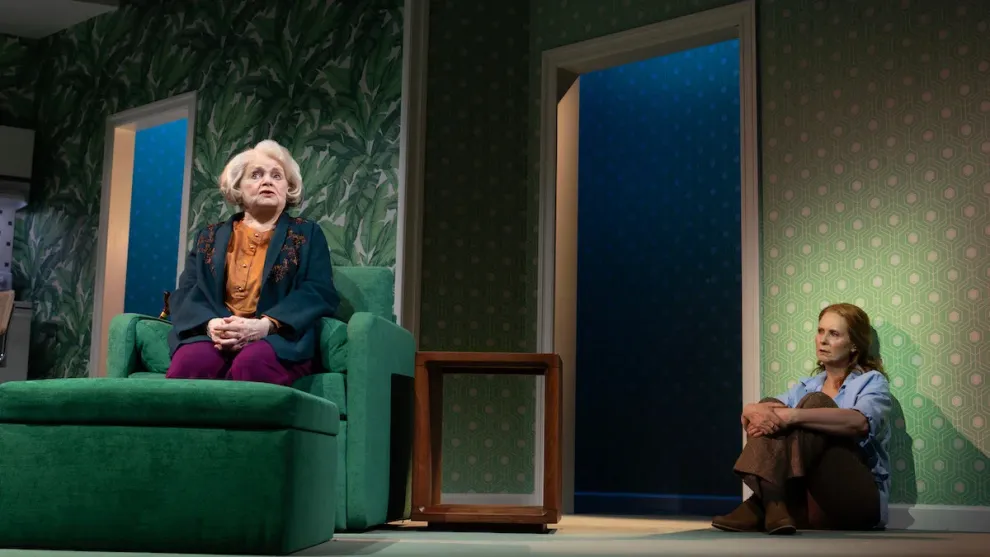
Director Anne Kauffman, who staged the 2015 Playwrights Horizons production, returns to shepherd this Broadway revival, bringing with her a near-exact rendering of Lee Jellinek’s handsome yet antiseptic living-room-and-kitchen design. The cast, however, is entirely different and two performances subtly warp the play’s meditation on what distinguishes humans from their smoother, programmed counterparts.
The real Marjorie, in earlier incarnations, was a razor-sharp, thorny presence Lois Smith embodied her that way both onstage and in the film. Her death triggers the creation of a Marjorie prime, and once she’s remade as a robot, she transforms into the idealized version of herself: attentive, gentle, uncomplicated. Smith used that duality to illuminate the gap between memory and its revision. Squibb, by contrast, doesn’t carve out that separation. She’s perfectly winning as the robot, but her human Marjorie is scarcely different she’s warm, sprightly, and borderline adorable, the classic sweet grandmother archetype whose most shocking lapse is that single bathroom mishap. You miss the prickliness, the complicated edges that make the prime’s perfection unsettling.
Danny Burstein, playing Jon Marjorie’s son-in-law seems to have borrowed from that same school of cuddliness. His Jon is all soft edges and compassion. True, Jon has always been more invested in Marjorie’s care than her own daughter Tess, but here he comes across almost eerily flawless, as spotless as the artificial primes themselves. It’s worth remembering he’s the only character who never becomes a prime; the production almost invites you to wonder if that’s because he’s functionally indistinguishable from one already.
Highly Recommended: The Beast in Me (2025) Parents Guide
Tess, meanwhile, cannot stop voicing her frustrations with her mother venting openly, sometimes cruelly, often within reach of Marjorie’s hearing aids. Cynthia Nixon grounds Tess’s resentment with real pain; she’s the only actor who consistently feels like she’s playing a person rather than a concept. Still, there’s something baffling about Tess choosing now, when Marjorie’s memory has faded into fog, to unearth these long-buried resentments instead of confronting them years earlier. One moment in particular a furious outburst over a caregiver leaving a Bible for her atheist mother lands with an almost operatic silliness.
One of Harrison’s clever twists is that eventually nearly everyone everyone but Jon gets turned into a prime. The fewer humans occupying the stage, the more the play seems to breathe. The most arresting scene arrives only after the living have shuffled off, leaving three primes seated around the kitchen table. Nixon’s Tess prime and Squibb’s Marjorie prime are joined by Christopher Lowell, who plays the prime of Marjorie’s late husband with a surprisingly disarming charm. Their conversation is serene, impeccably civil, almost too smooth. They trade stories and recollections that feel suspiciously sanitized, and for good reason: each robot has been programmed with distorted memories, reshaped by humans desperate to sand down the rough, painful truths of their own histories. It’s all very pleasant, if not remotely factual but it’s also the one sustained moment that isn’t weighed down by what often feels like Harrison’s forced human melodrama.
Highly Recommended: Spartacus: House of Ashur Parents Guide
Strip away the sci-fi packaging and Marjorie Prime is, at its core, a familiar domestic drama about two adult children trying to manage an aging parent. Harrison attempts to heighten the stakes by rummaging through his gothic bag of tricks and adding not one but two suicides, an escalation that pushes the human storyline toward the contrived.
In the end, the play suggests a curious inversion: it’s the machines who turn out to be the straightforward ones. They’re unburdened by guilt, unclouded by regret, blissfully insulated from the emotional knots that tie the living in circles and, most enticingly, free of all that human angst.
Content Breakdown for Parents
Violence & Intensity: There’s no physical violence of any kind. The intensity is emotional: the slow decline of memory, the strain of caregiving, and the existential unease of watching people construct their own version of the past. Sensitive viewers especially anyone who has dealt with dementia in the family — may find a few scenes quietly heartbreaking.
Language: The dialogue is clean. No swearing, no insults, and no aggressive confrontations. The tone is serious but gentle.
Sexual Content & Nudity: None. The film is entirely focused on relationships, memory, and identity.
Drugs, Alcohol & Smoking: Not a factor. Substance use simply doesn’t come up.
Parental Concerns: The biggest challenge isn’t objectionable content it’s the mood. Marjorie Prime is slow, dreamy, and sometimes emotionally heavy. Younger viewers may find it dull or confusing, while those who’ve experienced similar real-life situations may find it unexpectedly tender or painful. There are also subtle references to past tragedy that might catch you off guard if you’re expecting a calm sci-fi drama.
Recommended Age Range, Best for ages 15 and above, depending on maturity. Thoughtful teens who enjoy reflective, philosophical films may get a lot out of it; most younger kids simply won’t connect with its pace or themes.

Stephanie Heitman is a seasoned journalist and author dedicated to helping parents navigate the world of Hollywood entertainment through thoughtful, family-oriented film reviews. With over a decade of experience in writing and a passion for fostering safe, enriching viewing experiences, Stephanie launched Parentguiding.com to provide parents with the insights they need to make informed choices for their families.