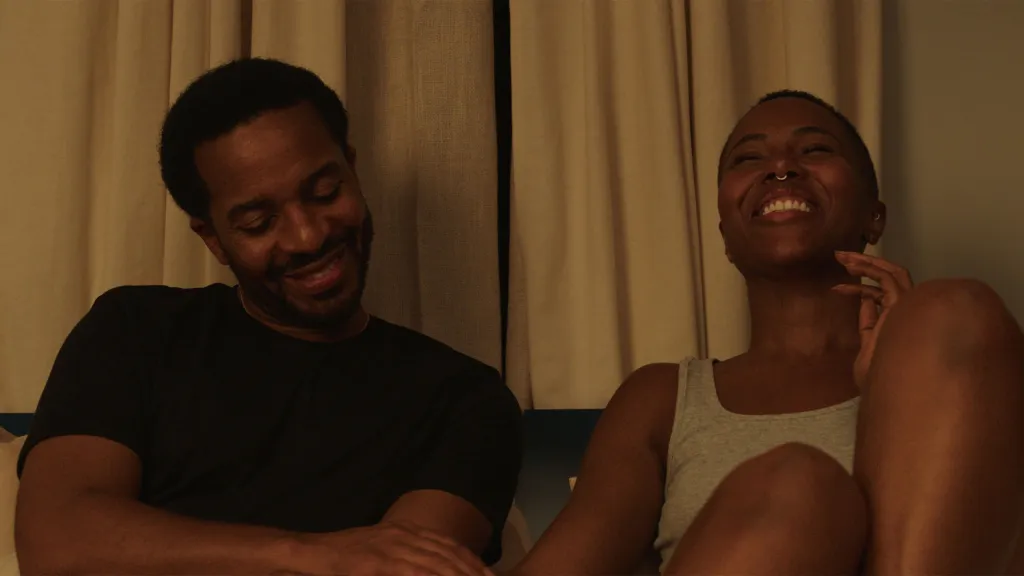
There’s a certain cozy glow radiating from Rachael Abigail Holder’s directorial debut, Love, Brooklyn the kind of warmth that makes you want to sink into it, even when the film itself doesn’t seem entirely sure what it’s doing. As Roger (André Holland) lazily bikes around the borough, the camera practically begs us to slow down, admire the brick facades, and bask in the sheer act of existing in Brooklyn. This easygoing rhythm is where the movie shines, supplying a gentle charm that almost distracts from the fact that its protagonist is juggling two relationships with all the decisiveness of a man trying to choose between oat milk and almond milk. Holder’s film may not always know what it wants to say, but it coasts by on its breezy energy, which is no small feat for a debut.
Roger, we’re told, is a writer though the film never bothers to show him doing much writing beyond staring pensively and avoiding deadlines. His editors are (understandably) irritated, since he can’t quite figure out if he wants to pen a piece about gentrification squeezing Black-owned businesses out of Brooklyn. But rather than explore this timely subject with any depth, the film prefers to linger on Roger’s personal entanglements, which are far more “Sex and the City” than “New York Times op-ed.”
He’s casually involved with Nicole (DeWanda Wise), a widow raising a young daughter, though their undefined arrangement has all the hallmarks of something meaningful minus the actual commitment. At the same time, Roger can’t resist rekindling sparks with his ex, Casey (Nicole Beharie), an art dealer who still shares an undeniable chemistry with him. Museums, dinners, flirtations the usual routine of people circling an old flame without actually committing to anything. The problem, in short: Roger is allergic to decision-making, both in love and in life.
Thankfully, Holland, Beharie, and Wise are far more compelling than the material they’re stuck with. Their performances feel effortless, their conversations so natural it’s as if they were plucked from real life. There’s even a rare chance to see all three flex some comedic muscle Holland and Beharie banter with the practiced wit of long-suffering exes, while Holland and Wise crackle with a cooler, more physical chemistry. Each moment between them feels warm and authentic, even if the script is giving them little more to do than improvise emotional realism. Holder’s cinematography deserves credit, too: rich colors, natural light, and a camera that seems to admire Brooklyn’s streets almost as much as Roger admires himself. At times, the film’s atmosphere nearly convinces you that it has something profound to say about life’s possibilities.
But then the script rears its head, and it becomes clear the film is just as indecisive as Roger. On paper, it seems like Love, Brooklyn wants to tackle big themes gentrification, post-COVID resilience, the evolution of a neighborhood but in practice, these threads are so undercooked they barely qualify as garnish. Instead, we’re left with the endlessly familiar portrait of a man who just needs to “grow up,” a cinematic archetype that feels more tired than lived-in. Worse, Roger spends most of the film bouncing between women based on who’s making life easier for him that day, which might be realistic, sure, but it’s also dramatically thin. Outside of his romantic triangle, Roger’s world is barely fleshed out; he’s not so much a character as he is a narrative device to hang mood and scenery on.
And yet, for all its muddled storytelling, Love, Brooklyn still manages to be worth watching mostly because its cast elevates every underwritten scene into something genuinely engaging. The film avoids descending into melodrama, keeping its love triangle grounded in a believable emotional reality, which is more than can be said for most romances. Like Roger’s meandering bike rides, it’s pleasant to drift along with, even if you realize halfway through that you’re not really headed anywhere. Holder’s debut has undeniable warmth and visual polish, but much like its protagonist, it ultimately mistakes indecision for depth.
Love, Brooklyn (2025) Parents Guide
Spoiler: It’s unrated. No MPA tag to hide behind, so parents, you’re flying blind.
Violence: Let’s be real this movie isn’t breaking bones or firing shots. There’s zero violence. You’ll see no blood, no fistfights, no danger. Just some emotional fumbling and maybe a metaphorical bruise or two. If you’re worried about your kid witnessing a bar brawl, you’ll leave disappointed… which may not be a bad thing.
Language: Expect a “damn,” a “hell,” maybe a “shit” slipped into conversation while Roger avoids deadlines or romantic fallout. Nothing that’d earn an R rating—but it’s enough to remind you this isn’t Mary Poppins.
Sexual Content: Love, Brooklyn is all about adults being adults in bed, in parks, in museums. Nothing graphic everything is implied with breezy intimacy. You’ll catch kissing, cozy in-bed scenes, and tight tops hinting at what’s beneath. A few nipples peek through snug clothing. It’s tasteful enough to dodge an R, but still, don’t let your 12-year-old wander in alone.
Substance Use / Drugs: Roger and company smoke weed with that relaxed enthusiasm usually reserved for “Can we have tacos?” moments. We see gummies, maybe a joint or two, and at least one drunk meme-puking aftermath. So yes, they’re indulging. Nothing glamorized more “adults navigating life,” but still… parental eyebrow raised. Common Sense Media
Highly Recommended:
- Splitsville 2025 Parents Guide
- Caught Stealing 2025 Parents Guide
- Little Trouble Girls 2025 Parents Guide

Stephanie Heitman is a seasoned journalist and author dedicated to helping parents navigate the world of Hollywood entertainment through thoughtful, family-oriented film reviews. With over a decade of experience in writing and a passion for fostering safe, enriching viewing experiences, Stephanie launched Parentguiding.com to provide parents with the insights they need to make informed choices for their families.