Little Trouble Girls is not rated because it has not undergone the official rating process by the Motion Picture Rating (MPA)
In Little Trouble Girls, Urška Djukić takes what should be a simple retreat for a girls’ choir and turns it into something far hotter, heavier, and spiritually knotted than anyone inside that convent is prepared to handle. Her feature debut Slovenia’s submission to the 98th Academy Awards and a quiet sensation after its FIPRESCI-winning premiere at the 75th Berlinale is steeped in Catholic imagery and queer longing, a combination that generates the sort of moral static that makes the walls of its solemn setting feel like they’re listening in.
The opening is a small sensory storm, almost fractal in its intimacy, and completely keyed to the inner murmurings of its lead, Lucia (Jara Sofija Ostan). Djukić begins not with faces but with fragments: an ear filling the frame, a mouth barely opening, fingers combing through coarse, impossibly long strands of hair. There are the soft, almost ticklish sounds of a smartphone keyboard, the low drone of a fly tracing lazy circles against the ceiling. You can feel how every tiny texture stirs something half-formed in Lucia. Then, after this swirl of sights and sounds, the camera finally settles on Lucia herself a blank, searching face that looks both present and miles away.
Highly Recommended: Marty Supreme (2025) Parents Guide
Sixteen, newly arrived to the choir, Lucia quietly studies the social constellation around her: the assured, sun-dappled Ana-Maria (Mina Svajger), her close friend Klara (Popovic Stasa), and the choir’s strict, almost sculptural choirmaster (Sasa Tabakovic). Lucia’s gaze drifts first toward Ana-Maria, tender and hungry in a way she may not fully understand yet, then jerks toward the authority figure she knows she must satisfy. In these early moments, both Lucia and the film seem convinced they know where desire and duty sit in her life and then, in a gentle but decisive way, Djukić begins to scramble everything, nudging Lucia toward a coming-of-age that feels both inevitable and slightly dangerous.
Djukić wears her influences openly, especially Lucrecia Martel’s The Holy Girl, and the echo is apt. What she builds here is a precise, emotionally knotty portrait of a young woman whose awakening sexuality strains against a psychological framework already stretched thin. You can see it in the small moments. After rehearsal, Ana-Maria casually sweeps lipstick across Lucia’s lips a harmless gesture on the surface, yet charged enough to leave Lucia strangely lit from within. Her mother (Natasa Burger), however, finds nothing innocent in it. “We agreed: no lipstick,” she scolds, her voice taut with a fear she won’t name.
Highly Recommended: Troll 2 Parents Guide
Later, Djukić frames mother and daughter in a revealing two-shot while a sex scene flickers across the TV. Lucia is rapt, drawn toward something she doesn’t bother to hide; her mother squirms, tugging at her robe as though modesty could shield her from the world’s messier truths. She’s prudish almost to the point of brittleness, and you sense why Lucia is already pressing against the constraints of this household like a plant leaning toward any available sun.
Freedom, or the closest approximation available to a tightly watched teenage girl, arrives in the form of a three-day rehearsal intensive at a convent in Cividale. The room Lucia shares with Ana-Maria and Katal overlooks a courtyard bustling with sweaty foreign laborers, their bodies distracting enough to pull Lucia into flashes of lust she tries, unsuccessfully, to smooth out with a serene expression. Ostan plays these moments beautifully: her lower face still and porcelain-like, her eyes flickering with the life she’s trying to conceal. It’s hard not to think of Botticelli’s delicate figures Venus and Mars, Portrait of a Young Woman where whole inner worlds shimmer in the slightest tilt of a brow.
Highly Recommended: Jingle Bell Heist Parents Guide
Ana-Maria, of course, notices everything. She’s the only one who reads Lucia’s guarded reactions as if they were spoken aloud. It’s Ana-Maria who draws Lucia into truth-or-dare, who pushes her to swipe a shirt from one of the construction workers, who keeps turning Lucia’s quiet yearning into action. “Isn’t it a sin?” Lucia whispers. Ana-Maria just shrugs a shrug that feels, to Lucia, like a map to a bolder version of herself.
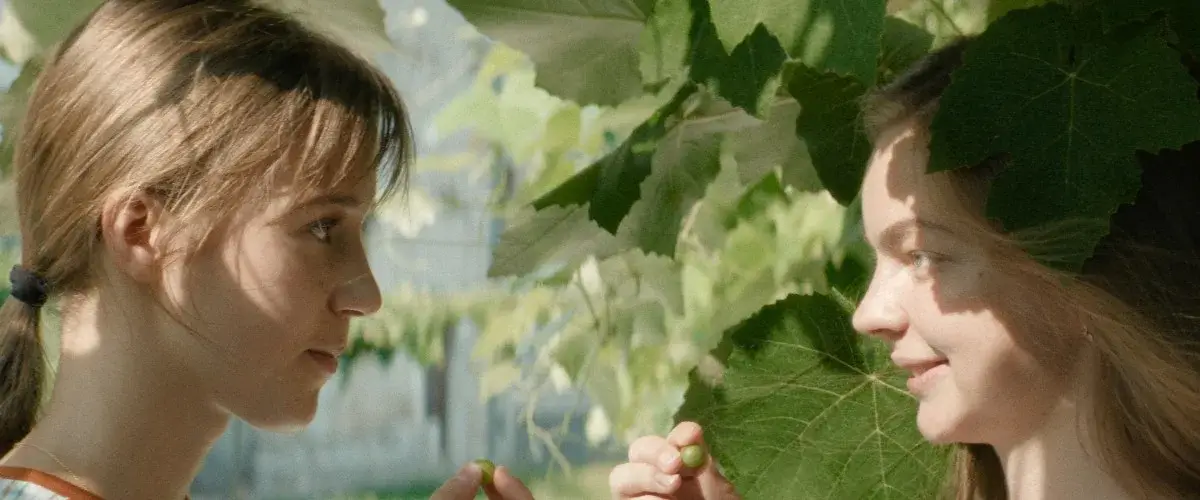
Religious symbolism hums through the film, sometimes bold, sometimes nearly imperceptible. Upon arrival, the girls discover that the convent’s statue of Mary has recently lost her hand a small but startling sign of severed connection, a broken conduit to the divine. Djukić doubles down on these themes with montages of flowers being pollinated and the recurring imagery of grapes, some sweet and flush with promise, others sour and sharp with consequence.
The film’s most startling illustration of spiritual and bodily conflict appears in a conversation Lucia and Ana-Maria have with a nun about celibacy. Their questions are gentle but probing do you ever miss being held, touched, adored? The nun exhales deeply before answering that God’s presence “spills over the body,” and for a moment she looks almost overwhelmed by the force of her own devotion. It’s a strange, luminous confession, and Lucia watches her with a mix of awe and recognition. She sees, perhaps for the first time, how faith can warp desire into something invisible, something that exists but must never be named.
Highly Recommended: Five Nights at Freddy’s 2 Parents Guide
And then there is the choir, which should be a space of expression but instead becomes another mechanism for erasure. “If one of you doesn’t conform, it all falls apart,” the choirmaster intones as he corrects Lucia’s posture, twisting her into a shape that matches everyone else’s. You feel the weight of those words the way they flatten her individuality, the way they echo the expectations pressing down on every corner of her life. He wants uniformity; she’s barely hanging onto herself.
What keeps the film from crushing Lucia entirely is Ostan’s performance, which has the quiet resilience of someone learning, painfully and beautifully, how to reclaim her own voice. The rebellious spark she carries isn’t loud, but it’s constant as constant as Djukić’s mesmerizing confidence behind the camera. Together, actor and filmmaker craft a debut that moves like a prayer whispered under one’s breath: fragile, yearning, and stronger than you’d expect.
Content Breakdown (for Parents)
Violence & Intensity: There is no graphic violence, gore, or explicit physical harm. The intensity arises from psychological and emotional pressure: peer dynamics, religious guilt, internal conflict, and the insistence on strict conformity by a controlling choir director. These tensions build a heavy emotional atmosphere more than bodily danger.
Language: The storytelling depends on tone, mood, and implication rather than harsh profanity. There is no strong evidence of explicit profanity, slurs, or coarse language in the film’s reported descriptions. The emotional tone is serious and contemplative, not comedic or casual there may be shame, whispered confessions, anguished dialogue but not vulgar language.
Sexual Content / Nudity: Sexuality is a central theme. The film depicts adolescent sexual awakening, attraction, and exploration of desire. It includes situations suggestive of intimacy and sensual tension for example, teenage girls playing truth-or-dare; Lucija’s attraction to a young worker; sexual curiosity; and emotionally charged glances. There is at least one scene playing on TV that triggers sexual feelings in the protagonist while her mother watches this is used as a moment of tension and awakening, though not explicit. There may also be an intimate moment with the choirmaster, involving emotional manipulation again, treated psychologically rather than explicitly.
Drugs, Alcohol & Smoking: There is no mention of drug use, alcohol consumption, or smoking in any available summaries or reviews. The film appears to focus on emotional, spiritual, and bodily awakening, not substance use.
Parental Concerns / What Might Worry Parents
- The film deals frankly with sexual awakening, desire, and emotional confusion, which may make younger viewers (under ~15) uncomfortable or may be misunderstood without proper context.
- Even though there’s no explicit sex or nudity, the suggestive tone, moral guilt, and almost religiously tinged repression might be heavy for some especially those from conservative or religious households.
- The emotional atmosphere is often serious, moody, and introspective not light or funny. Some younger teens or children might find it difficult or distressing.
- Because the film doesn’t sweet-wrap its themes, the lack of easy answers might leave some viewers uncertain, unsettled, or emotionally raw.
Recommended Age Range Mature younger teens (14–15) might be able to handle it but ideally with parental guidance, discussion, and context, BUT Not recommended for younger children (under ~13).

Stephanie Heitman is a seasoned journalist and author dedicated to helping parents navigate the world of Hollywood entertainment through thoughtful, family-oriented film reviews. With over a decade of experience in writing and a passion for fostering safe, enriching viewing experiences, Stephanie launched Parentguiding.com to provide parents with the insights they need to make informed choices for their families.