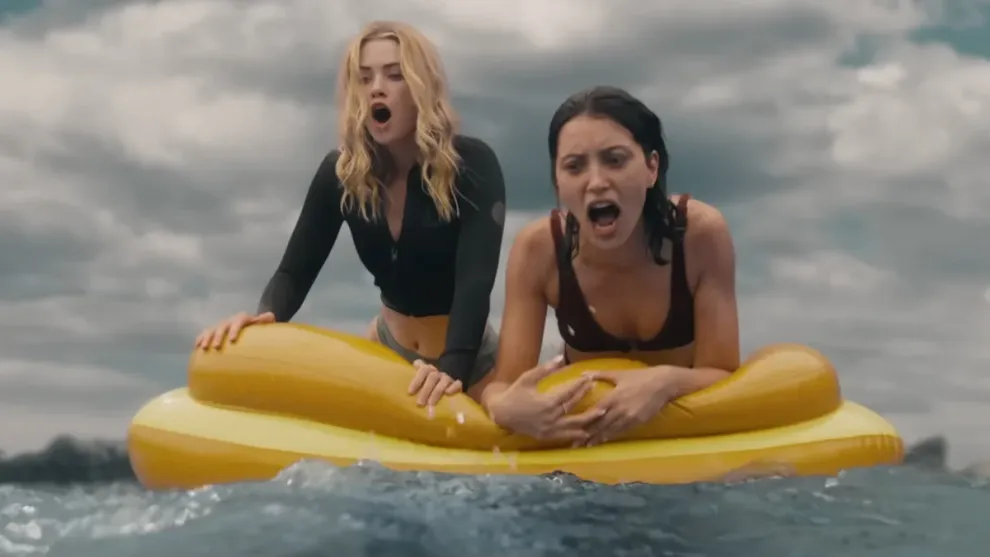
“Killer Whale” is rated R by the Motion Picture Association (MPA) for violent content, bloody/grisly imagery, strong language, and brief drug use.
Some creatures have better reputations than they deserve. Sharks, for instance, have taken a relatively small number of human lives, yet thanks to decades of cinema from “Jaws” to “The Shallows” they’ve been permanently branded as soulless, roaming engines of death. Meanwhile, hippopotamuses kill roughly 500 people a year and somehow we’re still crooning cozy holiday songs about wanting one for Christmas. Whoever manages hippo PR deserves a corner office and a lifetime contract, because that’s a masterclass in image control.
Orcas exist in a stranger cultural limbo. Years of SeaWorld branding, the earnest emotional manipulation of “Free Willy,” and the undeniable charm of viral videos (yes, including the one where they balance a salmon on their heads like a jaunty hat) have framed them as gentle, near-mythic companions. Sweet, intelligent, misunderstood. You’d think that would be flattering. But if you watch Jo-Anne Brechin’s “Killer Whale,” you get the sense the species itself might be pushing back against that narrative, demanding its rightful place as apex predator.
Highly Recommended: Predator: Killer of Killers 2025 Parents Guide
The film, like the 1977 cult oddity “Orca,” argues forcefully that these animals are not mascots but monarchs of the ocean. It’s a compelling argument. It’s just one that audiences have historically struggled to fully accept.
There’s an inherent tonal challenge in making a horror film about an animal that pop culture has trained us to love. It’s like casting a beloved children’s performer as the lead in a brutal revenge thriller; no matter how committed the performance, you feel the friction. Not because the performer is doing anything wrong, but because your emotional muscle memory is fighting the premise. “Killer Whale” never quite escapes that tension, though it does occasionally use it to interesting effect.
The film centers on Maddie (Virginia Gardner), a gifted cellist whose life fractures after her boyfriend is killed in a botched robbery, an event that also leaves her with permanent hearing loss. A year later, grief still clinging to her like damp clothing, Maddie is coaxed by her well-meaning best friend Trish (Mel Jarnson) into taking a trip to Thailand. The idea is healing: sun, distance, escape. There’s also a more specific motivation Maddie has long been emotionally attached to an orca named Ceto, held in captivity at a marine park and visibly deteriorating after years of confinement. Maddie loathes the idea of supporting such exploitation, and you can feel her ethical discomfort in every scene leading up to their visit. But the two sneak into the park after hours, and what Maddie witnesses there Ceto violently killing a janitor shatters any lingering illusions.
The revelation that Ceto has been killing staff members for some time reframes everything. Her rage is not portrayed as monstrous so much as tragically earned. The park’s solution is chillingly pragmatic: quietly dump the whale back into the ocean, disposing of the problem rather than confronting the abuse that created it. The location? A remote atoll where, in a twist that strains credibility even by genre standards, Maddie, Trish, and their charming guide Josh (Mitchell Hope) just happen to choose to spend an afternoon swimming. Coincidence is doing a lot of heavy lifting here. Before long, they’re stranded on a jagged rock, injured, exhausted, and being methodically circled by a predator with unfinished business.
Highly Recommended: 28 Years Later: The Bone Temple (2026) Parents Guide
The setup inevitably invites comparison to “The Shallows,” and the parallels are hard to ignore: isolated protagonist, open water, single relentless animal, survival as slow psychological torture. But “Killer Whale” also echoes “Fall,” another high-concept survival thriller about two friends trapped in an impossible situation also starring Gardner. You can almost imagine the scripts for these films scattered across a floor, chopped up and reassembled like cinematic collage. The components are recognizable. The beats are familiar. There are very few genuine surprises.
And yet… formulas endure for a reason. They work. What Brechin demonstrates here is a clear understanding of why audiences keep returning to stories like this. There’s something brutally effective about stripping characters of every safety net and forcing them to confront the raw math of survival. If they jump into the water, they die. If they stay put, they die. The tide is rising. Blood is already in the water. The camera lingers just long enough for you to start mentally calculating options alongside them, realizing, with a tightening in your chest, that none of them are good.
Brechin does wrestle with the film’s early stretches. The first act, cluttered with exposition and narrative contrivance, sometimes feels like it’s begging you to suspend your disbelief rather than earning it. But once the story narrows its focus to the rock, the water, and the circling presence beneath the surface, the film finds its rhythm. From that point on, “Killer Whale” becomes a taut, competently staged thriller that knows exactly what it is, even if it doesn’t pretend to be reinventing the genre.
The performances help. Gardner once again proves she can carry a film almost entirely through physicality and emotional endurance; we already saw that in “Fall,” but it’s no less impressive here. Her Maddie feels wounded without being passive, resilient without being superhuman. Jarnson, meanwhile, brings a lived-in warmth to Trish, avoiding the usual best-friend clichés and hinting at an actor with more range than the script always allows her to show. As for the titular whale: it looks like a whale. That’s faint praise, perhaps, but in a genre riddled with embarrassing digital creatures, it’s also a small victory.
This is not the orca movie that will dethrone “Free Willy” in the collective imagination. It’s not trying to be. If anything, it feels like the dark, cynical mirror image of that earlier film—a version where captivity has consequences and nature does not forgive. If you’re determined to see a “Kill Willy” instead of a “Free Willy,” you could do worse. You could do slightly worse, anyway. The fact that the murderous-orca subgenre remains so sparsely populated is not Brechin’s fault. That blame, once again, belongs to the astonishingly effective publicists of the whale world.
Killer Whale Parents Guide
Violence & Intensity: This is a survival horror film built almost entirely around sustained threat. Characters are stalked, injured, and psychologically broken down over long stretches of screen time. There are moments of explicit violence involving both humans and the whale, including on-screen deaths and aftermath imagery that lingers longer than is comfortable. Blood in the water isn’t just a metaphor here it’s a recurring visual. The tension is relentless, and the emotional intensity may be as upsetting for younger viewers as the physical violence itself.
Language (profanity, slurs, tone): Strong language appears throughout, often in moments of panic or emotional collapse. Characters swear when they’re terrified, furious, or grieving, which feels honest to the situation but still frequent enough to note. No playful banter here this is language used under stress, and it sounds like it.
Sexual Content / Nudity: There is no explicit sexual content driving the story. Some mild sensuality and suggestive dialogue may appear, but it’s not a focus. The camera is far more interested in survival than sexuality.
Drugs, Alcohol & Smoking: There is brief drug use and some alcohol consumption. These moments are incidental rather than glamorized, but they are visible and clear enough to warrant awareness.
Age Recommendations
This is not a film for children or younger teens. The emotional heaviness, sustained peril, and graphic moments make it best suited for older teens (17+) and adults, particularly viewers already comfortable with intense survival thrillers. If your household avoids grim material or prolonged anxiety-inducing scenarios, this one will likely feel like too much rather than merely exciting.
Release date January 16, 2026 (United States)

Stephanie Heitman is a seasoned journalist and author dedicated to helping parents navigate the world of Hollywood entertainment through thoughtful, family-oriented film reviews. With over a decade of experience in writing and a passion for fostering safe, enriching viewing experiences, Stephanie launched Parentguiding.com to provide parents with the insights they need to make informed choices for their families.