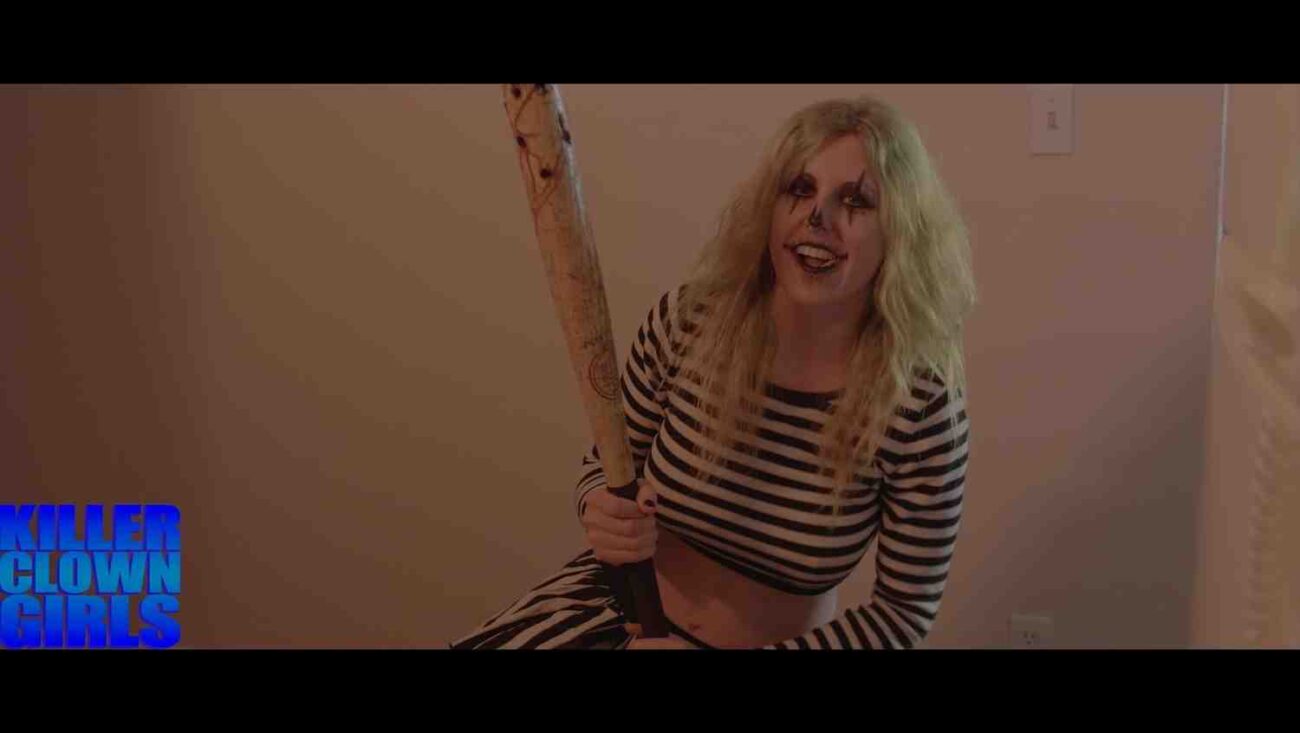
Killer Clown Girls announces itself like a prank you’d expect to stumble into at two in the morning one of those titles that dares you to take it seriously. And at first, it seems determined not to be taken that way. Written and directed by Roman P. Martinez and released 30TH December, 2025, the film arrives coated in grindhouse grime: killer clowns, arterial sprays of blood, a general promise of tasteless mayhem. You brace yourself for a gag stretched to feature length. Then, quietly, something else begins to surface. Beneath the greasepaint and the carnage, there’s an impulse that feels unexpectedly sincere, even searching. The movie doesn’t fully pull it off, but it keeps reaching and that reaching makes it far more compelling than its lurid name would ever suggest.
The story drops us into the lives of a small group of women scraping by as performers in a rundown traveling carnival parked near a forgotten desert town. This is the kind of place where nothing quite grows and no one is really passing through they’re just stuck. By daylight, these women hustle for spare change, endure leering customers, and carry the quiet fatigue of people who’ve learned not to expect much. When night falls, though, they step into another role entirely. Masks go on. Clown faces replace human ones. Together, they become vigilantes, targeting abusers, exploiters, and anyone foolish or cruel enough to end up in their path.
Highly Recommended: Percy Jackson and the Olympians’ Season 2 Parents Guide
What’s striking is how the film lets these two modes bleed into each other. Martinez isn’t content to simply stage a series of slasher set pieces, though those are certainly here. Between the violence, the film lingers on moments of intimacy: conversations that trail off, glances that carry shared history, silences heavy with things that have never been said out loud. Each killing raises the stakes, but not just because the police are circling closer. The real tension builds inside the group. Old wounds reopen. Guilt seeps in. Differing ideas about justice about how far is too far start to pull them apart. What once felt like release begins to harden into fixation. You can feel the shift, the way empowerment curdles into something uglier.

At heart, Killer Clown Girls is wrestling with the idea of performance. Not just the literal performance of carnival work or masked violence, but the roles people adopt to survive how hiding can feel like freedom, and how easily that freedom can rot. Violence here is seductive before it’s corrosive, and revenge is never as controlled as it pretends to be. Martinez is clearly aiming beyond novelty, even when the script doesn’t quite have the precision to articulate everything it’s circling. When the film connects, it carries a bruised emotional weight that lingers longer than you might expect. When it falters, it sometimes falls back on shock as a substitute for clarity.
Jason Adams anchors the film as a morally uneasy outsider who gets pulled into this orbit of chaos. His performance has a tired honesty to it, the look of someone who’s seen enough to know better but not enough to walk away. He becomes a kind of stand-in for the viewer, and his grounded presence is especially welcome when the film threatens to tip into pure delirium.
Highly Recommended: The Dutchman (2025) Parents Guide
Still, the film belongs most fully to Shelley Aisner and Theresa Allen. Aisner plays her character like a live wire stretched thin anger and exhaustion coiled together until they’re indistinguishable. Allen, by contrast, moves with a disquieting calm, the sort that makes you uneasy because you can’t quite tell what she’ll do next. Their chemistry feels earned rather than written, as if these women have been circling each other for years before the camera ever showed up. That shared history gives the film emotional credibility, even when the narrative shorthand starts to show.
Not everyone gets that level of depth. A few supporting characters are sketched broadly, and some performances drift into outright camp. But in a movie this steeped in exploitation aesthetics, that unevenness feels more like part of the fabric than a dealbreaker.
Martinez’s direction shows a filmmaker with a strong instinct for mood, if not always for balance. He leans into harsh lighting, grimy close-ups, and smeared neon hues that make the world feel sticky and oppressive. The clown imagery is used with restraint it’s unsettling because it’s treated as matter-of-fact, not because it’s pushed into grotesque excess. You might notice how rarely the film tries to make the clowns “cool.” They’re just wrong, and that wrongness hangs in the air.
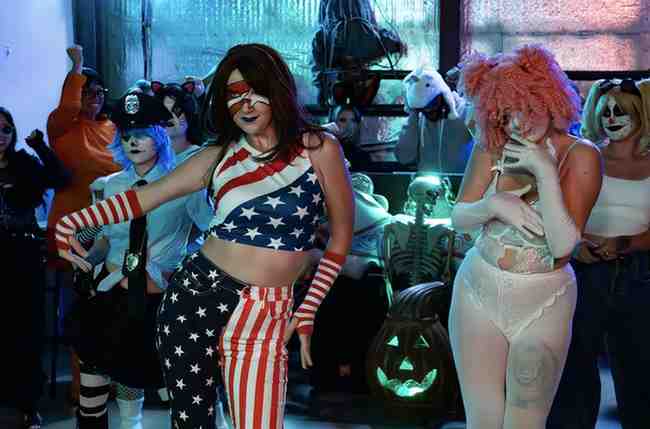
The pacing, however, is less assured. The first half takes its time, patiently establishing tone and relationships, and that patience pays off. The final act, by contrast, rushes through emotional consequences that could have used more space to land. Even so, there are sequences especially those unfolding under carnival lights at night where the film locks into a hypnotic groove. In those moments, it feels like you’ve wandered into a bad dream that smells faintly of gasoline and stale popcorn, and it’s hard not to admire how fully the film commits to that sensation.
Killer Clown Girls is not a movie designed to win over everyone. If you need polish, or if low-budget roughness sets your teeth on edge, this probably isn’t your ticket. But for viewers drawn to exploitation cinema that’s trying however imperfectly to grapple with something human beneath the blood, there’s real value here.
Highly Recommended: We Bury the Dead Parents Guide
It’s an untidy film, sometimes aggravating, often uneven. But it’s also sincere in a way that feels increasingly rare. In a horror landscape crowded with empty callbacks and algorithm-approved scares, that earnestness matters. It may not justify every misstep, but it does make the experience linger longer than expected.
Detailed Content Breakdown for Parents
Violence & Intensity: Killer Clown Girls features frequent, stylized violence that is central to its story. The main characters commit bloody acts of vigilante justice, including stabbings and attacks, often shown in graphic detail. While the gore is exaggerated in a grindhouse fashion rather than realistic, the scenes are intense, suspenseful, and sometimes shocking. The tension builds not only from the killings themselves but from the psychological strain and conflicts among the characters, which can be unsettling for younger or sensitive viewers.
Language: The film contains strong profanity throughout, with frequent swearing and aggressive insults. There are no notable racial or homophobic slurs, but the tone is consistently intense and harsh. Parents should be aware that the dialogue reflects adult frustration, moral conflict, and violent situations, contributing to the overall dark atmosphere.
Sexual Content / Nudity: Sexual content is minimal. A few suggestive moments are implied, and some scenes show partial nudity mainly related to carnival costumes or performer outfits. While these instances are brief and not overtly sexualized, they contribute to the mature tone of the film.
Drugs, Alcohol & Smoking: The movie occasionally shows light drinking in adult scenes, and smoking appears sporadically, but drug use is absent. These elements are minor and do not drive the plot.
Scary or Disturbing Scenes: Several scenes are intentionally designed to unsettle viewers, including masked figures lurking at night, suspenseful build-ups, and sudden violent attacks. The film’s nighttime carnival sequences, combined with blood and chaos, create a tense, immersive atmosphere. Younger children or more sensitive teens may find these moments frightening.
Recommended Age Range: Best suited for mature teens (16+) and adults. Younger teens may be upset or frightened by intense violence and disturbing imagery.

Stephanie Heitman is a seasoned journalist and author dedicated to helping parents navigate the world of Hollywood entertainment through thoughtful, family-oriented film reviews. With over a decade of experience in writing and a passion for fostering safe, enriching viewing experiences, Stephanie launched Parentguiding.com to provide parents with the insights they need to make informed choices for their families.