
Kill Bill: The Whole Bloody Affai is currently “Unrated.” Given its extreme violence, frequent bloodshed, and mature themes, a fair prediction for a formal rating would likely be “R” or equivalent adult-oriented rating
Quentin Tarantino’s Kill Bill opens with a howl of betrayal: Uma Thurman’s Bride, a former assassin, lies broken on her wedding day, left for dead by the man who taught her how to kill and loved her besides the enigmatic Bill (David Carradine). His elite squad of executioners (Vivica A. Fox, Lucy Liu, Michael Madsen, and Daryl Hannah) finish the job with gun barrels pointed at her belly. When she wakes up from a coma years later, she sets out after each of them, carrying revenge like a fever that burns through the film’s every frame. Tarantino’s first assembly ran four hours, a pulpy odyssey that Miramax decided audiences couldn’t take in one sitting. Rather than ask him to trim, they split the movie in half, creating 2003’s Volume One and 2004’s Volume Two a commercial compromise that would come to define how the world initially understood this movie.
Highly Recommended: Trap House (2025) Parents Guide
Critics were torn and awards bodies shrugged; Kill Bill remains the only Tarantino project to completely miss the Oscars. But audiences worldwide embraced it, and its success unlocked the operatic, revisionist streak that would define the director’s later career the myth-making extravagance of Inglourious Basterds, Django Unchained, and Once Upon a Time… in Hollywood begins here, with a woman crawling out of a grave she was never meant to leave.
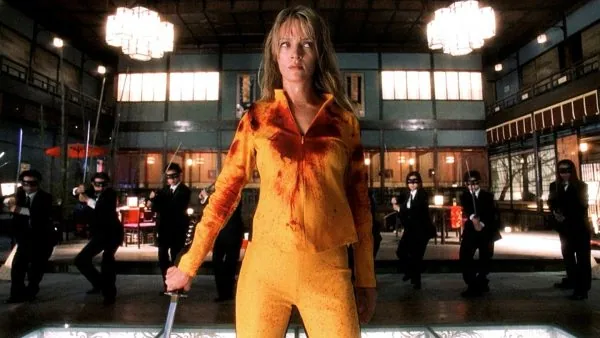
And now, with Kill Bill: The Whole Bloody Affair, Tarantino gets his wish: one long, wild, maximalist movie. It’s arguably the most distilled version of his sensibility the purest Tarantino — and that’s saying something for a filmmaker who once staged an entire diner sequence like a kitschy shrine to classic Hollywood. Whether you watch it as two films or as this uninterrupted torrent, you can feel the director folding every obsession he’s ever harbored into one frenzied universe: kung fu epics, Yakuza dramas, spaghetti Westerns, sleazy ’70s grindhouse carnage, even anime. Tarantino has long insisted Kill Bill was conceived as a single, mammoth tale; “The Whole Bloody Affair” finally lets the film stand that way. (And yes, spoilers the movie is old enough to drink.)
An early cut screened at Cannes back in 2006 and resurfaced occasionally in Tarantino’s Los Angeles repertory houses, but this new commercial release is the first time general audiences can see his intended vision. Unless Tarantino wakes up one morning with another grand idea always possible this should be considered the canon edition.
Highly Recommended: The Ministry of Ungentlemanly Warfare Parents Guide
The changes aren’t radical so much as clarifying. He tweaks both halves, inserts a 15-minute intermission, and reinstates scenes that most viewers never even knew existed. The most startling restoration is a lengthened version of O-Ren Ishii’s childhood saga now a full ten minutes longer charting her life from orphaned girl to feared Yakuza leader. Told in animation, it chronicles not just loss but the exploitation that scarred her adolescence, inflicted by the predator who killed her parents. In this version, the segment sprawls so expansively that it almost feels like an embedded prequel, a graphic novel chapter nested inside the Bride’s very human rampage.
There’s also a small but crucial adjustment at the midpoint. In the theatrical Volume One, Tarantino tipped his hand early: the Bride’s daughter was alive, kept by Bill, and named B.B. It was a tease meant to keep audiences hungry for Volume Two. Here, that reveal disappears. We only learn the truth when the Bride does — a choice that lands like a gut punch. What was always an emotionally messy twist now becomes something more intimate and destabilizing, challenging the Bride’s understanding of her mission and deepening the film’s running commentary on the ways men exploit women, and how women sometimes must weaponize what’s been done to them. She arrives determined to kill Bill, only to find her quest was built on a misunderstanding. The finale turns into a strangely tender, unsettling meditation on how the heart can cling to someone who has caused unimaginable harm.
Highly Recommended: Death by Lightning Parents Guide
I’ll admit: when I first saw Volume One, I admired pieces the performances, especially Thurman’s, and Tarantino’s cheeky technical bravura but overall found the pacing maddening. I’m as tolerant of slow cinema as anyone; I’ve given high praise to films so leisurely they seem to drift in real time. But Kill Bill, chopped in two, struck me as shapeless, like being cornered by an excitable vinyl obsessive who insists on telling you why every record in his collection is essential. I thought the two halves were the most languid revenge movies imaginable. Now, rewatching the unified film, I realize that wasn’t Tarantino’s intent it was the marketplace’s meddling, aided by a certain mogul (yes, that H.W.) whose preferences often bulldozed artistic shape.
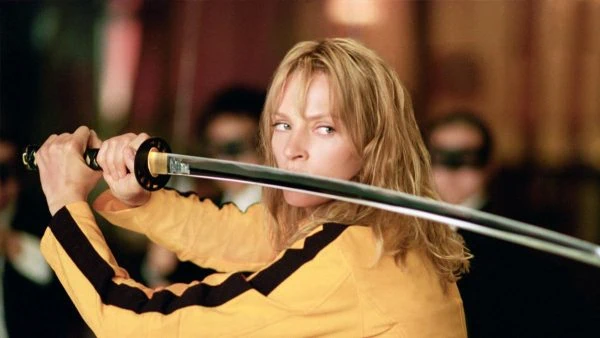
Seen as one continuous journey, the Bride’s crusade moves with a strangely elegant momentum. Restored to its unbroken, unrushed form which is frankly as avant-garde as a mainstream action film is likely to get The Whole Bloody Affair becomes the most inviting and satisfying incarnation of Tarantino’s vision. The movie’s bizarre hybrid world part Western, part gangster saga, part martial-arts blood opera, part noir cartoon feels more fully realized when it’s allowed to breathe. More than any of his other films, this one actually earns the pulp comparisons Tarantino loves to make about his work, those yarns once slapped onto cheap paperbacks and sold for pocket change.
Highly Recommended: The Running Man (2025) Parents Guide
And yet the movie also reaches back toward older, almost mythic storytelling traditions. You can sense the echo of biblical narratives, Greek tragedies, Roman epics, tarot symbolism, and ballads about wanderers marked by grief. The story is divided into numbered chapters, recalling both Godard’s collage-like films which attacked the screen with text and the serialized rhythm of graphic novels. The two halves mirror each other structurally: the split-screen fight scenes, the echoing motifs, the parallel losses. O-Ren’s story is about a child robbed of her parents; the Bride’s, about a mother robbed or so she thought of her child.
But the true revelation, once again, is Thurman. Watching her in this complete cut, you can see the full power of a performance that may be among the greatest feats of screen acting in modern cinema. She embodies the Bride’s contradictions the lethal precision of a Bruce Lee or Clint Eastwood fused with the interior stillness of a Bergman heroine. She moves like someone carved from steel and sorrow, shredding her way through enemies, yet carrying the weight of trauma in every gesture. And that bathroom breakdown near the end her daughter asleep in the next room remains one of the rawest moments Tarantino has ever put on film. In this expanded version, the scene lingers in a nearly unbroken take, and you feel the movie quiver under its emotional force.
Highly Recommended: Sisu: Road to Revenge Parents Guide
Wherever you stand on Tarantino whether his style delights or exhausts you The Whole Bloody Affair is a ferocious sensory experience: saturated colors, stark black-and-white imagery, and geysers of blood that feel almost operatic. And in its final stretch, with the story settling into something unexpectedly gentle and mournful, you might even sense what Tarantino himself declared in another of his films: this might be his masterpiece.
Content Breakdown (for Parents)
Violence & Intensity: Extremely graphic and stylized violence. The film is built around vicious, often bloody confrontations, martial-arts violence, gunplay, and vengeance-driven brutality. Expect intense fight scenes, visible blood, and some scenes that could feel shocking or disturbing, especially for younger or sensitive viewers.
Language: Frequent strong language profanity and harsh expressions are part of the film’s tone. It’s unlikely to include hate-based slurs, but the overall tone is raw, uncompromising, and adult.
Sexual Content / Nudity: There is no focus on romantic or family-friendly affection; sexual themes revolve around betrayal, exploitation, and trauma. Nudity is minimal or implied rather than the focus, but the film’s emotional cruelty and context make some of the relationships and backstories deeply disturbing.
Drugs, Alcohol & Smoking: These are not central to the story’s core themes the film focuses on revenge, violence, and trauma. Substance use is not a major element of the narrative.
Parental Concerns / What Might Surprise or Worry Parents
- The sheer and graphic level of violence not cartoonish, but visceral, bloody, and prolonged.
- Themes of exploitation, trauma (especially in backstory flashbacks), and emotional suffering that are heavy and possibly disturbing.
- The film’s length (over 4 hours) and its emotional intensity may be overwhelming.
- It is not suited for children or younger teens; even many older teens might find the content difficult.
Release on 5th December, 2025.

Matthew Creith is a movie and TV critic based in Denver, Colorado. He’s a member of the Critics Choice Association and GALECA: The Society of LGBTQ Entertainment Critics. He can be found on Twitter: @matthew_creith or Instagram: matineewithmatt. He graduated with a BA in Media, Theory and Criticism from California State University, Northridge. Since then, he’s covered a wide range of movies and TV shows, as well as film festivals like SXSW and TIFF.