Early in the fourth season of Industry, there’s a quiet moment that tells you almost everything you need to know about where this story is headed. Harper Stern, played with ferocious precision by Myha’la, opens a birthday card from her estranged mother. The message is simple, almost tender in its sting: Looks like you got everything you wanted. Desire has always been the engine of this series ambition as fuel, hunger as identity but this season is less interested in what these characters chase than in what that chase has cost them. You can feel the shift immediately. Harper barely absorbs the words before feeding the card into a shredder, the paper disappearing with the same casual finality she’s always reserved for emotional attachments. It’s an image that lingers, because it quietly signals that the armor everyone has been wearing is about to crack.
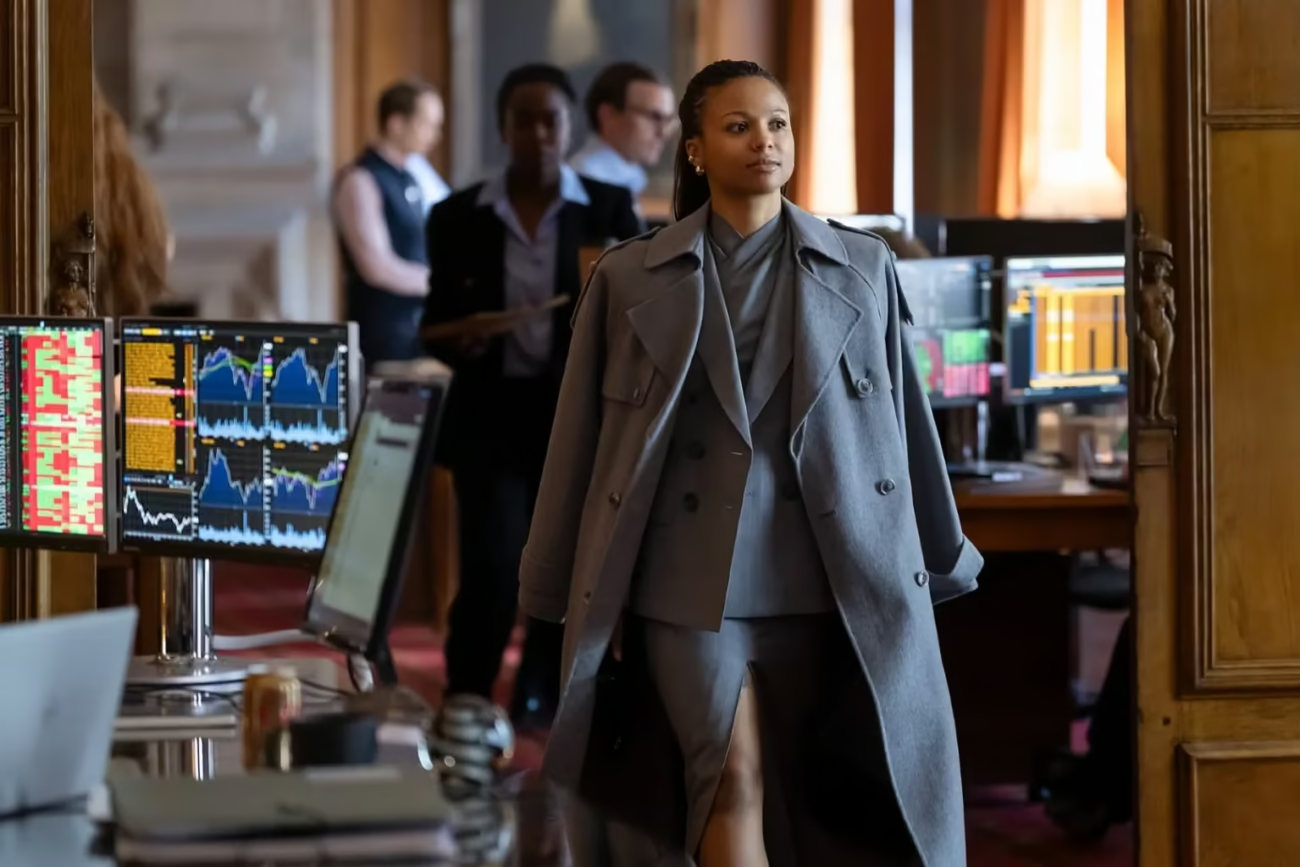
Harper, at least on paper, has won. She’s now running her own firm, surrounded by a carefully chosen inner circle: Sweetpea Golightly, the breakout presence from season three, Kwabena Bannerman, sharp and newly blooded, and, when it suits him, Rishi Ramdani, who trades in information as a revenue stream while still staggering under the trauma of his wife’s murder. It looks like a power structure. It sounds like control. And yet there’s an absence that gnaws at Harper, one she can’t outmaneuver or buy her way around. The partnership that once forged her into the ruthless operator she’s become her bond with Eric Tao is gone. So she does the unthinkable and reaches back into the past, calling Eric and asking him to abandon retirement to work with her again. After a season spent circling one another warily, history finally drags them back together, catalyzed by a call from financial journalist Jim Dycker. The decision feels less like a reunion than a mutual relapse.
Elsewhere, the series sinks into a different kind of decay. Yasmin Kara-Hanani, living inside the long shadow of a failing marriage, prepares for her husband Henry Muck’s 40th birthday party. Henry, having lost his MP vote, has retreated into something like a living death sleeping through the day, drifting through their estate, staring at the family’s hunting rifles with an unsettling, almost appetitive intensity. He moves through the house like a ghost who hasn’t realized he’s dead. Yasmin, meanwhile, keeps going, arranging meetings and making plans, including a calculated introduction between Henry and Tender’s interim CEO, Whitney Halberstram. It’s an act of desperation dressed up as support.

Henry’s drug use has escalated. His desire sexual, professional, existential has evaporated. Yasmin is suffocating under the weight of it, repelled and frightened in equal measure, and she convinces herself that giving him a purpose might pull him back from the edge. What she discovers instead is that purpose has teeth. The opportunity placed in front of Henry demands a ruthlessness he may no longer possess, and it arrives wrapped in an offer that feels suspiciously perfect. You can almost hear the trap snap shut before anyone steps into it.
At its core, Industry has always revolved around two emotional axes: Harper’s corrosive, symbiotic relationship with Eric, and the volatile bond between Harper and Yasmin. Last season scattered everyone into isolated orbits, but season four pulls them back into proximity, and the effect is electric. Conversations crackle with insult and intimacy in the same breath. Care is confessed in whispers, then weaponized seconds later. Watching Myha’la and Ken Leung together again is a genuine thrill. Each scene feels like a duel between two actors operating at full command, stripping their characters bare while pretending not to. Their chemistry suggests something rare that each has finally found the one scene partner capable of pushing them past their own defenses. Harper and Eric reveal versions of themselves they’ve long kept buried, and it’s hard not to feel both exhilarated and uneasy watching it happen.
Like Yasmin, like Henry, like Rishi, Harper and Eric are stalked by their histories. Sometimes that past intrudes literally, manifesting as ghosts or jagged flashbacks to earlier episodes. Other times, all it takes is a name spoken aloud for old wounds to reopen. Memory itself becomes an antagonist. This season binds every character to what they’ve done and what’s been done to them, and the writing leans into that reckoning with ruthless clarity. It gives the cast room to do the strongest work of their careers, and nearly everyone rises to the challenge.
The second episode stands out as something stranger and more intimate a sealed chamber that becomes Kit Harington’s devastating farewell. Henry spirals through haunted glances and chemical excess, unraveling in fits of manic energy and raw terror. His breakdown unfolds against swelling, unstable music, and by the time the final twelve minutes arrive, the show has transformed into something almost unrecognizable. Like season three’s “White Mischief,” it feels like Industry stepping outside its own skin, testing how far it can stretch before it breaks.
Television, especially now, has a habit of overstaying its welcome. Limited series bloat. Final seasons falter. Endings dodge the hard truths they’ve spent years promising. What’s remarkable about Industry is that with each new season, creators Mickey Down and Konrad Kay refuse stagnation. They push past the original confines of finance drama and let the show evolve without sacrificing its knife-sharp dialogue, its propulsive score, or its bruised, beating heart. This season is built on secrets long suppressed, now forcing their way out as if lodged in throats for years. Careers tremble. Relationships fracture. Nothing stays buried.

Some of these revelations are so brutal they briefly feel imported from another series entirely. But once the finale takes hold, it becomes clear these shocks were carefully seeded. They’re not derailments; they’re reinforcements, ensuring the show’s survival by allowing it to mutate into something riskier and harder to define. Industry no longer feels like a show about finance. It feels like a living organism, unpredictable and increasingly dangerous.
In earlier seasons, the stakes rose and fell with job titles and bonuses. Now the threat has shifted inward. It’s the characters’ bodies, minds, and moral cores that are under siege. As the season unfolds, Harper, Yasmin, and those orbiting them lose their grip on the lives they once controlled. The transition is subtle at first, then violently abrupt. Losing a job is no longer the worst-case scenario. Blackmail, physical harm, and total erasure take its place. The show veers into territory so intense it can make you feel queasy, not because it’s gratuitous, but because it’s earned.
Every performer is pushed to an edge, but Ken Leung delivers something extraordinary. Eric Tao has always been compelling, but season four dismantles him piece by piece. As his confidence collapses, Leung exposes a vulnerability we’ve never fully seen before. Fear drains the color from his eyes. His hands shake as they rise to his face, compulsively biting, scratching, betraying a man barely holding himself together. It’s painful to watch, and impossible to look away.
That performance speaks not only to Leung’s commitment, but to Down and Kay’s refusal to let their actors calcify into familiar shapes. They demand risk. They demand reinvention. No one is allowed to hide behind past success. And that fearlessness—shared by creators and cast alike—is why Industry stands among the strongest television to emerge in the post-pandemic era.
By pushing its characters toward their most venal, compromised selves, the show drives them closer to annihilation. The ensemble doesn’t just play these people; they vanish into them. And just as quickly, the characters themselves threaten to disappear with a single misstep, a tension amplified by the vertigo-inducing cliffhangers that end nearly every episode.
In its fourth season, Industry sheds whatever remnants of comfort or familiarity it once had. It leaves behind the husks of its already impressive past and emerges sharper, crueler, and more devastating. Each week feels like standing too close to something about to explode breathless, unsettling, and impossible to ignore.
Industry Season 4 Parents Guide
As for parental considerations: Industry remains firmly in TV-MA territory.
Violence is present less in spectacle than in psychological pressure and sudden eruptions of threat.
The language is frequent, profane, and often weaponized. Sexual content appears without sentimentality,
The Substance abuse drugs, alcohol, self-destruction threads through the narrative as both coping mechanism and catalyst.
This is a series designed for mature viewers, not simply because of what it shows, but because of what it demands emotionally.
Highly Recommended

Stephanie Heitman is a seasoned journalist and author dedicated to helping parents navigate the world of Hollywood entertainment through thoughtful, family-oriented film reviews. With over a decade of experience in writing and a passion for fostering safe, enriching viewing experiences, Stephanie launched Parentguiding.com to provide parents with the insights they need to make informed choices for their families.