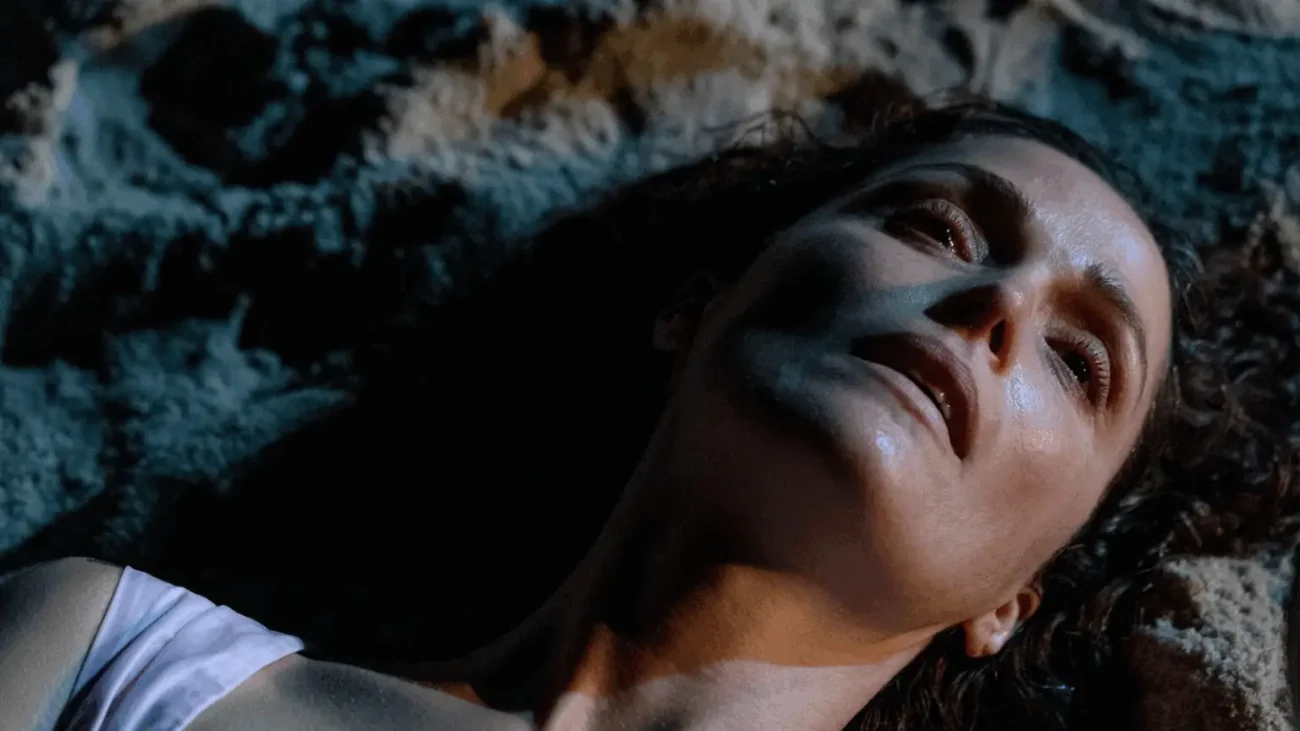
If I Had Legs I’d Kick You is Rated by Motion Picture Rating (MPA) for language, some drug use and bloody images.
If I Had Legs I’d Kick You opens with a howl disguised as laughter. Mary Bronstein’s latest film turns motherhood into a kind of cosmic trapdoor a hellhole both literal and psychological and Rose Byrne, giving the fiercest and most vulnerable performance of her career, tumbles straight through it. She plays Linda, an exhausted therapist and single parent (for now) to a daughter suffering from some vague but relentless gastrointestinal illness. Her husband, a ship captain, is away at sea; her apartment, ruptured by a burst pipe, is leaking from the ceiling. It’s as though the universe itself is conspiring to mirror her inner collapse.
The hole in her ceiling isn’t just a nuisance it’s a passageway to something like oblivion, a vast black expanse filled with shimmering stars and echoing voices, all calling for pieces of Linda she no longer has to give. It’s the kind of image that feels almost Jungian, as if Bronstein cracked open the floorboards of suburban anxiety and found a portal to the maternal unconscious. A second hole punctuates the film the one in her daughter’s abdomen, fitted with a feeding tube that becomes both lifeline and symbol, a reminder of the endless need surrounding Linda. “I’m one of those people who’s not supposed to be a mom,” she admits, and the film takes that confession seriously not as melodrama, but as existential recognition.
Highly Recommended: The Monster of Florence (2025) Parents Guide
The first scene sets the tone: Linda’s daughter calls her “stretchable” and sad, two words that could describe every mother in cinematic purgatory. Linda protests with a quivering smile, insisting she’s neither, even as her eyes betray her. Across from them sits the child’s doctor played by Bronstein herself exasperated that Linda can’t make the support groups or coax her daughter to fifty pounds, the magic number at which the feeding tube can finally go. But how do you get a child to eat when she won’t even touch a slice of pizza? Bronstein has said she drew on her own experience mothering a sick child, yet the film transcends autobiography. It’s less about a relationship than the psychic toll of caregiving that relentless erosion of self that leaves you feeling like vapor.
In an audacious move, Bronstein never shows the daughter’s face. She keeps the camera almost exclusively trained on Byrne, whose expression carries the film’s entire emotional geography the weary eyes, the flickers of panic, the moments when she tries to summon composure and fails. The effect is claustrophobic but revealing: the story becomes a study in containment, of what it costs to keep yourself from splintering.
Linda’s life is a balancing act that long ago lost its balance. By day she tends to patients at her cooperative office, the Center for Psychological Arts; by night she and her daughter live in a motel while the contractors fix the gaping wound in her apartment. The work halts for a week when one of them has to attend a funeral another tiny cruelty, another delay in a life defined by delays. Her husband (Christian Slater) checks in via disembodied phone calls warm enough to sound caring, distant enough to feel useless. He’ll be gone eight weeks in total, with five still to go. You can hear the clock ticking inside Linda’s mind.
So she slips away at night, leaving her daughter asleep in the motel room, to gulp down cheap wine from the cooler and smoke weed in the parking lot. The image is sad and defiant at once a woman trying to claw back a fraction of herself from the chaos. One night, she falls asleep watching Flesh-Eating Mothers (1988), a grotesque little horror flick about moms devouring their offspring. You don’t need a therapist to see the symbolism.
Recommend: 100 Nights of Hero Parents Guide
Speaking of therapists, Linda has one played, in a stroke of inspired casting, by Conan O’Brien. Gone is the impish talk-show host; in his place stands a therapist of unnerving calm and professional detachment. When Linda compares their sessions to “a series of cliffs with no end,” you feel her teetering on the edge of one. O’Brien plays him as someone who believes restraint is compassion, though to Linda it feels like abandonment. Her impatience boils over “There’s no thread,” she tells him, desperate for structure, for direction. “Tell me what to do.” He won’t. And so she transfers her craving for intimacy onto him, treating him like the substitute husband she wishes she had. When she whispers “I love you” as he exits the room, it’s both mortifying and heartbreaking the sound of a woman so starved for care that even professional distance starts to feel cruel.
Then there’s James, the motel superintendent, played with quiet warmth by A$AP Rocky another brief male presence, another temporary comfort she can’t quite accept. He’s gentle, patient; she’s curt, self-absorbed, occasionally cruel. She even abandons him after he falls through the apartment’s ceiling hole and breaks his leg. The universe is punishing everyone, it seems. And yet the apartment pulses with strange life bursts of light, firefly-like glimmers, a voice calling “Mom?” from nowhere. The supernatural edge never resolves into meaning; it just lingers, like grief or guilt. We learn nothing about Linda’s own mother, except through the ache in her voice.
Through it all, Byrne anchors the chaos. It’s a performance of unguarded intensity the kind that recalls Gena Rowlands in A Woman Under the Influence. Byrne, best known for her sharp comedic timing in Bridesmaids or Neighbors, or her haunted stillness in Insidious, channels both here. She’s funny, frantic, wounded, and occasionally unbearable but always human. Even at her most unhinged, you don’t recoil; you recognize her. She is every mother barely holding on, every person who’s ever loved past their limit.
Also Read: The Hand That Rocks the Cradle (2025) Parents Guide
Bronstein’s filmmaking mirrors Linda’s interior world jittery, restless, always on the verge of collapse. Her cinematographer, Christopher Messina (a Safdie Brothers collaborator), moves the camera like a nervous thought, darting and trembling but never losing focus. The Safdie connection runs deep: Bronstein’s husband, Ronald Bronstein, co-wrote and edited Good Time and Uncut Gems, and you can feel that lineage here — the same sense of anxious propulsion, but reframed through domestic madness instead of criminal chaos.
There are moments of absurd humor, too. When Linda’s daughter insists on a pet hamster, the creature later becomes a snarling, half-CGI menace after a fender-bender a surreal, hilarious outburst that feels like a nervous breakdown visualized. Bronstein walks that razor’s edge between farce and despair, and the laughter that erupts is always tinged with unease.
One of the film’s most harrowing sequences unfolds when one of Linda’s patients, played by Danielle Macdonald, leaves her baby behind during a session a small act of postpartum desperation. Linda, already late for her next appointment, is suddenly holding someone else’s crying child, caught between duty and panic. When her next patient (Daniel Zolghadri) barges in, demanding attention, she tries to offload the baby to her therapist neighbor O’Brien again, barely suppressing irritation. “Make a choice,” he tells the young man, but the line lands squarely on Linda. She must finally decide about her daughter, her life, her limits. The choice she makes leads to a finale so grotesque and shocking it elicits both laughter and nausea. You may not want to look, but you can’t turn away.
Bronstein isn’t interested in tidy resolutions. What she’s after is the unbearable pressure that defines modern motherhood the way love and guilt intertwine until they’re indistinguishable. You’re expected to do everything right, to never fail, to smile through exhaustion. And when you can’t, there’s no sympathy only judgment. If I Had Legs I’d Kick You stares into that abyss and doesn’t flinch.
Detailed Content Breakdown for Parents
Here’s a closer look at the kinds of content you’ll want to know about if you’re considering this film for yourself or your family.
Violence & Intensity: There are no standard “action-movie” fights, but the intensity comes from psychological stress, emotional breakdowns, and disturbing imagery. One review calls the ending a “nightmarish and squirmy outcome… among the most disgusting things I’ve seen this year.” The hole in the ceiling, strange lights and void-like sequences add a horror or thriller-tinged mood.The depiction of the child’s illness, medical interventions (feeding tube, doctor appointments) and the daily grind are realistically grim.
Because of this, while there isn’t graphic car-chase violence, the atmosphere is heavy and potentially disturbing.
Language: The film uses adult-level language (profanity is present). The official rating mentions “language”. It does not appear to hinge on slurs, but the tone is adult: the characters are distressed, frustrated, sometimes angry.Expect emotionally raw exchanges rather than sanitized dialogue.
Sexual Content / Nudity: There is no overt or gratuitous sexual content noted. The focus is on parental stress and psychological collapse rather than sex.Nudity does not appear to be a major factor in the reviews or guides. (Still, given the R-rating, there may be brief or mild scenes typical of adult dramas.)
Drugs, Alcohol & Smoking: Yes: Linda self-medicates. According to content guidance: she smokes pot, has motel-cooler wine, and there is talk of “I like cocaine!” in dialogue. The use is not glamorized; rather it is part of the portrait of a parent under pressure.As a parent, it’s worth noting that the depiction of substance use may suggest coping-mechanisms, not solutions.

Stephanie Heitman is a seasoned journalist and author dedicated to helping parents navigate the world of Hollywood entertainment through thoughtful, family-oriented film reviews. With over a decade of experience in writing and a passion for fostering safe, enriching viewing experiences, Stephanie launched Parentguiding.com to provide parents with the insights they need to make informed choices for their families.