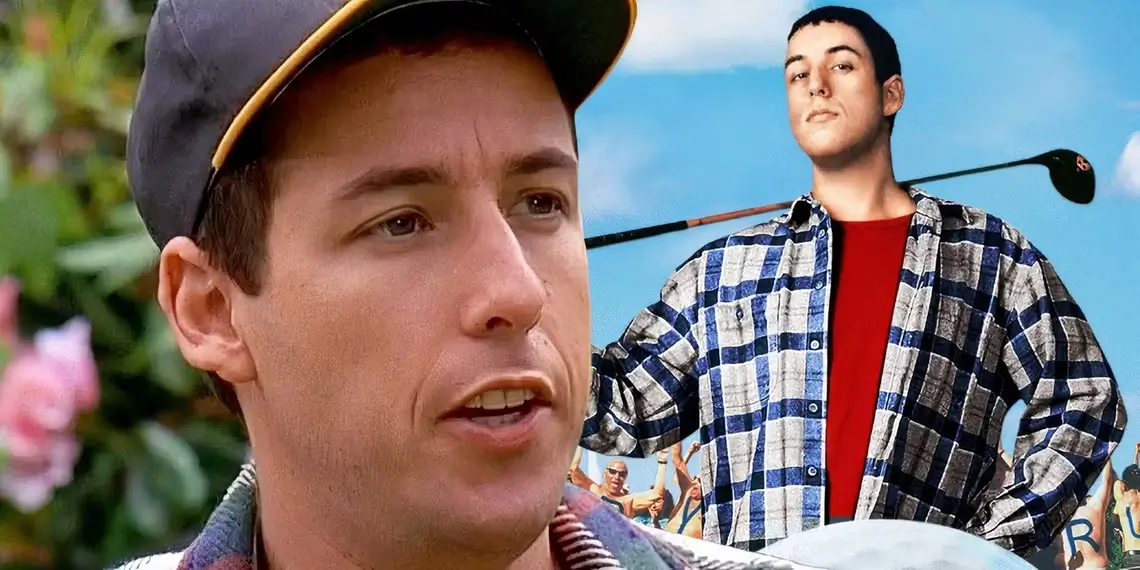
Happy Gilmore 2 is Rated PG-13 by Motion Picture Rating (MPA) for strong language, crude/sexual material, partial nudity and some thematic material.
The Story & What It Tries to Say
The story follows Happy Gilmore, now in his fifties and semi-retired from professional golf, living a modest, contented life with his longtime partner Virginia and their teenage daughter, Vienna. Once the brash outsider who revolutionized the PGA Tour with a hockey swing and hot temper, Happy has mellowed slightly. He’s still got a sharp tongue and a taste for the absurd, but fatherhood and time have softened him. That’s the first surprise: this isn’t just a rehash of the first movie’s antics. Happy Gilmore 2 is about legacy what we leave behind and how we reckon with the parts of ourselves we can’t quite shake.
When Vienna earns a spot in a prestigious ballet school an opportunity Happy never had growing up he’s thrilled. But there’s a catch: tuition costs are through the roof, and the Gilmore family doesn’t have that kind of cash lying around. Pride keeps Happy from taking Virginia’s advice to ask for help. Instead, he does what only Happy Gilmore would do he comes out of retirement to rejoin the professional golf circuit.
Naturally, chaos ensues. Happy’s return shakes up the staid, overly polished modern PGA Tour. He’s an odd fit in today’s sanitized sports world: his temper is still volcanic, his swing is still unorthodox, and his sense of humor is stuck in the early 2000s. But the crowds love him. Old fans chant his name, and new fans, including TikTok teens and golf influencers, rally around his authenticity. He’s not there to sell protein powder or push a betting app. He’s there to win for his daughter. Highly Recommended: The Naked Gun (2025) Parents Guide
Complications arise when his old rival Shooter McGavin now a smug, sharp-suited sports commentator decides to return to the green too, craving relevance and a rematch. Shooter’s presence reignites their rivalry, and McDonald plays him with delicious smarm. But here’s the twist: beneath the banter and showboating, there’s a weary mutual respect. They’re relics of the same era, clinging to a game that has evolved without them.
There’s also a subplot involving Happy’s new caddy, Oscar (played by Bad Bunny), a flamboyant and unpredictable figure who throws Happy’s already-chaotic game into further disarray. Their odd-couple dynamic provides comic relief, but it also pushes Happy to reassess how much control he really needs and how much he’s willing to trust others. It’s not just about golf. It’s about letting go.
The film takes a surprisingly emotional turn as Happy reflects on the loss of his mentor Chubbs (Carl Weathers, whose real-life passing is acknowledged with grace). Flashbacks and voiceovers allow Chubbs to remain a guiding presence. In one particularly touching sequence, Happy finds one of Chubbs’ old putters in a dusty golf bag, triggering a quiet moment of grief and gratitude. It’s handled with restraint, and it works.
The final tournament the film’s inevitable climax isn’t about beating Shooter or proving anything to the world. It’s about earning enough to support his daughter’s dream and showing her that resilience, even when messy and unconventional, matters. The last putt? It’s not the most dramatic shot of Happy’s career, but it’s the one that means the most. And in typical Sandler fashion, the moment is undercut with humor someone heckles, Oscar sneezes but the emotion still lands.
Thematic Reflection
Beneath its zany surface, Happy Gilmore 2 is about legacy, second chances, and the uncomfortable process of growing up even if you’re already technically grown. It asks, What do we owe the people who got us here? And more poignantly, What do we owe the people coming after us? The film explores the tension between nostalgia and evolution. Happy can’t be the same guy he was in 1996 but he doesn’t have to be. He just has to show up, do the work, and love his family fiercely.
There’s also something quietly profound about how it deals with grief Chubbs’ absence is a hole Happy feels deeply. It’s a reminder that aging means not only changing, but also saying goodbye. The film doesn’t dwell in sadness, but it doesn’t run from it either.
Does it succeed in what it’s trying to say? Mostly, yes. While some of the emotional beats are a little rushed or drowned out by slapstick humor, the sincerity still shines through. It’s a film that knows its audience but doesn’t pander. It winks at the past, but it’s not stuck there. That’s more than you can say for most legacy sequels.
Performances & Characters
Adam Sandler delivers exactly what we expect but with surprising warmth. He’s still crude, still fiery, but now more three-dimensional not just a heckler on the green, but a dad trying to redeem himself. Christopher McDonald shines as Shooter McGavin, his rivalry rekindled with playful nostalgia. Julie Bowen returns as Virginia with a mix of fond exasperation and grace, reminding us why she worked so well alongside Happy the first time.
Fresh faces like Bad Bunny (as messy caddy Oscar) and Travis Kelce (surprisingly natural on camera) add fun new dimensions. Kelce, according to McDonald, is “surprisingly good” . Sunny Sandler brings real sweetness as Vienna, grounding the film’s more outlandish comedy in genuine father-daughter chemistry.
Direction, Visuals & Pacing
Kyle Newacheck keeps things crisp and lively. The golf-course sequences are dynamic and visually playful—bright greens, quick cuts, slapshot slow‑mo moments that feel both sporty and comical. Editing by Brian Robinson and Tom Costain ensures the film never drags, balancing rapid-fire jokes with slower, reflective scenes, especially in montage sequences around family and memory.
There are standout visuals dreamlike flashbacks with Chubbs woven in, graceful ballet interludes, even goofy group-therapy framing. It’s a tonal mash-up of comedy, sports, and tender drama that mostly holds together.
Happy Gilmore 2 (2025) Parents Guide
Language & Tone: Expect strong language and mild profanity, with occasional swearing such as “s‑‑‑” and “a‑‑‑‑” thrown into punchlines or frustrations (a signature Sandler move). While the film plays it for laughs, there are enough colorful words that it won’t feel out of place for a PG-13 rating.
Sexual Content & Humor: There’s some cartoonish, grown‑ups‑jokes think quick innuendo, playful teasing, and a few light-hearted references to body parts or sexuality. Nothing explicit, but enough that you might chuckle quietly or raise an eyebrow.
Violence & Slapstick: Violence remains comedic and over‑the‑top: golf balls get whacked into heads, characters tumble down fairways, and there’s temper‑fueled scuffles. No real threats, no scary tension just silly chaos that’s more about laughs than gore.
Recommended for ages 13 and up, especially if your teen is into lighthearted sports comedies that don’t take themselves too seriously—but don’t mind a few off-color jokes and a tug at the heartstrings.
Final Thoughts & Recommendation
Happy Gilmore 2 is for fans of the original and anyone who enjoys warm, crowd-pleasing comedies with a bit of heart. It’s no daring reinvention, but it’s enthusiastic and surprisingly emotional while still delivering the punchlines we crave. The absence of Carl Weathers is felt, but the respectful tributes and narrative adjustments work.
If you want smart laughs without pretension, this one’s a solid 7/10 from me. It doesn’t change the game, but it’s a welcome reunion with a familiar friend with a fresh coat of paint and a family-centric purpose.
Film Details:
Director: Kyle Newacheck
Writers: Tim Herlihy, Adam Sandler
Stars: Adam Sandler, Margaret Qualley, and Julie Bowen
Release date: July 25, 2025 (United States)
Streaming Platform: Netflix
Country of origin: United States
Language: English

Stephanie Heitman is a seasoned journalist and author dedicated to helping parents navigate the world of Hollywood entertainment through thoughtful, family-oriented film reviews. With over a decade of experience in writing and a passion for fostering safe, enriching viewing experiences, Stephanie launched Parentguiding.com to provide parents with the insights they need to make informed choices for their families.