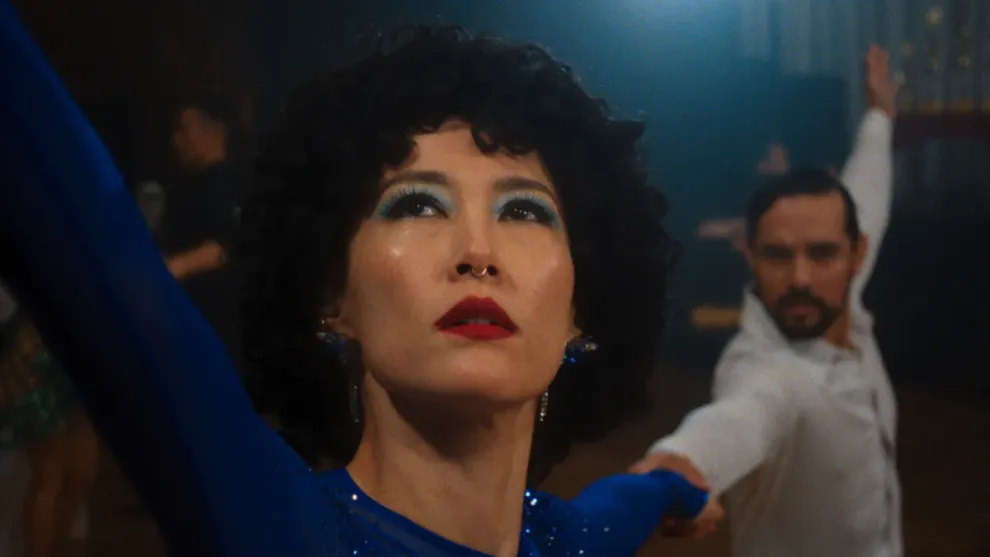
Haru or Ha-chan, as everyone who knows her calls her has a way of announcing herself to the world before she ever speaks. Rinko Kikuchi plays her with a tight, unapologetic perm, a septum ring that feels like a small act of rebellion, and bold, almost aggressive makeup that she wears for ballroom competitions. In another movie, she might be framed as an outcast, the proverbial nail begging to be hammered down by a rigid society. Japanese culture classes love to repeat that saying. But as co-writer and director Josef Kubota Wladyka makes clear in “Ha-Chan, Shake Your Booty!”, real life is slipperier, kinder, stranger, and far more complicated than tidy proverbs suggest.
This is Wladyka’s third feature, premiering at Sundance, and it carries a deeply personal undercurrent. The film is dedicated to his mother, a Japanese immigrant who raised Josef and his brothers alone and who, astonishingly, still competes in ballroom dancing at 81. The character of Haru isn’t a direct portrait, but you can feel the emotional lineage. The film seems to breathe with affection. That tenderness shows up in small, offbeat touches: the perky voiceover that introduces each chapter like a whimsical diary entry, or the plush raven mascot that becomes a physical manifestation of Haru’s grief. On paper, these details might sound precious, even irritating. (Some viewers will inevitably feel that way.) But Wladyka anchors them in something sturdier: genuine pain, recognizable loneliness, and a Tokyo that feels lived-in and multicultural rather than postcard-pretty.
Highly Recommended: Wonder Man (2026) Parents Guide
Despite the title and the premise, competitive dance isn’t actually the film’s central obsession. The opening is intimate, domestic, and disarmingly gentle. We meet Haru and her husband, Luis (Alejandro Edda), on the morning of a major competition. He cooks breakfast. They curl up with videos on a tablet. They practice each other’s languages Luis is Mexican, and their bilingual rhythm feels like its own private choreography. There’s an ease between them that’s hard not to envy. When they dress, take a cab, and arrive at the event, you already believe in the depth of their connection. On the dance floor, Haru looks almost weightless, euphoric with love for the music and the man in her arms. Then, without warning, the music cuts off in the cruelest way possible: Luis collapses, hand to chest, the world tilting with him.
It’s only after this devastating rupture that “Ha-Chan, Shake Your Booty!” truly begins. The film does include a pair of funeral scenes laced with dark comedy moments that might make fans of Juzo Itami smile in recognition but this isn’t a meditation on death itself. It’s about the exhausting, awkward, nonlinear business of continuing to live. Of figuring out what comes after. The film flirts with a “just keep dancing” message, and yes, that idea can veer toward the saccharine. But Wladyka undercuts the neatness of that theme by steering the story somewhere messier, more bodily, more uncomfortable. The movie mutates into something unexpected: a boldly contemporary sex comedy, driven by grief as much as by desire.
Nine months after Luis’s death, Haru can’t even bring herself to attend her own birthday party. That’s the point where her friends, Hiromi (You) and Yuki (Yoh Yoshida), intervene. They quite literally drag her out of bed and deposit her in a Latin dance class, an act of love disguised as exasperation. There, Haru meets Fedir (Alberto Guerra), a globe-trotting ballroom champion who seems to treat both the dance floor and the bedroom as professional arenas. Haru’s infatuation hits like a fever. It’s not subtle, and it’s not dignified, and that’s exactly the point.
Highly Recommended: Return to Silent Hill (2026) Parents Guide
The conversations between Haru and her friends about Fedir’s open marriage are especially telling. They quietly sketch a world that feels genuinely international one where ideas circulate across borders, but not without friction. Open relationships aren’t mainstream in Japan, but in urban, bohemian pockets they’re hardly unthinkable either. Haru wants to believe she can handle this arrangement. She wants to be modern, liberated, unbothered. Of course, she can’t. Watching her tie herself in emotional knots, pretending she’s fine with a situation that’s clearly wounding her, becomes both painful and darkly funny. The resulting chaos escalates into a series of increasingly absurd misadventures, but they’re rooted in something achingly familiar: the lies we tell ourselves when we’re desperate not to feel alone.
Visually and culturally, the film operates with a sensitivity that feels rare. The aesthetic of “Ha-Chan, Shake Your Booty!” is all about appreciation rather than appropriation. Haru’s love for Latin dance, Latin music, and the film doesn’t shy away from this Latin men, is portrayed as sincere and informed, not as a shallow costume she slips into. Her apartment is warm and crowded with objects that look like souvenirs from real journeys. The soundtrack is a carefully woven tapestry: Japanese city pop, ’90s alt-rock, tango, bluegrass. It’s eclectic without feeling like a Spotify algorithm. When Haru brings Fedir to a stage musical adaptation of “Dirty Dancing,” the moment where the cast belts out “I’ve Had the Time of My Life” in Japanese is undeniably played for humor but it’s affectionate humor, never cruel. The joke is shared, not aimed.
What really holds all of this together is Kikuchi. Watch her face during that “Dirty Dancing” performance: the expression isn’t ironic or detached, but open, childlike, genuinely thrilled. Whenever the film’s quirkiness threatens to eclipse its emotional core, Wladyka smartly cuts back to her, trusting her presence to recalibrate the tone. Even when the film indulges in fantasy sequences where characters burst into song and dance like they’ve wandered into an old Hollywood musical, Kikuchi keeps us grounded. She draws us into Haru’s chaotic inner world — the longing, the confusion, the self-sabotage. You root for her not because she’s making good choices, but because she feels so painfully, recognizably human while making bad ones.
In some respects, this film feels like a sharp turn away from Wladyka’s previous feature, “Catch the Fair One,” a brutal revenge thriller anchored by boxer Kali Reis. The tonal distance between the two films is enormous. Yet there are connective threads. Both center on fiercely driven women pursuing something with tunnel vision. The stakes here are smaller, more intimate heartbreak instead of survival but that doesn’t make them trivial. And in both films, Wladyka demonstrates a keen control of tone. That control is crucial. Without it, “Ha-Chan, Shake Your Booty!” could easily collapse under the weight of its own tonal shifts. With it, the film moves with surprising grace. It stumbles, recovers, spins, and keeps time with its own peculiar rhythm.
As of now, “Ha-Chan, Shake Your Booty!” is still seeking distribution. One hopes it finds a home not just because it’s charming or unusual, but because it feels sincerely invested in the emotional lives of its characters. It’s a film that understands how ridiculous grief can make us, how embarrassing desire can be, how clumsy the act of surviving often looks from the outside. And it treats all of that with humor, compassion, and an unexpectedly tender heart
Ha-Chan, Shake Your Booty! Parents Guide
Not Rated by the Motion Picture Association (MPA)
Violence & Intensity: There is no conventional violence, but the film does open with a sudden medical emergency when a character collapses and dies. It’s a jarring moment, handled without gore but with real emotional force. Much of the intensity comes from what follows: sustained depictions of grief, loneliness, and emotional unraveling. The tone can swing between sorrowful and darkly comic, yet the emotional weight never really lifts. Sensitive viewers, especially younger ones, may find this distressing.
Language: There are no slurs used in a hateful way. The overall tone is candid and sometimes blunt, particularly when characters talk about sex and relationships.
Sexual Content / Nudity: Characters discuss sexual desire openly, and the plot includes themes involving an open marriage. There is strong sexual tension and clear implication of sexual encounters, though the film generally avoids explicit imagery. The emphasis is more on emotional need and confusion than on physical display, but the subject matter is unquestionably adult and not filtered for younger viewers.
Drugs, Alcohol & Smoking: There is no significant depiction of drug use, and smoking is minimal to nonexistent.
Age Recommendations: It is best suited for adults and older teens who are comfortable engaging with complex emotional material.

Stephanie Heitman is a seasoned journalist and author dedicated to helping parents navigate the world of Hollywood entertainment through thoughtful, family-oriented film reviews. With over a decade of experience in writing and a passion for fostering safe, enriching viewing experiences, Stephanie launched Parentguiding.com to provide parents with the insights they need to make informed choices for their families.