Goodbye June is Rated R by Motion Picture Rating (MPA) for language.
There’s a single scene early in Goodbye June in which Kate Winslet, slumped in a hospital hallway, murmurs something like, “If someone asked me what this feels like sitting here, waiting for someone to die I don’t think I could put it into words.” It lands for a moment, because anyone who’s lived through anticipatory grief knows that peculiar fog, that sense of being suspended above your own life. But then a realization creeps in: describing that feeling is, in fact, the film’s entire job. Winslet, who not only stars but steps behind the camera, never quite manages to give language or cinematic shape to the emotional terrain she gestures toward. The film keeps insisting it understands the weight of its situation, but you can sense it fumbling for depth it never reaches.
Highly Recommended: Fackham Hall Parents Guide
Written by Winslet’s son Joe Anders, Goodbye June belongs to a long lineage of stories about gathering around a dying parent. Hollywood likes to treat these moments as emotional scavenger hunts everyone reassembles, digs up buried resentments, and emerges with some glossy revelation about love or forgiveness. At least, that’s the hope. The theory. The ideal version projected onto a Christmas backdrop and wrapped in soft lighting.
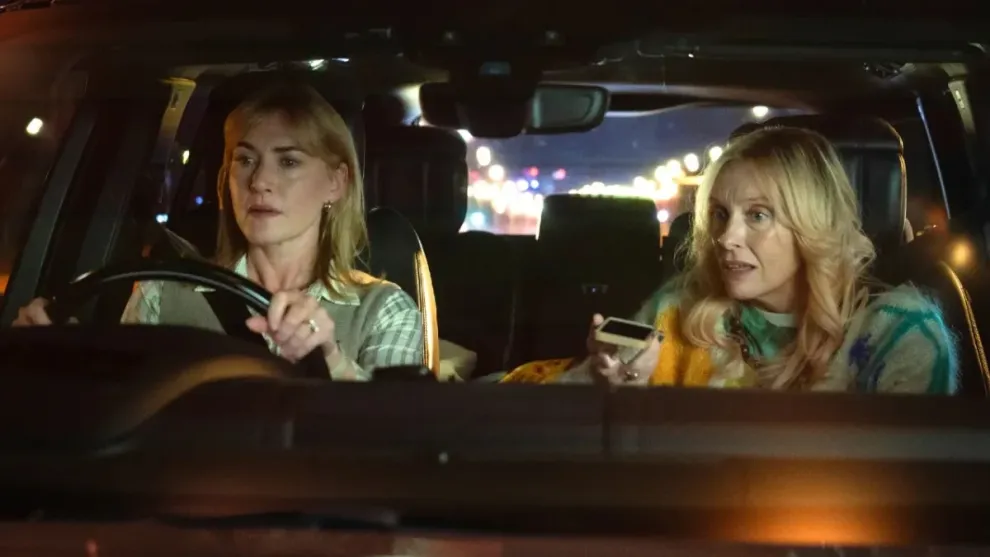
Here Winslet plays Julia, a career-driven mother so stretched thin she looks moments away from unraveling. Andrea Riseborough is Molly, her stay-at-home sister, similarly overwhelmed in a different key. Johnny Flynn rounds out the trio as Connor, the brother who isn’t so much adrift as marooned living with their parents, unemployed, and ruled by inertia. And then there’s Helen, played with characteristic gusto by Toni Collette, whose free-spirited, crystal-waving guru persona is meant to provide levity. The film seems convinced she’s funny. You may find yourself gently disagreeing.
Hovering over them is June, their mother, brought to life by Helen Mirren. She collapses in the opening minutes and is whisked to a hospital bed from which she won’t return. Doctors can only offer comfort care, so the clan gathers, drifting in and out of her room like mourners rehearsing for a moment that hasn’t quite arrived. Tears are shed. Sentimental lines float around the air. Lifelong grudges dissolve with almost magical ease Julia and Molly’s years of resentment undone by a Snickers bar and a story about sandals. Connor’s long-simmering tension with their father, Bernie (Timothy Spall), evaporates through a brisk montage, the kind of shorthand you can practically hear a screenwriter using to save time.
Highly Recommended: Merv (2025) Parents Guide
It’s not that these characters lack relatable struggles. It’s that the film sands down their edges so thoroughly that nothing feels specific. In an attempt to make the story universal, it flattens everyone into dullness. You never get the sense these people existed before the movie or will continue after it. Their lives orbit one event two weeks of slow decline and the film seems content to treat that stretch as the sum total of who they are. As viewers, we keep waiting for the novel we were promised, only to be handed a pamphlet.
And yet Goodbye June doesn’t feel cynical. Far from it. You can sense the sincerity behind it, the attempt by Winslet, Anders, and the ensemble to craft something gently comforting. But something is misaligned. Consider a brief but telling moment: a nurse, played by Fisayo Akinade, lifts June into bed. The camera stays over his shoulder until her face contorts in pain; then it rushes in, uncomfortably close, as if her suffering is the shot worth capturing. The moment her grimace fades, the camera withdraws. You can almost feel the film revealing its priorities pain equals drama; absence of pain equals irrelevance.
Highly Recommended: Influencers (2025) Parents Guide
What we’re given isn’t a study of grief so much as an emotional sightseeing tour. We’re tourists wandering through someone else’s sorrow, touching nothing, learning little. Even within the family, emotional participation is optional. Julia and Molly’s husbands appear so rarely they might as well be names on a sign-in sheet. Their children hover in the background like props present but spiritually blank. The youngest ones, sure, might not grasp the gravity of the situation, but the older kids? Their composure doesn’t suggest resilience so much as narrative neglect. They function mainly as logistical headaches for the adults, not as people living through the loss of a grandmother.
For a film built on towering emotions, Goodbye June is oddly difficult to feel anything about. It isn’t a failure in the conventional sense nothing here is egregiously wrong but it never reaches beyond competence toward something real. Stories about slow, painful goodbyes have existed for as long as cinema, and Winslet and Anders don’t seem especially interested in digging for the unexplored caverns of that experience. The result is a Christmas tearjerker that never quite earns a tear. Not tragic. Not even particularly sad. Just muted.
Content Breakdown for Parents
Violence & Intensity: There’s no violence in Goodbye June in the traditional sense no fights, no weapons, nothing alarming on a physical level. The intensity comes entirely from the emotional terrain. Much of the film takes place in a hospital room where June’s decline is shown with quiet realism: labored breathing, discomfort, and the stillness that settles around a loved one in pain. A few arguments between siblings bubble over into shouting, but the film avoids melodramatic fireworks. What may challenge younger or more sensitive viewers is the sheer emotional gravity of watching adult children brace themselves for their mother’s death. It’s raw in places, but never graphic.
Language: The language is what pushes the film comfortably into R-rated territory. While it’s not wall-to-wall profanity, characters do let frustration slip out in the form of several F-words and sharp verbal jabs during tense exchanges. The tone of the language reflects the stress these characters are under snippy, defensive, occasionally harsh. The profanity isn’t used for humor or shock value; it mostly emerges when years of unspoken resentment finally boil over.
Sexual Content / Nudity: Sexual content is minimal to nonexistent. There are no nude scenes and no sexual behavior depicted onscreen. The closest the film comes to touching on intimacy is in a few hushed conversations about strained marriages or emotional distance between spouses, but the film keeps the focus firmly on family dynamics rather than romantic ones. Parents concerned about explicit content won’t find much to worry about here.
Drugs, Alcohol & Smoking: Alcohol appears here and there, usually in the form of a glass of wine during long, late-night conversations when everyone’s nerves are frayed. A couple of characters smoke on occasion, usually outside the hospital, in that familiar “I just need air” kind of way. There’s no illegal drug use, and the film doesn’t glamorize drinking or smoking; they’re portrayed as coping mechanisms more than lifestyle habits. Still, younger teens may pick up on the idea of adults reaching for substances during stressful moments.

Stephanie Heitman is a seasoned journalist and author dedicated to helping parents navigate the world of Hollywood entertainment through thoughtful, family-oriented film reviews. With over a decade of experience in writing and a passion for fostering safe, enriching viewing experiences, Stephanie launched Parentguiding.com to provide parents with the insights they need to make informed choices for their families.