| Category | Verdict |
|---|---|
| Official Age Rating | R (lRestricted |
| Safe for 10-Year-Olds? | No. Not recommended. |
| Safe Age Recommendation | 16–18+ with parental guidance |
| Why? | Graphic violence, disturbing themes, sexual content, strong language |
| Worth Watching? | Yes but for mature teens and adults only. |
The bottom line: Fight Club is one of the most influential films of the late 1990s. It’s bold. It’s messy. It’s brilliant. And it is absolutely not appropriate for a 10-year-old.
The film dives deep into identity crises, toxic masculinity, anti-consumerism, and mental instability. Those ideas alone are heavy. Add in brutal bare knuckle fights, disturbing imagery, explicit language, and sexual situations, and you’ve got a movie that most elementary-age kids simply aren’t ready to process.
I remember seeing Fight Club during a late-night screening years ago when I was covering cult films. The audience laughed nervously during the first fight scene. By the final act, the theater had gone silent people were genuinely shaken. That reaction tells you a lot about the movie’s intensity.
For adults? It’s a fascinating watch.
For a 10-year-old? Hard pass.
Deep-Dive Plot Summary
Act 1: The Man Who Can’t Sleep
The movie opens with a gun literally inside the narrator’s mouth.
Yes. That’s the tone.
Then the film rewinds to explain how things got there.
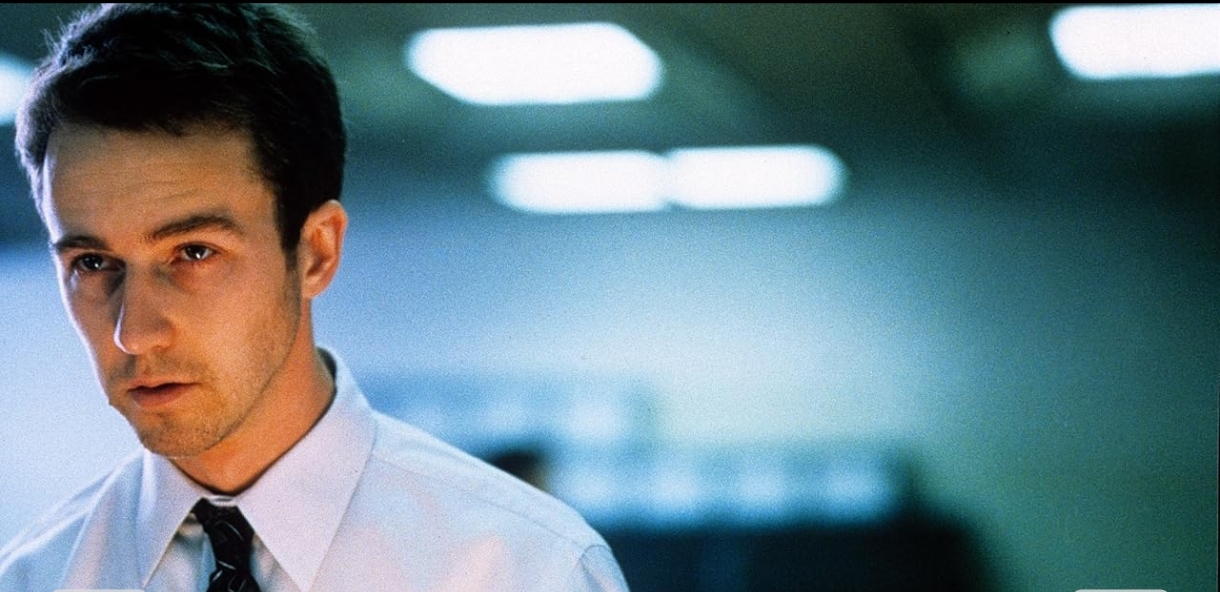
Edward Norton plays an unnamed narrator, an office worker trapped in a soul-crushing corporate job. His life revolves around catalog furniture and meaningless routines. He suffers from severe insomnia. The kind where days blur together.
He tries everything.
Doctors dismiss him.
Therapy doesn’t help.
Finally, he finds relief in an unexpected place: support groups for people with serious illnesses.
He pretends to have testicular cancer. Then brain parasites. Then blood diseases.
It sounds twisted. But crying with strangers helps him sleep.
That fragile routine collapses when he meets Marla Singer Helena Bonham Carter. She’s another fraud attending the same support groups. Their presence ruins the illusion for each other.
No illusion means no sleep.
And the narrator starts falling apart again.
Act 2: Enter Tyler Durden
Everything changes on a business trip.
The narrator meets Tyler Durden Brad Pitt a charismatic soap salesman with anarchist ideas and zero respect for society’s rules.
Tyler is everything the narrator is not.
Confident. Reckless. Magnetic.
Soon after their meeting, the narrator’s apartment mysteriously explodes. His entire Ikea-perfect life disappears overnight.
With nowhere to go, he calls Tyler.
They meet in a bar.
Outside the bar, Tyler says something strange:
I want you to hit me as hard as you can.
And just like that, Fight Club is born.
At first, it’s just the two of them. Punches thrown in a parking lot.
But word spreads.
Soon dozens of men gather in a basement to beat each other senseless.
The rules are simple:
- First rule: You do not talk about Fight Club
- Second rule: You do not talk about Fight Club
- Fights go on as long as they have to.
The club becomes a release valve for frustrated men drowning in modern life.
Bruised faces. Broken teeth.
And strangely… freedom.
Act 3: Chaos Spreads
Fight Club evolves.
Tyler turns it into something bigger. Something darker.
He forms Project Mayhem, an underground movement dedicated to tearing down consumer culture.
Members shave their heads.
They live together like soldiers.
They carry out bizarre acts of vandalism:
- Destroying corporate art
- Sabotaging businesses
- Threatening executives
Tyler’s speeches become more extreme. More cult-like.
The narrator begins to feel uneasy. He created this world with Tyler, but now it’s spinning out of control.
Meanwhile, Tyler grows closer to Marla. Their relationship is loud, chaotic, and sexual something the narrator finds both disturbing and confusing.
Then things escalate.
A member of Fight Club dies during an operation gone wrong.
The narrator finally realizes this isn’t rebellion anymore.
It’s something far worse.
ENDING Explained: The Final Twist and What It Means for the Sequel
The final act of Fight Club delivers one of the most shocking twists in modern cinema.
Let’s break it down.
Throughout the film, Tyler Durden seems like a separate person. He travels independently, gives speeches, and leads Project Mayhem.
But slowly, clues appear.
People talk to the narrator like he is Tyler.
Security footage shows something strange.
Memories start conflicting.
Then comes the reveal.
Tyler Durden isn’t real.
He’s a split personality created by the narrator’s fractured mind.
Everything Tyler did every fight, every speech, every act of sabotage was actually done by the narrator himself.
Tyler represents the narrator’s suppressed desires:
- Freedom from corporate life
- Aggression
- Rebellion
- Total rejection of society
In psychological terms, Tyler is an extreme manifestation of dissociative identity disorder.
Once the narrator realizes the truth, he tries desperately to stop Project Mayhem.
But Tyler’s followers don’t see the difference.
To them, he is Tyler.
And the plan is already in motion.
The goal? Destroy major credit card company buildings to erase debt and reset the financial system.
The narrator confronts Tyler in a mental showdown. They fight though from an outside perspective, he’s fighting himself.
Finally, he does the only thing he can think of.
He shoots himself.
Not to die.
But to kill Tyler.
The bullet passes through his cheek, symbolically destroying the alter ego.
Tyler disappears.
The narrator survives.
Then comes the final image.
He holds Marla’s hand.
Together, they watch as multiple skyscrapers collapse in the distance Project Mayhem’s plan unfolding anyway.
It’s equal parts victory and defeat.
Tyler is gone.
But the chaos he created can’t be undone.
What About the Sequel?
Many fans don’t realize this, but Fight Club does have a sequel story, though not in film form.
Author Chuck Palahniuk released Fight Club 2, a graphic novel continuation.
In that story:
- The narrator now named Sebastian is living a medicated suburban life.
- Marla wants Tyler back because life feels boring without him.
- Tyler returns as a psychological force.
The sequel explores a disturbing question:
Was Tyler actually destroyed or just sleeping?
That ambiguity is part of why the original film remains so powerful.
Parents Guide Breakdown
| Content Category | Intensity 1–10 | What Parents Should Know |
|---|---|---|
| Violence | 9/10 | Frequent brutal fistfights with blood, broken teeth, and injuries. One character dies during a violent operation. Graphic self-harm moment near the end. |
| Language | 8/10 | Constant strong profanity including the F-word and other harsh language. |
| Sexual Content | 6/10 | Several sexual scenes between Tyler and Marla. Explicit dialogue and suggestive sounds. |
| Positive Messages | 4/10 | Themes about rejecting consumer culture and questioning identity, but delivered through destructive and violent behavior. |
Biggest Concern for Kids
The real issue isn’t just violence.
It’s the philosophy behind the violence.
Young viewers may misunderstand the movie as glorifying chaos and aggression instead of seeing it as a critique.
That nuance is something most 10-year-olds simply don’t have yet.
Screen Safety Tips & Parental Controls
If you’re planning to watch Fight Club at home, especially with teens, it’s smart to control how and where it’s accessed.
Where the Movie Streams
Depending on your region, Fight Club appears on platforms like:
- Amazon Prime Video
- Hulu
- Apple TV
- Disney+ Star catalog in some regions
Using Parental Controls
Most platforms allow content filtering.
For example:
Amazon Prime Video
- Open Account Settings
- Select Parental Controls
- Set a Viewing Restriction PG-13 or below
- Add a PIN code
This prevents younger kids from launching R-rated films like Fight Club.
Using a VPN for Geo-Locked Libraries
Sometimes a movie isn’t available in your region. That’s where a VPN can help access different streaming libraries.
Parents often use VPNs to:
- Access alternate catalogs
- Maintain privacy
- Control family browsing safety
Look for a VPN that offers:
- Fast streaming servers
- Parental safety features
- No-log policies
Search terms like “Best VPN for streaming platforms” often point to services optimized for high-definition playback.
Cast & Performance Analysis
This movie works because the cast commits fully.
No half measures.
Edward Norton The Narrator
Norton delivers a career-defining performance. His character begins as a hollow corporate drone and slowly fractures under pressure.
Watch his body language early in the film. Shoulders slumped. Voice tired.
By the final act, he looks like a man fighting a war inside his own skull.
It’s unsettling in the best way.
Brad Pitt Tyler Durden
Let’s be honest.
Brad Pitt steals the movie.
Tyler Durden is magnetic, funny, and terrifying all at once. Pitt plays him like a cult leader mixed with a rock star.
Every line feels quotable.
Every entrance commands the screen.
But the genius of the performance is subtle: Tyler represents wish fulfillment, which is why audiences find him so appealing even when he’s clearly dangerous.
Helena Bonham Carter Marla Singer
Marla is chaos in human form.
Helena Bonham Carter brings raw unpredictability to the role. She’s messy, sarcastic, emotionally unstable — yet strangely sympathetic.
She’s also the only character who seems to instinctively sense something is off about Tyler.
Cinematography & Direction
Director David Fincher creates a gritty, grimy visual style.
Highlights include:
- Dark green color grading
- Unusual camera movements
- Surreal CGI sequences (like the famous Ikea apartment breakdown)
Some of the late-90s digital effects look a bit dated now.
But the atmosphere still hits hard.
Movies Like Fight Club If You Want Something Similar
If Fight Club grabbed your attention, these films explore similar themes.
1. American Psycho 2000
A dark satire about consumerism and identity.
Also extremely violent.
Age Rating: R
2. Joker 2019
Another character study about alienation and societal pressure.
Less philosophical but emotionally intense.
Age Rating: R
3. The Matrix 1999
Released the same year, but explores identity and reality in a more accessible sci-fi way.
Age Rating: R though many teens watch it earlier
FAQ: People Also Ask
Why is Fight Club rated R?
Because of graphic violence, strong language, sexual content, and disturbing themes involving mental illness and anti-social behavior.
Can a 13-year-old watch Fight Club?
Possibly with parental guidance, but many parents prefer waiting until 15–16+.
The themes are complex and intense.
Is Fight Club actually about toxic masculinity?
Partly, yes.
The film critiques how frustrated men sometimes channel identity crises into aggression and cult-like movements.
Is the violence realistic?
Very.
There are no superhero punches here. Fights are messy, painful, and often disturbing.
Is Fight Club still worth watching today?
Absolutely.
More than 25 years later, it still sparks debates about identity, capitalism, and masculinity.
Few movies leave audiences arguing this much after the credits roll.
Final Thoughts
Here’s the thing about Fight Club.
It’s not a simple action movie about men punching each other.
It’s a psychological time bomb disguised as one.
The film asks uncomfortable questions:
- What happens when people feel invisible?
- What if society’s rules suddenly stop mattering?
- How far can rebellion go before it becomes destruction?
For adults, it’s a fascinating sometimes disturbing piece of cinema.
For kids?
It’s simply too much, too soon.
If you’re building a movie night for younger viewers, there are far better options.
But if you’re ready for a dark, thought-provoking ride… Fight Club still hits like a punch to the jaw.

Stephanie Heitman is a seasoned journalist and author dedicated to helping parents navigate the world of Hollywood entertainment through thoughtful, family-oriented film reviews. With over a decade of experience in writing and a passion for fostering safe, enriching viewing experiences, Stephanie launched Parentguiding.com to provide parents with the insights they need to make informed choices for their families.