Eternity is Rated PG-13 by Motion Picture Rating (MPA) for sexual content and some strong language.
When you settle in for a grand, old-fashioned heterosexual romance, the script usually funnels you into one of two dependable endings: either the lovers stroll off into the sunset, or fate yanks them apart in some operatic tragedy. Eternity, David Freyne’s buoyant and slightly mischievous new film, grins at that binary and asks, almost with a wink, “Why not both?” There’s a sly glee in the way he poses the question, the same sort of energy you feel when a meme nails a truth you didn’t realize you’d been circling.
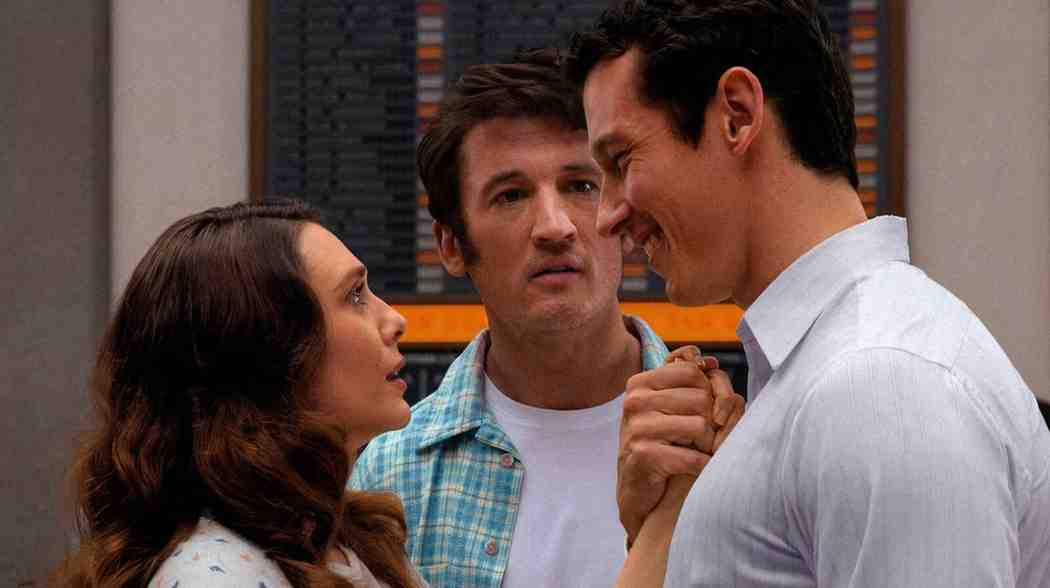
Freyne’s screenplay written with Patrick Cunnane stirs these time-tested melodramatic beats into something part romance, part afterlife farce, with a faint aftertaste of Defending Your Life. Miles Teller plays Larry, a steadfast husband who devoted 65 years to making his wife, Joan (Elizabeth Olsen), feel seen, loved, understood. His death is absurdly mundane he chokes on a pretzel, of all things and suddenly he’s in the afterlife, youthful again and itching to find Joan. But when he arrives, he discovers he’s not the only man waiting for her. Her first husband, the effortlessly handsome Luke (Callum Turner), died in “the war.” The movie makes a whole running joke out of which war that might actually have been, and you can feel the cast having fun with its vagueness.

Highly Recommended: The Beast in Me (2025) Parents Guide
Once Joan finally appears on the other side, a new battle ignites less a cosmic showdown than a romantic turf war. Two men, equally convinced of their right to spend eternity with her, clash in a place that was never meant to host anything more volatile than indecision. That Freyne turns all this into a breezy, sweet-natured comedy is part of the film’s charm; he knows this tug-of-love story could have curdled, but instead it feels alive, impish, even tender.
Forget the pearly gates you’ve seen in a hundred religious dramas or the baroque grotesquerie of Burton’s Beetlejuice. Freyne imagines the afterlife as a kind of bureaucratic purgatory like someone fused a train station with an outpatient clinic and didn’t bother to decorate. It’s aggressively plain: white walls blending into white corridors that spill into generic hotel rooms and a convention-center sprawl. But that drabness is the point. This is not a world anyone is meant to live in; it’s a cosmic waiting area where you choose the landscape in which you’ll spend forever.
As soon as Larry checks in, he’s paired with his afterlife counselor, Anna (Da’Vine Joy Randolph), who explains the rules with the weary flourish of someone who has been through this conversation thousands of times. You pick a destination, she tells him, and that choice is permanent. No returns, no exchanges, no wandering soul searching for a loophole. The options are playfully extravagant mountains, oceans, art museums, outer space. There’s even an alternate 1930s Germany dripping with cabaret glamour but devoid of Nazis, a cheeky slice of wish-fulfillment. If capitalism is your religion, there’s a world for that too. And those with faith-based preferences can opt into the afterlife they spent their lives picturing.
Highly Recommended: Murder at the Embassy Parents Guide
Most of these choices drift humorously around the edges of the film advertised on posters, hawked by overeager “representatives” desperate to snag new clients. But the heart of the movie belongs to Larry and Luke’s escalating rivalry.
The contrast between the two men is delicious. Luke is smooth, gentle, and perfectly timed he knows exactly when to execute a gallant gesture. Larry, meanwhile, is a prickly old soul trapped in a rejuvenated thirty-something body, impatient in ways that make him both exasperating and endearing. Luke can sweep Joan up with the finesse of someone who has studied old Hollywood romances; Larry, grinning like a man who’s rediscovered his knees, proudly demonstrates that their bodies can now squat without complaint. You can practically hear the audience chuckling at the way Teller throws himself into the motion.
Cunnane and Freyne use this contrast to nudge at the glossy fantasy of love versus its often awkward, stubborn, imperfect reality. Olsen channels a sparkling, grandmother-reborn energy she glows as the object of two men’s devotion, but she’s even better when Joan’s patience runs thin. She plays Joan as someone torn not just between men, but between two philosophies of love. Turner matches her sweep-for-sweep in the classic romance mode, yet he’s also game for the slapstick scraps he shares with Teller. Teller, for his part, leans fully into the comedic bruises; Larry becomes the guy who will take any punchline, even the ones about the war that claimed Luke, if it keeps him in the fight.
Highly Recommended: Playdate (2025) Parents Guide
Randolph, known lately for the emotional heft of The Holdovers and her gritty detective stint in Only Murders in the Building, taps into a much sillier register here. Her Anna has guided so many souls toward their customized eternities that she’s grown cynical, but when she sees Larry’s devotion, something inside her sparks. Suddenly she’s rooting for him, trying subtly, then not so subtly to tilt the scales in favor of the underdog.
Opposite her is Ryan, played by John Early (fresh off his own TIFF buzz for Maddie’s Secret). As Luke’s counselor, Ryan is ambitious in the way only a man who has waited 67 years for his two favorite clients to reunite can be. He’s not letting Larry upend the reunion he’s been envisioning since mid-century. Their dynamic becomes a delightful miniature comedy about workplace turf and cosmic office politics. Randolph and Early wring every petty power move for laughter, often stealing scenes with nothing more than a well-timed glare or an overly enthusiastic sales pitch.

Even their uniforms the bland beige suits, the crisp white shirts, the punchy red ties serve as visual jokes, blandness set against a world exploding with saturated reds, greens, blues, and golds. The film is gorgeous in a postcard sort of way; every vista feels dialed up a few degrees from reality, as though this realm has been painted with richer pigments than the ones we get on Earth. And in that lush palette, the human touches flushed cheeks, wet eyelashes hit with extra force. When Joan faces the decision of her eternity, those subtle details carry an unexpected emotional weight.
Content Breakdown for Parents
Violence & Intensity — Low to Mild: The “death by pretzel” moment is played for comedy, not shock.Larry and Luke engage in a few physical tussles—more slapstick than threatening.No gore or realistic violence.Emotional tension forms the bulk of the “intensity,” especially around Joan’s decision.
Language — Mild: Occasional light profanity (“hell,” “damn,” etc.)Some snarky insults between rival love interests.No slurs or harsh verbal attacks.
Sexual Content / Nudity — Mild to Moderate: Flirty banter and romantic longing.One or two mildly suggestive jokes about afterlife bodies feeling “brand new.”No explicit sex scenes; kisses are affectionate and tasteful.Themes revolve around love, not lust.
Drugs, Alcohol & Smoking — Minimal: A couple of scenes show wine or cocktails in the background.No drug use, no smoking.
Parental Concerns
The entire plot revolves around death, albeit handled playfully. Sensitive kids may struggle with that. Some jokes lean slightly risqué nothing explicit, but not PG-rated innocence either. The love triangle may raise questions about remarriage, grief, loyalty, and “who you love most,” which could spark big conversations at home. For most teens, none of this will be surprising, but younger children may feel overwhelmed.
In the end, Eternity manages something tricky: it gently spoofs the clichés of romantic comedies without sneering at the people who cherish them. The duel between two forms of love storybook idealism and the messier, more lived-in devotion gives the film real tension. The narrative detours veer from zany to sensual to warmly sentimental, while the afterlife conceit lets Freyne slip in jokes that would never fly in a standard rom-com.
Eternity premiered at the Toronto International Film Festival and arrives in theaters Nov. 26.

Stephanie Heitman is a seasoned journalist and author dedicated to helping parents navigate the world of Hollywood entertainment through thoughtful, family-oriented film reviews. With over a decade of experience in writing and a passion for fostering safe, enriching viewing experiences, Stephanie launched Parentguiding.com to provide parents with the insights they need to make informed choices for their families.