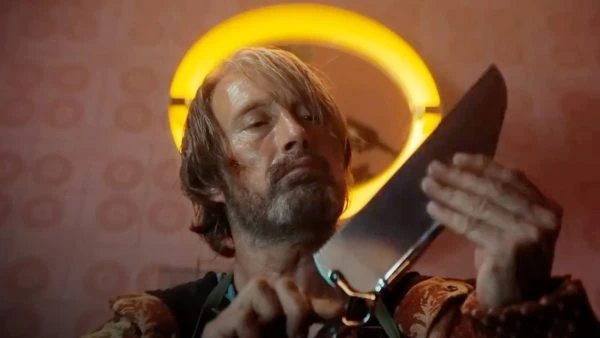
Dust Bunny is Rated R by Motion Picture Rating (MPA) for some violence.
Bryan Fuller has spent his career walking a tightrope between the whimsical and the gruesome, and Dust Bunny may be his most elegant, deranged dance across that line yet. Long before this film, he’d already marked the television landscape with stories that treat death as both a playground and a wound. Back in 2003, he delivered Dead Like Me, a sneaky heartbreaker wrapped in sardonic humor, all centered on a young woman whose premature end recruits her as a grim reaper barely equipped to handle her own afterlife. Not long after, he gifted us Pushing Daisies, a candy-colored fable that folds murder mysteries into a love story so delicate you feel you might bruise it just by watching a pie maker who can resurrect the dead, and the girl he loves but must never touch again. He later plunged into shadowier terrains with Hannibal and American Gods, pushing myth and monstrosity into mesmerizing extremes.
With Dust Bunny, Fuller returns to fairytale terrain though in his hands, “fairytale” means tender, eccentric, and absolutely, delightfully unhinged.
Highly Recommended: Five Nights at Freddy’s 2 Parents Guide
The premise alone has a mischievous sparkle: a girl hires a hitman to kill the monster lurking beneath her bed. Fun enough on paper but the real jolt of electricity comes from seeing Mads Mikkelsen attached as the hitman. In an instant, the film stops being intriguing and becomes essential viewing. Fuller and Mikkelsen reuniting after Hannibal feels like an invitation into a different kind of nightmare, one threaded with unexpected warmth. Imagine Léon: The Professional stitched together with Amélie and then shaken up with a dose of Tremors, and you’re in the neighborhood though Dust Bunny owns its strangeness so fully that comparisons feel like shadows on the wall.
Fuller, writing and directing, leans into a distinctly French sense of storybook romanticism, drawing on the moods of Luc Besson and Jean-Pierre Jeunet. Like Besson’s Léon, the story revolves around a solitary little girl who turns to the assassin living just down the hall in her shabby apartment building, hoping he can save her from something unspeakable. And like Jeunet’s Amélie, the film seems dipped in a palette of postcards left too long in the sun colors softening, textures fraying, everything touched with both magic and melancholy.
Aurora (a startlingly self-possessed Sophie Sloan) lives inside a home swallowed by patterns. Everywhere you look, something curls or blooms or stripes across the wallpaper and furniture; the effect is not cozy but suffocating, like décor that has forgotten when to stop. Her bedroom, drenched in pinks and greens, feels less like a child’s retreat and more like a fevered nursery a mix of chalky Pepto-Bismol pink and murky twilight green.
The city outside is no relief. Aurora trails “the intriguing neighbor” (Mikkelsen), whom she believes might be her only hope, through a metropolis painted in heavy strokes of mustard, teal, and dried-blood red. These hues aren’t lively; they’re dulled by grit, as if dust has worked its way even into the air itself. People here wear their loud prints like battle armor. One gang struts about as if they’re modeling Thom Browne kilt suits in some parallel-universe fashion show a detail so specific and absurd it becomes its own kind of poetry.
Highly Recommended: Spartacus: House of Ashur Parents Guide
Beauty and decay mingle everywhere Aurora looks, and in that tension lies the emotional logic of the film. So when the monster under her floorboards devours her parents surfacing with the same dreadful inevitability as the shark in Jaws she turns to the one person who seems immune to the ever-growing rot around her.
She confronts the hitman with every scrap of money she’s scraped together (how she obtains it is a wickedly funny surprise that Fuller wisely lets unfold without fanfare). He listens, mostly unmoved, insisting monsters don’t exist. If her parents died, he reasons, the cause must be human.
What follows is a tug-of-war between perception and reality, as this taciturn neighbor brings Aurora’s plea to his handler a sleek, lethal figure played by Sigourney Weaver, who treats murder contracts and child psychology with the same cool disdain. She suspects Aurora’s parents were taken out by a rival assassin. But if you’ve ever surrendered to one of Fuller’s universes where deadpan humor, earnest emotion, and operatic horror feed off each other you already know the truth won’t be so straightforward.
Dust Bunny earns its shocks. It’s weird, gnarly, and legitimately frightening.
The film opens almost gently, as if inviting children inside, only to gradually reveal something far too wild and too psychologically sharp for young viewers. Fuller favors visual storytelling in the early scenes, allowing the gazes and tentative movements of Sloan and Mikkelsen to communicate a connection before they ever exchange a word. A showdown where Aurora spies her neighbor’s combat skills erupts into a kaleidoscope of stylized action fight choreography fused with shadow-puppet silhouettes and green-screened worlds that feel like artifacts of early-2000s cinema, evoking Sin City and Sky Captain and the World of Tomorrow.
Highly Recommended: Kill Bill: The Whole Bloody Affair Parents Guide
Yes, the CGI looks intentional rather than realistic. But that artificiality suits the film’s handmade quality its conviction that imagination and dread share the same edges. These effects coax us into Aurora’s perspective, where belief creates its own truth. And the creature at the heart of her fear deserves that belief.
The dust bunny itself is a marvel of grotesque design a hulking thing made of fluff, teeth, and something like muscle, rising out of the floorboards with a dreadful elegance. The crackling wood amplifies its presence even when it remains unseen. At first, its killings happen offscreen. But as Aurora and the hitman grow closer, the danger escalates, and the violence becomes explicit. Fuller treats the demise of a crew of plaid-clad assassins like a series of punchlines macabre, escalating, and weirdly joyful.
In a story this dark, another filmmaker might have softened the hitman, lending him some cuddly eccentricity. Fuller refuses. Mikkelsen plays him with a restrained seriousness, a man conditioned to keep his pulse steady. It’s a marvelous contrast to Aurora, who mirrors his intensity without ever seeming precocious. Watching them stare one another down, separated only by a chicken-shaped lamp, feels like classic silent comedy brought into a more brutal era you can almost hear Chaplin chuckling from the rafters.
Their chemistry works because both characters operate without irony. For them, life is a matter of survival, not whimsy.
Around this pair, Fuller scatters more flamboyant figures. Weaver, draped in impeccable fashion, skewers every line with a venomous wit. David Dastmalchian transforms a trembling goon into a strangely endearing presence, capable of shrieking like a human alarm. Rebecca Henderson slinks through her scenes with icy menace. And Sheila Atim, in a role that feels like it wandered in from a forgotten Pushing Daisies episode, plays a social worker with such crisp oddity you can’t help but grin.
In fact, anyone still mourning the abrupt loss of Pushing Daisies will find echoes of its charm here filtered through something darker, more feral, but no less heartfelt.
Dust Bunny is exactly what longtime Fuller fans might anticipate, yet it still finds ways to leap into new territory, catching you off guard in the best way. When the credits rolled, I felt the urge to watch it again immediately partly for the thrill, partly to reassure myself that I hadn’t hallucinated the whole thing. It has that dreamlike quality: the sweetness and sourness of a candy you shouldn’t enjoy but absolutely do.
The film made its world premiere at the Toronto International Film Festival, and one can imagine the audience leaving the theater a little dazed, a little delighted and maybe checking under the bed that night, just in case.
Content Breakdown for Parents
Violence & Intensity — High: The film features brutal violence, including gruesome kills as the monster consumes victims, and assassinations of human characters. Early on, deaths may occur off-screen, but as the film progresses the horror becomes more explicit and disturbing. There are scenes of fight choreography, monstrous attacks, and death by monstrous creature or assassin — often visually stylized, but likely to unsettle sensitive viewers.
Language: There is likely to be coarse, mature language consistent with an R-rated horror / action film (i.e. profanity). No references to slurs are guaranteed, but tone and dialogue are dark, cynical, and adult-oriented.
Sexual Content / Nudity: There is no overt sexual content described in the premise, and no mention of nudity. The focus remains on fantasy horror the emotional bond between the girl and the hitman is intense but not romanticized in a sexual way.
Drugs, Alcohol & Smoking: The story as described doesn’t involve drug use, alcohol consumption, or smoking these elements are not central to the film’s horror-fantasy focus.
Parental Concerns
Very graphic and intense violence might be overwhelming or traumatizing for children and younger teens.
Persistent horror and disturbing imagery the monster and its attacks are deeply unsettling.
Emotional heaviness themes of death, loss, grief, and revenge dominate the film’s tone, which may be too intense for younger or sensitive viewers.

Matthew Creith is a movie and TV critic based in Denver, Colorado. He’s a member of the Critics Choice Association and GALECA: The Society of LGBTQ Entertainment Critics. He can be found on Twitter: @matthew_creith or Instagram: matineewithmatt. He graduated with a BA in Media, Theory and Criticism from California State University, Northridge. Since then, he’s covered a wide range of movies and TV shows, as well as film festivals like SXSW and TIFF.