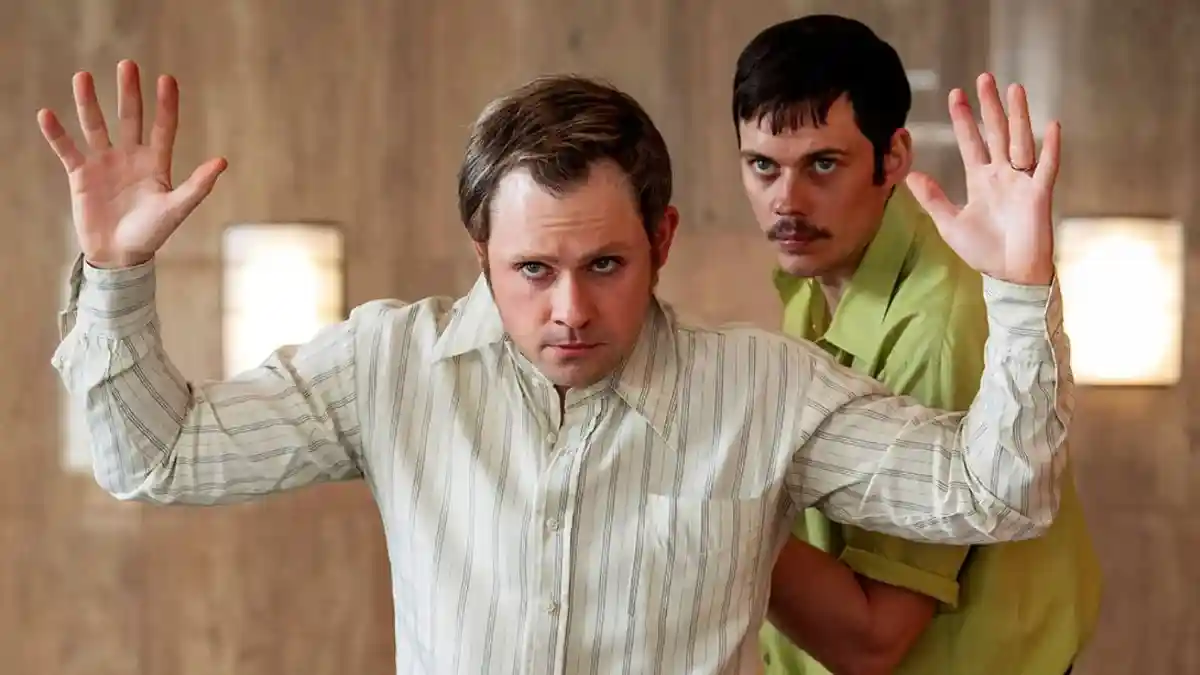
Dead Man’s Wire is Rated R by Motion Picture Rating (MPA) for language throughout
February of 1977. Just saying it drops you into a particular headspace. Disco was still pulsing, Star Wars hadn’t yet rearranged the cultural furniture, and Ralph Bakshi’s Wizards one of those gloriously unhinged animated epics that only the ’70s could produce was playing in theaters. There’s a temptation to imagine the world briefly in balance, or at least vibrating with possibility. And then reality, as it so often does, cuts in hard. In Indianapolis, a failed real estate investor named Tony Kiritsis walked into his mortgage broker’s office, strapped a shotgun to the man’s head, and wired it so that if anyone fired at Kiritsis or if the broker tried to run the gun would discharge. The spell was broken. Whatever sense of order existed evaporated on contact.
Highly Recommended: Silent Night, Deadly Night (2025) Parents
The standoff became national spectacle, broadcast live and later dissected in Alan Berry and Mark Enochs’ documentary Dead Man’s Line. Now Gus Van Sant revisits the incident in Dead Man’s Wire, a dramatization that arrives with a recognizable cast and the implicit promise that this strange, grim footnote of American history might reveal something deeper under scrutiny. Bill Skarsgård plays Kiritsis with volatile intensity. Dacre Montgomery is Richard O. Hall, the man tethered to the weapon. Al Pacino appears as Hall’s father part mortgage executive, part infernal patriarch. Colman Domingo turns up as a local radio DJ pulled unwillingly into the circus, while Cary Elwes plays a police officer so physically transformed you may find yourself squinting, wondering if that really is Cary Elwes. It is. And yes, the performance works, even if the casting choice initially feels like a visual prank.
Van Sant opens the film with admirable nerve, staging the first stretch in near real time. You can feel the tension humming before anything explicitly awful happens. Kiritsis pulls into the parking lot, and immediately ominously his car key snaps off in the ignition. It’s the kind of mundane mishap that feels like fate laughing under its breath. Part of the plan is ruined, so he improvises. Even if you know nothing about the real event, the air thickens; something terrible is clearly en route. Hall enters carrying a long cardboard box, cradling it like it contains something volatile, which of course it does. Once inside the office, the situation detonates: the shotgun is revealed, Hall is physically bound to it, Kiritsis calls the police, cameras gather, and suddenly logistics intrude on horror. Transportation becomes a problem. The solution? Marching a man through public streets with a death machine affixed to his head, a real-life Jigsaw contraption unfolding in full view of stunned bystanders.
Highly Recommended: Goodbye June Parents Guide
It’s electrifying, and Van Sant wrings every drop of dread from it. Unfortunately, when the story moves into its second phase once Kiritsis and Hall retreat to Kiritsis’ apartment for what becomes a multi-day standoff the film’s pulse slows to a concerning degree. The danger is still present, but it’s no longer escalating. The narrative has room to breathe now, which allows for conversation, backstory, and attempts at mutual understanding. These scenes are not without value, but the sense of imminent catastrophe that defined the opening act has dissipated. Van Sant is constrained by history here; this is how it happened. Still, by expending so much energy up front, Dead Man’s Wire leaves itself with limited momentum for what follows.
What keeps the film upright during these quieter stretches is Skarsgård. He’s no longer a secret weapon—he’s been too consistently excellent for that but he remains an underappreciated one. Known largely for monsters buried under layers of prosthetics, he brings the same ferocious concentration to a role that relies entirely on exposed nerves. In Dead Man’s Wire, you can see the gears turning constantly behind his eyes. Not reasoned gears, not healthy ones but relentless motion all the same. Kiritsis believes this is his story, his reckoning, and Skarsgård plays him like a man auditioning for the lead role in his own moral tragedy. There’s something almost comic-book about him, like a Batman villain stripped of the theatrics and dropped into a drab Midwestern reality, costume misplaced, grievance intact.
Highly Recommended: Not Without Hope Parents Guide
The film makes a deliberate, if uneasy, case that Kiritsis isn’t acting in a vacuum. He believes perhaps correctly that the mortgage company sabotaged him. He bought land in what should have been a lucrative area, only to watch brokers discourage tenants and inflate his rates until the investment collapsed. Van Sant never challenges this version of events. Instead, he underscores it by casting Pacino as Hall’s father, M.L. Hall, and effectively instructing him to play the character as a moral void. Pacino does not disappoint. This is a man who refuses to eat a burrito because it hasn’t been sliced into thirds an insane demand under any circumstance and because the waiter failed to intuit that Tuesdays are meatless, a rule known only to him. By the time he declines to offer Kiritsis even a hollow apology in exchange for his son’s life, worried it might cost him financially, our contempt is complete. You might not side with Kiritsis, but you understand the shape of his rage.
When Dead Man’s Wire finds its footing, it’s usually for one of two reasons: the residual tension from that blistering first act, or the dynamic between Skarsgård and Montgomery. Montgomery’s performance, in particular, is easy to overlook precisely because it’s so restrained. As Hall, he is quietly shattered. This is a man complicit in Kiritsis’ financial ruin, yet also a victim of forces beyond his control most notably a father more invested in profit than in the living son standing in mortal danger. Montgomery plays him as someone operating on fumes, terrified to the point of near paralysis. The fear doesn’t spike; it settles in and stays. You see it in his posture, his eyes, the way exhaustion etches itself deeper with each passing hour. It’s subtle work, and essential.
Still, there’s no getting around it: the film doesn’t always hold together. That opening surge of adrenaline eventually collapses, and Dead Man’s Wire never quite regains its balance. If you come in unfamiliar with Tony Kiritsis’ story, the sheer oddity of it may be enough to carry you through. Or you may start to sense that this saga, compelling as it is in fragments, resists the shape of a conventional feature film. As a real-life thriller, it works in bursts. As a sustained cinematic experience, it only partially clicks an unsettling, uneven reminder that not every true story wants to be a movie, even when a filmmaker as capable as Gus Van Sant is the one telling it.
Detailed Content Breakdown for Parents
Violence & Intensity: While there isn’t nonstop physical violence, the threat of violence is constant and deeply disturbing. A shotgun is literally wired to a character’s head for much of the film. The tension comes from knowing that a single misstep could result in death. There are moments of police confrontation, emotional breakdowns, and sustained hostage peril that may be upsetting for younger viewers.
Language: Strong, frequent profanity throughout, including repeated uses of the F-word and other harsh language. The tone is angry, bitter, and often cruel, reflecting the emotional state of the characters.
Sexual Content / Nudity: Minimal. No explicit sexual scenes or nudity. Adult themes are present, but sexuality is not a focus.
Drugs, Alcohol & Smoking: Some adult drinking and smoking appear, consistent with the time period and characters’ stress levels. No glamorization, but it’s present.
Older teens (16–17) might handle it if they are emotionally mature and watch with a parent, but this is firmly an adult film in tone, pacing, and subject matter.
Final Verdict
Dead Man’s Wire is not suitable for kids or families, and only appropriate for older teens with supervision or adults who are prepared for a heavy, intense experience. As a piece of cinema, it’s serious, unsettling, and often compelling. As a family viewing option, it’s a hard no.
For parents, the key question isn’t “Is it graphic?” it’s “Is my teen ready to sit with this kind of emotional weight?” If the answer is no, it’s best saved for much later.

Stephanie Heitman is a seasoned journalist and author dedicated to helping parents navigate the world of Hollywood entertainment through thoughtful, family-oriented film reviews. With over a decade of experience in writing and a passion for fostering safe, enriching viewing experiences, Stephanie launched Parentguiding.com to provide parents with the insights they need to make informed choices for their families.