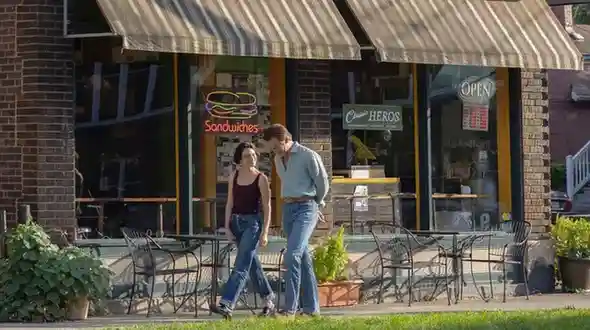
It’s easy to miss, in the churn of ordinary days, just how much tenderness and odd, fleeting beauty is hiding in plain sight. But if you happen to be inside a film by Rachel Lambert, those small moments don’t just register they glow. Her work insists that even the quietest corners of existence can hold romance, humor, and ache in equal measure, if only someone patient enough is watching.
Lambert announced herself with real authority in 2023’s Sometimes I Think About Dying, a film that understood loneliness not as a gimmick but as a lived condition, punctuated by surreal visions of death that felt strangely gentle rather than morbid. What made that film linger wasn’t just its premise, but her uncanny sensitivity to the in-between spaces: pauses in conversation, glances that say more than dialogue, the weight of a room when someone is alone with their thoughts. Taken individually, those details might seem trivial. Accumulated, they became quietly devastating.
Her new film, Carousel, feels like a natural evolution of that sensibility. On the surface, it looks more conventional: a romantic drama about two former lovers Chris Pine’s Noah, a compassionate but quietly unraveling doctor, and Jenny Slate’s Rebecca, all fire and intelligence who reconnect years later in Cleveland. If you come in expecting something safer, more predictable than Sometimes I Think About Dying, Lambert quickly disabuses you of that notion. The shapes are familiar, yes. The feelings are not.
This is a film deeply attuned to the strange gravity that pulls people back toward each other, even when history suggests they should know better. Lambert tells the story with patience, letting scenes stretch and breathe, but she’s also unafraid to fracture time, skipping around in a way that mirrors how memory actually works. It’s not flashy; it’s intuitive. And the more time you spend inside it, the richer it becomes, like a conversation that only reveals its real meaning after you’ve sat with it for a while.
A huge part of why Carousel works as powerfully as it does comes down to the performances. Pine delivers his finest work since Hell or High Water, and that’s not faint praise. His Noah is a man performing stability especially for his young daughter while internally unsure of almost everything. You can see the effort behind his easy smiles, the way his confidence feels practiced rather than natural. Pine plays all of that without announcing it, trusting us to notice the cracks. It’s subtle, generous acting.
Slate, meanwhile, reminds us of something too often forgotten: that she is not just funny, but profoundly emotionally precise. As Rebecca, she toggles effortlessly between sharp wit and exposed vulnerability, sometimes within the same line of dialogue. There’s a hunger in her performance a sense of someone who feels deeply and thinks too much and knows it. Watching her here, it’s hard not to wish Hollywood would finally start giving her the kinds of roles this performance suggests she’s more than ready for.
Their reunion comes at a moment when both characters are off-balance, with Noah now navigating single parenthood alongside his gentle, anxious daughter, played beautifully by Abby Ryder Fortson (still glowing with the emotional intelligence she brought to Are You There God? It’s Me, Margaret). From the moment Pine and Slate share the frame, the connection is palpable. Not the shiny, scripted chemistry of movie romance, but the messier kind the kind where you can feel the shared past pressing in on the present. You believe, completely, that these two people want this to work. That belief is everything.
What’s especially moving is how the film handles conflict. There are no melodramatic betrayals, no arbitrary twists designed to manufacture tension. Instead, the friction grows out of who these people are their habits, their fears, the ways they protect themselves from being hurt. When things begin to fray, it feels earned. Painfully so. There’s an extended argument between Noah and Rebecca that’s so raw, so specific, that it makes the much-discussed confrontation in Marriage Story feel almost theatrical by comparison. You don’t feel like you’re watching actors perform conflict. You feel like you’ve wandered into a room where two real people are failing, in real time, to articulate what they need.
You can watch them slipping back into old dynamics, retreating into behaviors that feel safe precisely because they’re familiar even though those behaviors are the very things that once drove them apart. It’s frustrating in the way real life is frustrating. You might find yourself wanting to reach into the screen and shake them, demand better of them. And yet, thanks to the compassion of the performances, you never stop caring. Their choices aren’t always easy to decode, but the emotions beneath those choices are achingly clear. That’s the difference between manipulation and honesty. This is the latter.
Lambert’s control extends well beyond performance. The film is elevated by Dabney Morris’s lush, emotionally attentive score and Dustin Lane’s richly textured cinematography. These aren’t just technical flourishes; they’re part of the storytelling. The music swells at unexpected moments, lending grandeur to scenes of everyday community life. The camera sometimes frames conversations at slightly off angles, subtly destabilizing the image when the emotions beneath the surface are doing the same. There are sequences that rely almost entirely on the interplay between sound and image, and Lambert handles them with remarkable confidence. She trusts atmosphere. She trusts silence. She trusts us.
It’s best not to spell out where the story ultimately lands. Carousel is a film that thrives on uncertainty, on the feeling of being emotionally unmoored. Some developments are deliberately disorienting. Others are unexpectedly tender. But there is one scene that captures the spirit of the entire film: a moment in which Noah literally listens to his own heartbeat. On paper, it sounds perilously close to symbolism so on-the-nose it could curdle into cliché. In practice, it’s quietly astonishing. Lambert slows the world down. Pine lets us see every flicker of thought cross his face. What could have felt reductive instead opens outward, suggesting not a single, fixed meaning but a whole constellation of possibilities.
That’s what Lambert does best. She doesn’t tell you what to feel. She creates the conditions in which feeling becomes unavoidable. And when the film finally lets go of you, you may find yourself looking at your own life a little differently more attentive to the small moments, the half-spoken truths, the fragile beauty hiding in the ordinary. That’s not just good filmmaking. That’s a rare, generous kind of art.
Carousel (2026) Parents Guide
MPA Rating: Not Rated R by the Motion Picture Association (MPA)
Detailed Content Breakdown for Parents
Violence & Intensity: There is no physical violence in the film. The intensity is emotional rather than physical. Several scenes involve heated arguments between adults, including one extended confrontation that feels raw and deeply uncomfortable in a realistic way. Voices are raised, feelings are hurt, and the emotional stakes feel high. You can feel the tension, but nothing becomes threatening or unsafe. Think emotional weight rather than danger.
Language: There are occasional uses of strong language, including words like f—k and other common adult profanity, especially during moments of conflict.
No hateful slurs are emphasized in the story, and the tone is grounded in realism rather than shock value.
Sexual Content / Nudity: The film handles intimacy with restraint and emotional sensitivity.
There are romantic moments between adults, including kissing and emotionally charged closeness. If there is sexual content, it is implied rather than explicit, with the focus staying on emotional connection rather than bodies.
Drugs, Alcohol & Smoking: Characters may be shown drinking socially (wine, beer) in realistic adult settings. There is no depiction of drug use as a major element of the story.
No glamorization of substance use; it’s treated as part of everyday adult life.
Age Recommendations: Best suited for: Older teens and adults who can understand emotional nuance, relationship dynamics, and slower storytelling. Recommended for: Ages 15+ or 16+, depending on maturity.
Highly Recommended:

Stephanie Heitman is a seasoned journalist and author dedicated to helping parents navigate the world of Hollywood entertainment through thoughtful, family-oriented film reviews. With over a decade of experience in writing and a passion for fostering safe, enriching viewing experiences, Stephanie launched Parentguiding.com to provide parents with the insights they need to make informed choices for their families.