Avatar: Fire and Ash is Rated PG-13 by Motion Picture Rating (MPA) for intense sequences of violence and action, bloody images, some strong language, thematic elements and suggestive material.
Is there anyone in modern blockbuster cinema who understands the mechanics and the meaning of a sequel better than James Cameron? For decades, he’s been the rare filmmaker who didn’t just go back to the well, but deepened it. Terminator 2: Judgment Day didn’t echo its predecessor; it challenged and expanded it. Aliens transformed a haunted-house sci-fi film into a war movie without losing the terror. Even Avatar: The Way of Water found a way to evolve its world rather than simply repaint it. With a track record like that, you walk into Avatar: Fire and Ash expecting escalation: bigger ideas, darker emotions, sharper conflict. You expect Cameron to push forward. Instead, the film quietly asks you to leave those expectations at the door.
Highly Recommended: Wolf of Wall Street Parents Guide
On a purely visual level, Fire and Ash delivers exactly what you’d anticipate from Cameron astonishing scale, meticulous world-building, images engineered to overwhelm the senses. That part is never in doubt. What’s missing is the emotional propulsion, the sense that this chapter exists to bring something to a boil rather than keep it warm. For a film that appears designed to conclude a trilogy—though if history teaches us anything, a fourth chapter still feels inevitable it lacks the anger, urgency, and finality that such a position demands. The screenplay, by Rick Jaffa and Amanda Silver, repeatedly gestures toward new thematic territory before retreating to familiar ground, the narrative equivalent of dipping a toe into deeper water and then stepping back onto safe, glowing blue sand.
Yes, Fire and Ash was conceived alongside The Way of Water as part of a single extended narrative. But that doesn’t excuse how often this film feels like it’s tracing its predecessor’s outlines. So many plot beats echo the previous installment that, years from now, it may be genuinely difficult to distinguish one from the other in memory. Great sequels don’t survive on repetition; they survive on accumulation. This one, for all its visual beauty, feels strangely static adrift, circling the same ideas without pushing them anywhere new.
Highly Recommended: Speak No Evil Parents Guide
The story resumes a year after the harrowing finale of The Way of Water, still shadowed by the death of Neteyam. Jake Sully (Sam Worthington) has retreated emotionally, especially from his surviving son Lo’ak (Britain Dalton), who opens the film with a quietly lovely narration about grief and absence. You can feel the film setting itself up for something raw and intimate a meditation on inherited guilt, on the difficulty of loving what remains after loss. That promise lingers, tantalizingly, but it never quite materializes. Jake and Lo’ak strain toward reconnection, yet the film never allows their relationship to fully fracture or heal in ways that feel dramatically earned.
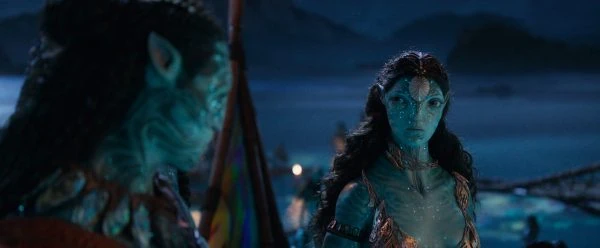
Neytiri (Zoe Saldana), meanwhile, exists in a constant state of emotional displacement. Far from her ancestral home, she carries her grief like an open wound, unable to find balance or belonging. Cameron again circles his recurring concerns: harmony versus domination, spiritual connection versus exploitation, Eywa versus those who would bend nature to their will. These ideas remain potent, but here they feel reiterated rather than interrogated.
On the opposing side of that moral divide stands Quaritch (Stephen Lang), resurrected once more this time fully embodied in Na’vi form. There’s something inherently awkward, and occasionally amusing, about watching him bark military orders while navigating a body not his own, stalking human bases alongside figures played by Edie Falco and Giovanni Ribisi. Quaritch remains a blunt instrument of imperialism, and Fire and Ash gives him a great deal of screen time perhaps too much.
Caught uncomfortably between these forces is Spider (Jack Champion), now effectively part of Jake and Neytiri’s family. His role balloons in importance here, yet the character never deepens in proportion. A handful of thoughtful scenes between Spider and Kiri (Sigourney Weaver), in which they articulate the loneliness of feeling unmoored from one’s community, hint at something emotionally rich. Weaver, especially, does remarkable work with Kiri, infusing her with the quiet ache of someone whose very identity keeps her just out of reach of the peace she craves. But Spider remains frustratingly thin on the page, which becomes increasingly problematic as the humans identify him as a strategic linchpin in their renewed effort to dominate Pandora.
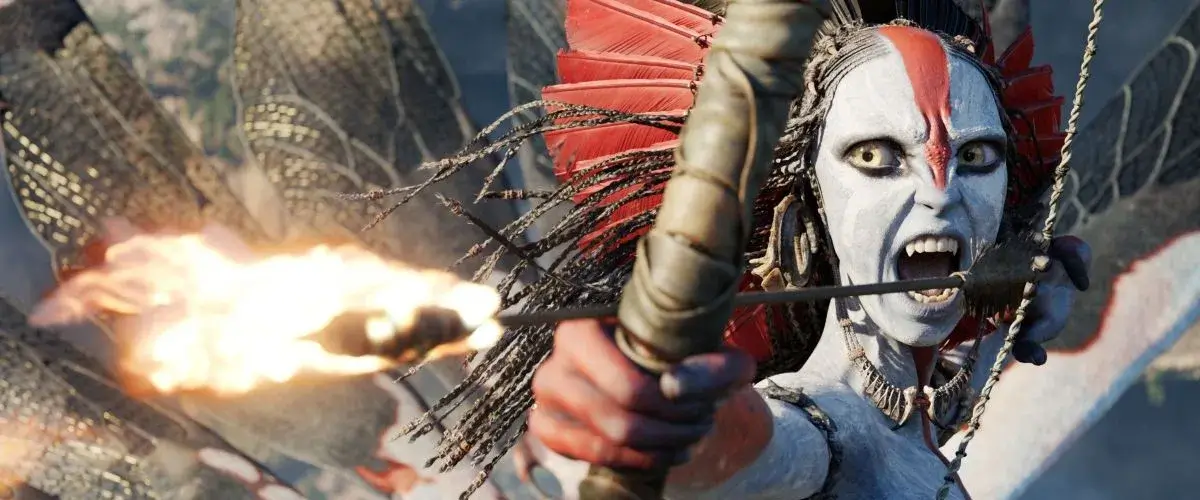
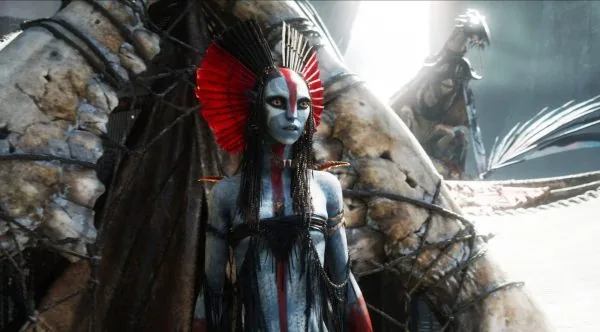
Into this already strained family structure steps Varang (Oona Chaplin), the arresting leader of the Mangkwan, a Na’vi faction that operates more like a militant cult than a community. Where Tonowari (Cliff Curtis) and the Matkayina embodied restraint and coexistence, the Mangkwan represent the opposite impulse: rage, self-interest, and violence untethered from empathy. When Quaritch encounters Varang in her stronghold, Cameron delivers the film’s most compelling sequence, painting her as a charismatic tyrant—a figure who rules through fear and mythmaking, more spiritual demagogue than tribal leader. For a moment, you can feel the movie crackle with danger and possibility.
And then, almost inexplicably, that energy dissipates. Varang is sidelined, reduced to a narrative accessory orbiting Quaritch rather than emerging as a fully realized antagonist. It’s a deflating turn, and one of the most surprising miscalculations of Cameron’s career, given his long history of crafting formidable, complex female characters. Instead of nurturing Varang or fleshing out Spider, Fire and Ash barrels toward a climax that feels uncannily familiar another confrontation that mirrors The Way of Water, complete with human interlopers once again underestimating the sheer force of Pandora’s most majestic creatures.
For many viewers, none of this will matter. The spectacle alone may be enough. In an era when mainstream entertainment often feels diminished flattened by rushed streaming content and the creeping presence of algorithmic creation there’s something almost noble about Cameron’s insistence on scale, craft, and immersion. Few filmmakers remain so committed to giving audiences a sense that their ticket buys something monumental. And if Cameron were to spend the rest of his career exclusively in this universe, he could still reasonably claim an extraordinary legacy: a fully realized cinematic world destined to persist through theme parks, games, toys, and cultural memory. Part of you wants to forgive Fire and Ash on sheer audacity alone.
Highly Recommended: John Wick 4 Parents Guide
But the sense of missed opportunity lingers, stubbornly. The unrealized potential of Varang, the narrative weight Spider never quite earns, the action beats that feel lifted wholesale from the previous film it all adds up to a chapter that feels lesser rather than larger. It’s difficult to imagine anyone calling this the strongest entry in the saga. And that, perhaps, is the most unexpected development of all. James Cameron once understood how to turn up the heat with each sequel, forging something fiercer and more essential from what came before. Here, he seems content to sift through familiar ashes instead of setting the fire anew.
Detailed Content Breakdown for Parents
Violence & Intensity: Violence is the most significant factor for parents to consider with Avatar: Fire and Ash. The film features frequent large-scale battle sequences involving futuristic weapons, explosions, aerial combat, and powerful creatures. Characters are injured and killed, sometimes in emotionally impactful ways rather than graphically violent ones. While there is no bloodshed meant to shock, the constant sense of peril and conflict keeps the intensity level high throughout the movie. Younger viewers may find the sustained action overwhelming, especially given the film’s long runtime and darker tone compared to earlier entries.
Language: The language stays firmly within PG-13 boundaries. Mild profanity appears occasionally, including words like “damn” and “hell,” along with tense or aggressive dialogue during confrontations. There are no slurs, sexually explicit terms, or sustained coarse language. For most families with teens, the dialogue will feel typical of modern action films and unlikely to raise concern.
Sexual Content / Nudity: Sexual content is minimal and non-explicit. There are no sex scenes or overt sexual references. As in previous Avatar films, brief non-sexual nudity may be visible due to Na’vi cultural norms, but it is presented matter-of-factly and without titillation. Romantic elements are limited to mild affection between adult characters and are handled tastefully.
Drugs, Alcohol & Smoking: There is little to no emphasis on substance use. Alcohol may appear briefly in background moments involving adult characters, but it is not glamorized or central to the story. There is no depiction of drug use, smoking, or substance abuse.

Stephanie Heitman is a seasoned journalist and author dedicated to helping parents navigate the world of Hollywood entertainment through thoughtful, family-oriented film reviews. With over a decade of experience in writing and a passion for fostering safe, enriching viewing experiences, Stephanie launched Parentguiding.com to provide parents with the insights they need to make informed choices for their families.