All You Need Is Kill is Rated R by Motion Picture Rating (MPA) for some violence/bloody images.
Rita (voiced by Ai Mikami) exists inside one of those cosmic jokes that feels cruel enough to sting. She’s a withdrawn, exhausted young woman who quietly aches for the finality of death and yet she’s trapped inside a time loop where death refuses to stick. She can’t escape existence, but she can’t quite inhabit it either. It’s a limbo that feels less like science fiction than an emotional condition many people will recognize. All You Need Is Kill, adapted from the light novel and manga by Hiroshi Sakurazaka (and later reimagined by Hollywood as Edge of Tomorrow), leans into this premise as a blunt but often potent metaphor for the suffocating repetition of daily life. Director Kenichiro Akimoto renders the world in bursts of vivid, almost graffiti-like color, giving the film the look of a canvas splattered by feeling. His version tracks closer to the spirit of the original book than Doug Liman’s slicker adaptation ever did but fidelity comes at a cost. Where the American film surged forward on momentum, this one sometimes stalls, weighed down by its own earnestness.
This is not a movie that hides its intentions. Its compassion is worn openly, almost defiantly.
The film pleads for life with the clarity of someone who desperately wants to be understood. That sincerity is touching. It’s also limiting. Yuichiro Kido’s script lays out its ideas so plainly that the metaphors feel spent long before the film ends, stretching the 82-minute runtime until it feels oddly prolonged. You can sense a richer, longer cut hiding underneath this version a film where Rita’s anguish could breathe, where her despair could deepen into something more complex. Instead, she remains defined almost entirely by her sadness. We’re told who she is through the weight she carries, but we’re rarely allowed to discover her beyond it.
Highly Recommended: Girl Taken 2026 Parents Guide
The rupture of Rita’s world arrives in a vision that feels both apocalyptic and strangely beautiful. A beam of red light crashes into rural Japan and blossoms into a colossal tree, its roots threading across the planet like veins. The government names the phenomenon “Darol.” For a year, it simply exists displacing entire communities near its base but otherwise remaining inert, a silent, unsettling monument. Volunteer teams are sent in to chart its terrain and collect samples; Rita is among them. A TV murmurs in the background about Darol’s cells possibly distorting time and space, but no one seems fully prepared for what’s coming.
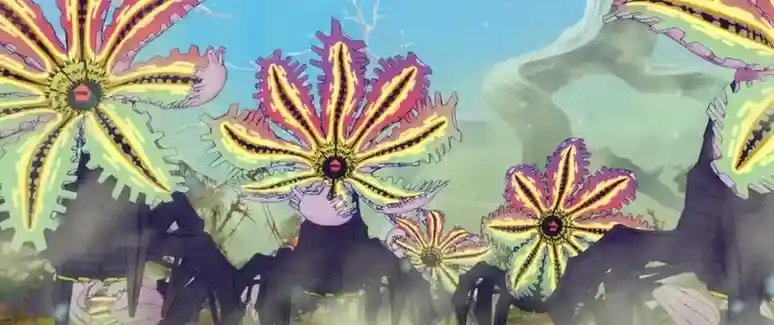
Rita, with her blunt orange bob, oversized clothes, and watchful blue eyes, moves through this environment as though she’s already half gone. She barely speaks. She hides behind her CD player. When invited to a celebratory “birthday” gathering for Darol, she fades into the background like someone who’s long since accepted her own invisibility. Then, outfitted in an awkward mechanical suit, she steps out on what feels like another pointless day until the tree awakens. Monsters erupt from it, floral-headed and feral, swift and merciless. The scene becomes a massacre. Everyone dies. Rita included.
And then she wakes up. 7:03 a.m. again.
At first, she dismisses the memory of her death as a nightmare. Then it happens again. And again. By the third iteration, she tries to warn her fellow volunteers, frantic and sincere but to them, she’s just another unstable stranger. You can feel the loneliness deepen here. Like Groundhog Day before it, the film tracks the familiar trajectory: denial, confusion, rebellion. Rita attempts to flee the danger zone, only to learn that the catastrophe will find her wherever she runs. There’s no geographic escape from a psychological trap.
The film admires its own hopefulness, and in many ways you can admire it too. It believes fiercely in the idea that existence, however painful, is worth clinging to. Still, you might wish it trusted its audience a little more instead of underlining every thought.
When escape fails, Rita turns inward. Suicide, for her, isn’t a shocking pivot so much as a bleak continuation of her emotional logic. If she chooses to die on her own terms, maybe the loop will break. But drowning changes nothing. Each reset returns her to the same morning, the same suffocating awareness. So she chooses another path: confrontation. She begins fighting the monsters, studying them, testing strategies. Each death becomes a lesson. The structure starts to resemble a video game die, learn, respawn, improve. And in a quietly devastating gesture, she marks each death on her hand, tallying the number of times she’s been forced to live and die. It’s both practical and heartbreaking, a physical record of her endurance.
Highly Recommended: Night Patrol (2025) Parents Guide
The loop shifts when she discovers that she’s not alone. Keiji (Natsuki Hanae) is also repeating the day, his timeline knotted with hers. When one of them dies, the other resets too. Keiji, nervous and soft-spoken, masks his despair with jittery laughter. His hopelessness mirrors Rita’s; it’s just packaged differently. Together, they talk about the absurdity of it all the endless violence, the gallons of purple blood, the fact that nothing truly changes no matter how many enemies they defeat. It’s the kind of conversation that feels less like science fiction dialogue and more like two young people confessing their quiet fears about adulthood, purpose, and emotional stagnation.
It’s impossible to ignore the cultural context hovering around the film. Japan’s youth mental health crisis, intensified in recent years and worsened by pandemic isolation, has resulted in alarmingly high suicide rates. Conversations about this suffering are often stifled by stigma, which forces artists to find indirect ways of expressing it. In that sense, All You Need Is Kill feels brave. Its optimism is exposed, vulnerable, almost raw. Yet there’s a sense that its message pushes too hard, too quickly, as though afraid silence might undo it.
Still, there’s something undeniably striking about the way the film stages its chaos: creatures blooming in impossible shapes, colors that recall glass sculptures more than gore, violence rendered in surreal bursts of beauty. It’s an oddly poetic environment in which to confront mortality. And even when the film falters, even when its writing feels thin, you can sense its heart beating loudly beneath every frame. It may not fully succeed as allegory, but as an emotional experience as a story about the exhausting work of choosing to live again each morning it lingers longer than you might expect.
All You Need Is Kill Parents Guide
Violence & Intensity: Much of it is stylized and surreal creatures with enormous flower-like heads erupt from a colossal tree, spraying vivid purple blood rather than realistic gore but the repetition of death gives the imagery cumulative weight. Rita dies again and again in varied ways: torn apart in battle, caught in mass slaughter, drowning herself in desperation. While the visuals often lean toward the fantastical, the emotional intensity is heavy. You can feel the exhaustion of constant dying, and younger viewers may find the relentless cycle of death disturbing even when the imagery isn’t graphically explicit.
There are also battlefield sequences involving mechanical suits, explosions, and panic-driven chaos. The tone is not celebratory; violence is portrayed as traumatic, draining, and existentially crushing.
Language: The language is more emotionally heavy than verbally explicit. The tone, however, is often bleak characters speak openly about hopelessness, meaninglessness, and the desire to die. That emotional weight may land harder than any swear word.
Sexual Content / Nudity: There is no meaningful sexual content. No nudity, no sexualized behavior, and no romantic material beyond mild emotional closeness between characters.
Drugs, Alcohol & Smoking: No significant depiction of drug use. Alcohol and smoking are not central elements. The film’s escapism is psychological rather than chemical its characters are battling internal despair, not substance abuse.
Age Recommendations
Recommended for ages 16+, with strong caution and ideally parental discussion afterward.
This isn’t an R-rated film because of sex or extreme gore it’s rated R because of emotional heaviness and existential subject matter. Mature older teens who are comfortable with challenging themes may find it meaningful. Younger teens are likely to find it overwhelming or confusing.

Stephanie Heitman is a seasoned journalist and author dedicated to helping parents navigate the world of Hollywood entertainment through thoughtful, family-oriented film reviews. With over a decade of experience in writing and a passion for fostering safe, enriching viewing experiences, Stephanie launched Parentguiding.com to provide parents with the insights they need to make informed choices for their families.