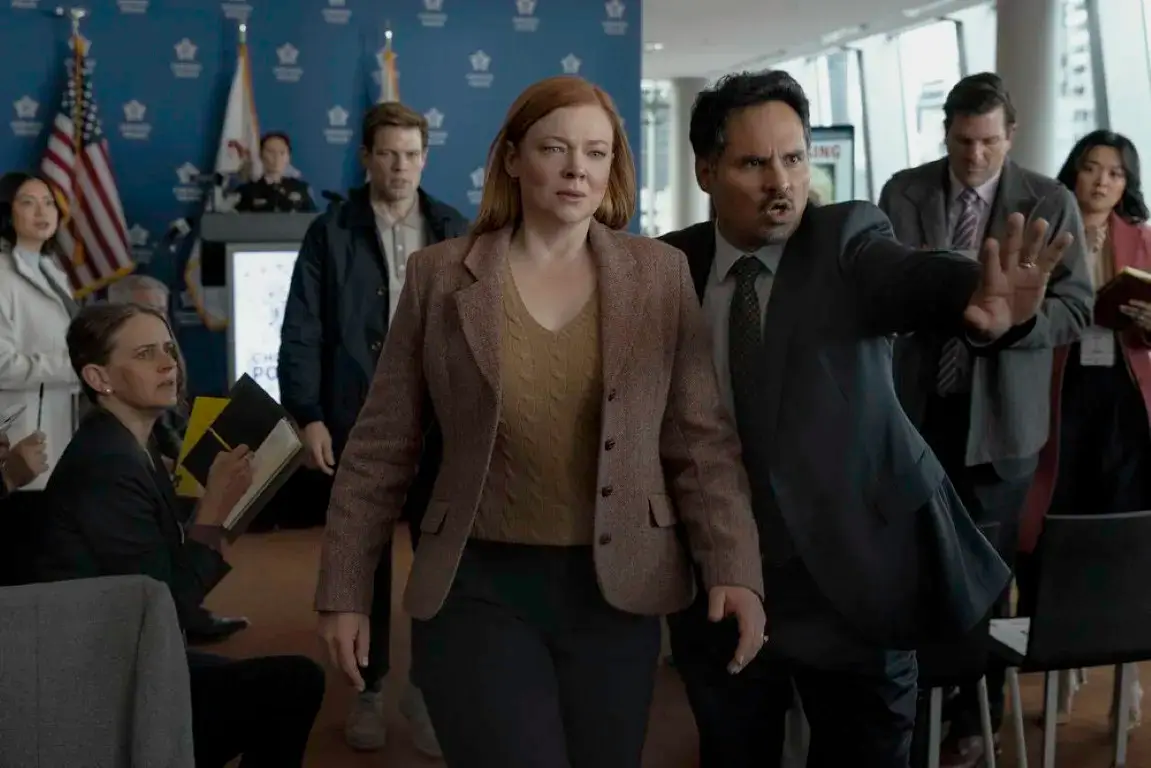
All Her Fault is rated TV-MA rating due to its mature relationship themes and adult language.
“All Her Fault”: The Anatomy of Panic and the Performance of Perfection
“All Her Fault” begins with a nightmare that feels too plausible to shake off. Marissa (Sarah Snook), composed and confident in that brittle, modern way, arrives at a playdate to pick up her son, Milo (Duke McCloud). The toys are out, the snacks are half-eaten, the air feels lived in but Milo isn’t there. He was never there. That quiet revelation lands like a scream muffled under glass. When Marissa calls Jenny (Dakota Fanning), the mother hosting the supposed playdate, she’s met not with reassurance, but confusion. Jenny doesn’t know what she’s talking about. And from that point on, every certainty in Marissa’s life begins to crumble.
Also Read: “Baahubali: The Epic Parents Guide
The show, based on Andrea Mara’s novel, doesn’t waste time coaxing you into comfort. “All Her Fault” is a thriller built on the same mechanics as panic itself sharp drops, sudden turns, the sensation of solid ground giving way beneath you. Its first episode, in particular, operates like a trapdoor: the second Milo vanishes, the tension doesn’t just rise, it multiplies. Every glare, every whispered accusation, every small domestic detail is infused with menace. The series wants you rattled, and you will be. It’s engineered for that very response.
What’s striking, though, isn’t just the mystery of the missing boy, but how suspicion metastasizes. No one not Marissa’s husband Peter (Jake Lacy), not the other moms, not the nannies (Kartiah Vergara, Sophia Lillis), not the family members (Abby Elliott, Daniel Monks), not even the seemingly trustworthy business partner (Jay Ellis) escapes the fog of doubt. The camera, like a nervous system on high alert, studies faces for flickers of guilt. Everyone looks slightly guilty of something, and that might be the point.
Recommended: In Our Blood (2025) Parents Guide
Through a dense weave of flashbacks some stretching back a decade the show reveals and conceals in equal measure. We’re given fragments that almost connect, but just when a pattern begins to form, the narrative slides the puzzle pieces out of reach. The thrill lies in that deliberate disorientation: the cat-and-mouse game between the show and its audience. You begin to realize that the script never technically lies, but it delights in letting you lie to yourself. What you think you know in one scene gets obliterated in the next. Even Detective Alacaras (Michael Peña), who at first seems like our anchor of reason, turns out to have his own murky moral tides.
And yet beneath the structure of a mystery beats something far more recognizable: the exhaustion of modern parenting under judgment’s glare. You can feel it pressing down on Marissa and Jenny, the way they’re constantly observed and evaluated by husbands, by peers, by themselves. Their anxiety becomes a performance art: the need to appear endlessly capable, the fear of failing in public. When they sneak off to share wine in a bathroom during a social event, it’s not comic relief; it’s catharsis. You want to join them. You’ve earned it.
At one point, Marissa sighs, “I’m tired of being amazing. I don’t want to be amazing anymore.” It’s a small confession that hits like a hammer. The show’s title starts to resonate here “All Her Fault” as both accusation and prophecy.
Highly Recommended: The Hand That Rocks the Cradle (2025) Parents Guide
The themes are orchestrated with almost musical precision. First comes blame: women carrying the moral debris of everyone else’s mistakes. The camera lingers on faces that are trying and failing to stay composed. Snook, especially, does extraordinary work in the space between reactions: the split-second tremors of guilt, anger, or self-doubt that flicker across her features. The thrill of this show often lives inside those micro-expressions.
The second theme, friendship under duress, is threaded through the relationship between Marissa and Jenny a fragile bond strengthened by disaster. Around them, echoes of solidarity and betrayal play out among the supporting cast Ellis, Monks, and Elliott who mirror those same tensions in miniature.
And then there’s a third, crueler theme, delivered in one of the show’s most exasperating flashbacks. Marissa, sleepless and fraying, can’t get baby Milo to rest. She finally pleads with her husband for help to maybe look something up, do something, anything. He smiles and says, with the smooth confidence of the utterly oblivious, “Of course. Whatever you need. Just tell me what you want me to do.” It’s a moment so infuriating; you can almost hear the audience groan. This is weaponized incompetence rendered in perfect, nauseating form the kind of scene that makes you mutter, “Oh, come on,” but also nod, recognizing the truth of it.
Over eight episodes, “All Her Fault” becomes less about the mechanics of the mystery and more about the psychology of guilt how disillusionment curdles into poor choices, how loneliness becomes both symptom and weapon, and how tragedy exposes the fractures we spend our lives trying to plaster over. The final episodes bring a bitter symmetry: the line “I honestly didn’t see this coming” appears first in Episode 1, then again in Episode 8, as if to remind us that foreknowledge never prevents the fall. Even when we’re expecting the twist, we can’t quite brace for it.
Few of these characters are “good people” in any conventional sense. But that’s precisely what makes them so compelling the way they rationalize their moral compromises, convincing themselves that circumstance, not choice, drove them there. Those “becauses,” as flimsy as they sound, are the fault lines that make this series worth watching.
When the credits roll, “All Her Fault” leaves you with that uneasy residue of thrillers that understand human frailty too well. It begins as a procedural, morphs into a psychological portrait, and finally becomes an elegy for control the illusion that we can hold our lives together through sheer effort.
Premiering November 6 on Peacock, with all episodes available to binge, the series invites you to lose your footing. It’s a story about the terror of not knowing not just what happened to a child, but what’s hiding inside the people who claim to love him.
Content Breakdown for Parents
Violence & Intensity: While there’s little direct violence, the tension runs high throughout. Viewers will see frightening moments involving a missing child, scenes of panic and confrontation, and a few disturbing flashbacks. Emotional violence shouting, manipulation, gaslighting is frequent. Some brief physical scuffles, but the real power comes from the dread of what might happen.
Language: Strong adult language appears in nearly every episode including frequent uses of the F-word, S-word, and occasional blasphemy. The tone is realistic and heated rather than gratuitous, fitting the emotional stakes.
Sexual Content / Nudity: Mild to moderate. Some intimacy between married or dating characters, but no explicit nudity or prolonged sex scenes. A few sensual moments framed through the lens of marital strain and emotional distance rather than titillation.
Drugs, Alcohol & Smoking: Social drinking is common wine glasses often in hand during stressful gatherings or late-night conversations. Alcohol becomes a coping mechanism for several characters. Occasional smoking and prescription medication misuse are depicted briefly.
Scary or Disturbing Scenes: The fear is psychological. The show often lingers on emotional breakdowns, guilt, and parental panic. There are moments of genuine terror tied to a child’s disappearance and the unraveling of relationships. Flashbacks may include disturbing imagery of sleep deprivation and anxiety.
Parental Concerns: Parents should be aware that All Her Fault can be emotionally draining. Its realistic portrayal of a missing child, along with scenes of marital conflict and betrayal, may hit close to home. Though not graphic, the psychological tension is intense. It’s better suited to adults who can handle the emotional weight rather than teens or families.

Stephanie Heitman is a seasoned journalist and author dedicated to helping parents navigate the world of Hollywood entertainment through thoughtful, family-oriented film reviews. With over a decade of experience in writing and a passion for fostering safe, enriching viewing experiences, Stephanie launched Parentguiding.com to provide parents with the insights they need to make informed choices for their families.