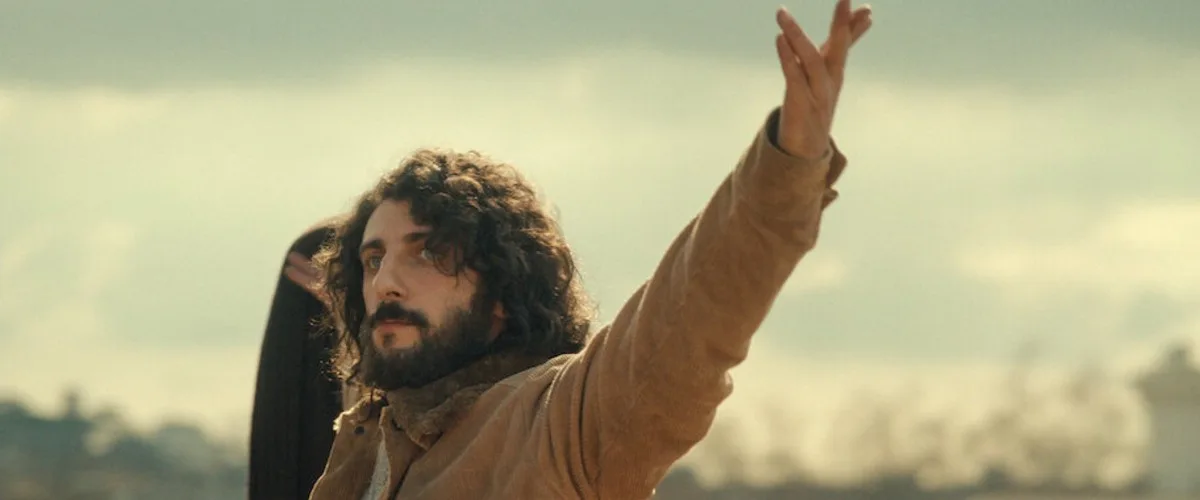
Have you ever cheated a little on something harmless a signature scribbled for a parent, a shortcut taken because no one was watching and felt a tiny thrill because you got away with it? That nervous giggle of “I shouldn’t be doing this”? The Big Fake understands that feeling very well. It just asks a darker question afterward: what happens when you never stop?
Directed by Stefano Lodovichi and written by Lorenzo Bagnotori and Sandro Petraglia.
The Big Fake introduces us to Toni, an aspiring artist with movie-star looks (played with cool detachment by Pietro Castellitto) and a dangerous gift: he can perfectly replicate famous artwork, including the signature. A forged Modigliani? No problem. A falsified check? Easy. At first, Toni treats this skill like a clever party trick. Then he realizes something more tempting: there’s real money in deception.
The film opens with Toni and his childhood friends a priest and a factory worker, as he introduces them living a modest, almost idyllic life in the countryside. Then comes Rome, fortune-seeking, and the inevitable sense that something is going to go wrong. The soundtrack underlines this with a needle drop of Iggy Pop’s “The Passenger,” one of several well-chosen musical cues that give the film a stylish, restless pulse.
The early stretch of the film feels almost light. Toni drifts through life with a shrug and a grin, hanging out with friends, enjoying the attention, treating crime less like wrongdoing and more like a mischievous hobby. He even attracts a girlfriend, Donata (Aurora Giovinazzo), who is charmed by his talent and intoxicated by the lifestyle that starts to bloom around it. The two of them feel young, restless, and convinced the world will bend if they push hard enough.
But The Big Fake isn’t just about personal downfall; it drifts into political territory too. The real-life kidnapping of Italian politician Aldo Moro becomes part of the plot, and Toni is soon recruited by shadowy figures who want him to forge propaganda in the name of the Red Brigades. When asked whether he’s “Red or Black,” Toni replies with blunt honesty: “I don’t give a f**k about colors. I’m for whoever helps me live well.” It’s meant to sound rebellious. Instead, it lands like a confession.
The vibe of the film is a strange, uneasy blend. On the surface, it plays like a slick crime drama stylish, intelligent, occasionally funny. Underneath, there’s a growing chill. You can feel the story tightening around Toni, even when he doesn’t. There’s a sense of inevitability that creeps in quietly, like realizing you’ve taken one step too many toward the edge of a cliff.
There are things the film does very well. Castellitto’s performance is controlled and unnerving; he never begs for sympathy, and that feels intentional. The cinematography is moody and confident. The soundtrack choices are excellent. There’s also a sharp idea at the heart of the story: forgery as metaphor. Toni doesn’t just fake art he fakes loyalty, identity, even morality. Everything in his life becomes a copy of something real, but hollow at the center.
And yet, despite all that, the film struggles with its biggest challenge: making us care.
Not because Toni is unlikable. Plenty of great movies center on unlikable characters. The problem is that Toni is emotionally opaque. We watch him betray friends, manipulate lovers, and orchestrate increasingly elaborate schemes, but the film keeps us at such a distance that his downfall never quite lands with the emotional weight it wants. Even when he pulls off an ingenious heist framed as a piece of “conceptual art,” it feels clever rather than affecting.
By the end, Toni has burned nearly every bridge around him, but instead of tragedy, the dominant feeling is exhaustion. You don’t mourn him. You don’t rage at him. You simply want to step away. It’s like spending too long in the company of someone selfish and magnetic, only to realize that the magnetism has worn off and all that remains is the damage.
If I had to compare The Big Fake to something, I’d say it sits somewhere between Catch Me If You Can and a colder European character study a film that wants the style of a con-artist thriller but the soul of a moral parable. It never quite balances the two.
Still, there’s plenty here for viewers who enjoy smart, adult dramas with political undertones and morally messy protagonists. The Big Fake isn’t an easy watch, nor is it especially warm but it is thoughtful, well-made, and occasionally haunting.
The Big Fake (2026) Parents Guide
Official Rating:
The Big Fake is NOT rated R by the Motion Picture Association (MPA), but its themes and content skew firmly toward mature audiences.
Violence & Intensity: There is little graphic violence, but the film carries a heavy emotional and psychological intensity throughout. Themes include political extremism, manipulation, betrayal, and references to real-world terrorism (notably the Aldo Moro kidnapping). Tension builds steadily, and the atmosphere becomes increasingly dark. No gore, but the subject matter can be disturbing for younger viewers.
Language: Strong language appears throughout. Characters use profanity naturally in conversation, including the f-word. The tone of the dialogue is often cynical and harsh. There are no repeated slurs, but the overall language level feels adult and unfiltered.
Sexual Content / Nudity: There is sexual content, though it is not explicit. Scenes imply sexual relationships, and the tone is mature rather than romanticized. A pregnancy becomes part of the storyline. Brief sensual moments may occur, but this is not an erotic film.
Drugs, Alcohol & Smoking: Characters drink alcohol socially and in excess at times. Smoking is present, consistent with the film’s gritty atmosphere. Drug use is implied in certain social circles, though not glamorized or shown in detail.
Age Recommendations: This film is best suited for ages 16+, and realistically 17+ for most viewers.
Final verdict:
The Big Fake is best suited for viewers who like slow-burn character studies and aren’t afraid of stories where the protagonist is his own worst enemy. It’s flawed, distant, and sometimes frustrating but it also lingers, like a forged signature you can’t quite stop staring at once you know it’s fake.
Highly Recommended:

Matthew Creith is a movie and TV critic based in Denver, Colorado. He’s a member of the Critics Choice Association and GALECA: The Society of LGBTQ Entertainment Critics. He can be found on Twitter: @matthew_creith or Instagram: matineewithmatt. He graduated with a BA in Media, Theory and Criticism from California State University, Northridge. Since then, he’s covered a wide range of movies and TV shows, as well as film festivals like SXSW and TIFF.