Now You See Me: Now You Don’t is Rated PG-13 for some strong language, violence and suggestive references. This film is best suited for teens (13+) and upward younger tweens (~10‑12) with stronger maturity might handle it with parent guidance.
Review – Now You See Me: Now You Don’t
The Four Horsemen are back, this time joined by a new generation of illusionists, promising mind-bending twists, audacious heists, and magic unlike anything we’ve seen on screen. The conceit is tantalizing: a world where sleight-of-hand meets spectacle, and where clever misdirection can carry a story. And yet, for all the spectacle, there’s an uneasy sense that the film has lost sight of what made the original concept so beguiling.
Lionsgate, at least, deserves credit for finally landing on a title that clicks: Now You See Me: Now You Don’t. But beyond that modest victory, Ruben Fleischer’s direction supported by a sprawling writing team of Seth Grahame-Smith, Michael Lesslie, and the Deadpool duo Rhett Reese and Paul Wernick struggles to maintain the delicate alchemy of magic and narrative. A movie about illusion should thrive on the subtle, the clever, the almost imperceptible. Instead, much of what unfolds here is dominated by flashy CGI effects, which, paradoxically, feel both cheap and antithetical to the very idea of magic. And yet, in its loopy, sometimes absurd way, there’s a certain charm to the madness.
Highly Recommended: The Things You Kill (2025) Parents Guide
Consider two standout moments that illustrate this tension. Jesse Eisenberg’s Four Horsemen leader a character channeling Robin Hood with a penchant for showmanship is pitted against his younger, hipper counterpart, Dominic Sessa’s Bosco. The resulting magic-off is energetically filmed, the camera darting and spinning to capture every angle of the tricks. But what begins as playful competition soon veers into nonsense: cards levitate, diamonds defy physics, and the spectacle overwhelms the sleight-of-hand. At a certain point, the film crosses a line from enjoyable illusion into pure silliness, where the viewer’s suspension of disbelief feels tested more than it’s delighted.
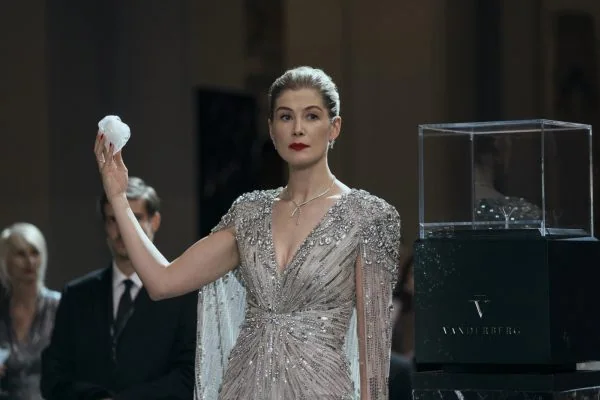
Then there’s the getaway sequence with South African diamond magnate Veronika Vanderberg. Rosamund Pike’s accent is a performance so extravagantly off-kilter it’s hard not to laugh it practically competes with Tommy Wiseau for sheer audacity. The chase begins with a tangible, physical helicopter, only to dissolve into a CGI-constructed cityscape where our heroes zip-line across rooftops. The sense of danger is diminished, replaced by a cartoonish thrill that is visually dazzling but emotionally hollow. Magic, at its best, invites the audience to wonder how, without ever needing to see the gears behind it. Here, the mechanics are so overexposed that the mystery evaporates.
There are, thankfully, moments that recapture the tactile delight of crafted illusion. A rotating room sequence and scenes where cards are thrown like ninja stars absurd, yes, but delightfully practical remind us what magic can feel like when grounded in clever design rather than digital trickery. And the story itself, which unites the old and new Horsemen to thwart Veronika’s diamond-driven schemes, is ridiculous enough to be fun. The interactions between Jesse Eisenberg, Woody Harrelson, Isla Fisher, and Dave Franco with Dominic Sessa, Justice Smith, and Arianna Greenblatt are lively; the chemistry is there, playful and dynamic, and the absurdity of the concept makes it entertaining.
Recommending: Jay Kelly (2025) Parents Guide
Yet, the film never quite reconciles its ambitions with its methods. Fleischer seems to misunderstand a fundamental rule: magic is about suggestion, illusion, and misdirection. Replace that with overt CGI, and you rob the audience of wonder. The result is a sprawling hybrid of heist movie, video-game puzzle, and generational clash, punctuated by campy villains and over-the-top set pieces. You can admire the audacity there is something cheerfully mad about it but it’s also a betrayal of the very thing the franchise should be celebrating: the intelligence and craft of real magic.
Now You See Me: Now You Don’t is, in a sense, a paradox. It’s simultaneously thrilling and hollow, dazzling and frustrating, clever and ridiculously silly. You can feel the ambition, but you also sense the missteps. Perhaps, if the filmmakers had trusted the illusions, relied less on digital spectacle, and leaned more into the characters’ charisma and ingenuity, this could have been a genuinely magical sequel. As it stands, it’s a spectacle that leaves you marveling at the tricks and wishing they had been real.
Detailed Content Breakdown for Parents
Violence & Intensity: There are action sequences involving heists, chase scenes, fight/escape moments, and threat from criminal elements (arms dealers, money‑launderers) though the violence is stylised rather than graphic. The antagonists use force, there are dangers faced by the protagonists, but you won’t find overly gory or explicit scenes. The level of intensity is moderate young teens may feel the suspense, but younger children might find some of the scenarios a bit overwhelming (e.g., when characters are cornered, or when illusions create tension).
Language: The film includes some “strong language” as noted in the rating (“Some Strong Language”). Most profanity is likely mild to moderate; I did not find reports of pervasive slurs or extremely harsh language. That said, parents should be aware there may be occasional “damn”, “hell”, or similar expletives in an action‑thriller context.
Sexual Content / Nudity: Minimal sexual content. There is likely flirting, a couple of relationships (for instance Henley Reeves’ role), and glamorous costuming, but no major nudity or explicit sexual scenes flagged so far in the reviews. The focus remains on magic/illusion and heist rather than romance.
Drugs, Alcohol & Smoking: While the world of high‑stakes crime and luxury may suggest adult behaviour (e.g., drinking in clubs, high‑end parties), reviews do not highlight significant scenes of drug abuse or heavy smoking. There may be background alcohol consumption or classy party contexts, but nothing that stands out as central or shocking in parental guides yet. If you’re sensitive about children seeing alcohol use in glam contexts, it’s worth a note.
Parental Concerns
The core premise is a heist: stealing a valuable diamond from criminals. While the protagonists are arguably “good guys,” heist films carry moral ambiguity (stealing, trickery, law‑bending). Parents may want to talk with younger viewers about the difference between crime in fiction and real life, and the idea of consequences and justice.
The film’s slick style may glamorize risky behavior high stakes, fast cars, money, danger — which could appeal strongly to teens, so parents may wish to guide conversation around values.
Younger children might be unsettled by illusions that blur reality (vanishing acts, fake deaths), or by tense sequences involving criminal threats.
Occasional moderate language or mild suggestive references could surprise parents expecting a purely “clean” film.
Because streaming availability is not yet known (depending on region), access might be through a theatrical outing in Nigeria check local rating and suitability for your child.
Release date November 14, 2025 (United States)

Stephanie Heitman is a seasoned journalist and author dedicated to helping parents navigate the world of Hollywood entertainment through thoughtful, family-oriented film reviews. With over a decade of experience in writing and a passion for fostering safe, enriching viewing experiences, Stephanie launched Parentguiding.com to provide parents with the insights they need to make informed choices for their families.